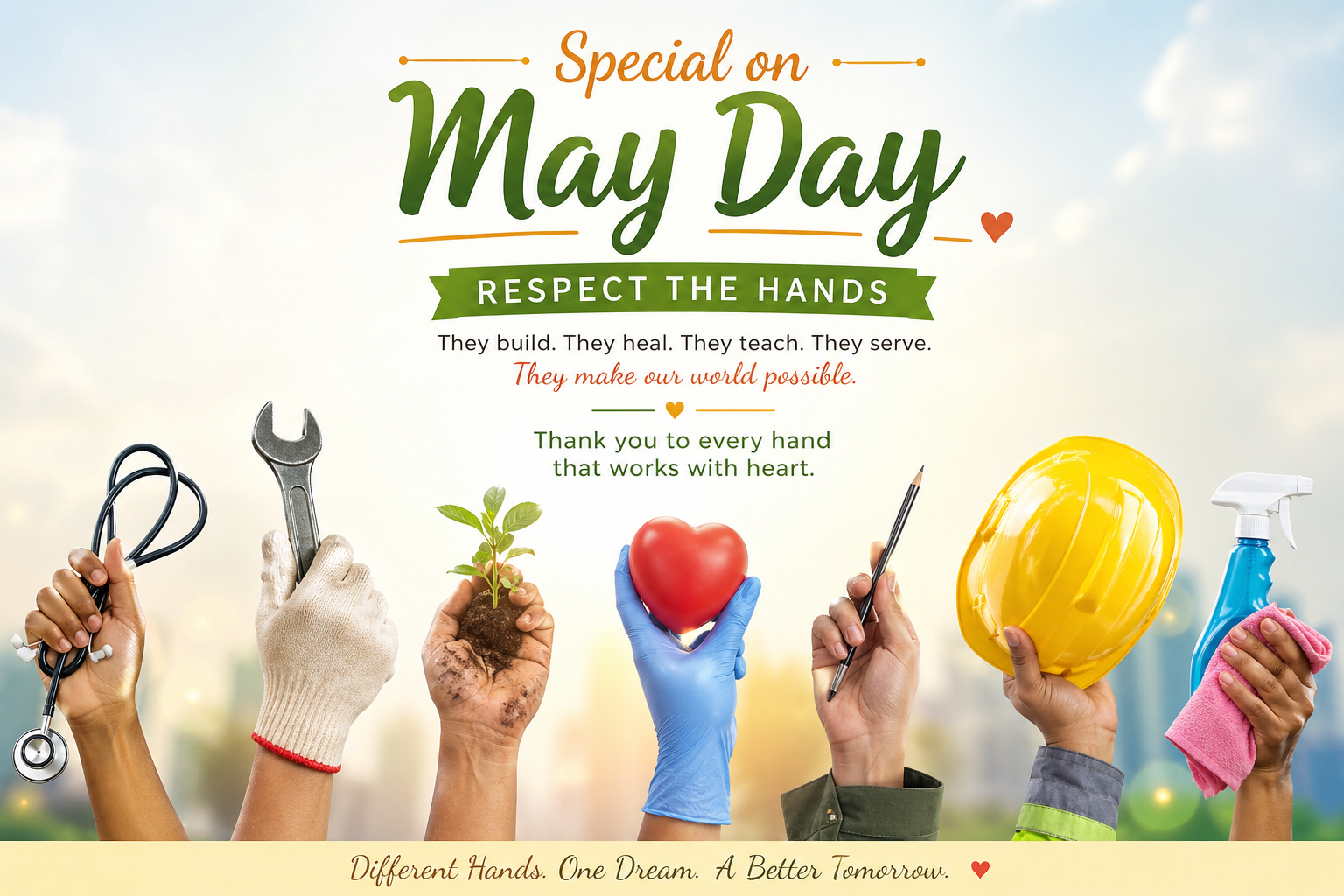
Special On May Day:
Respect the Hands
Professor (Dr.) R.K. Uppal, [PhD, D.Litt.]
………………………………………………………………………
Respect the hands that build the world. This is not a poetic exaggeration—it is a hard economic truth. Every road that connects cities, every building that defines a skyline, every product that fills a market, and every service that sustains daily life exists because of human effort. Yet, these hands—the workers—often remain invisible in the narrative of progress. “Respect the Hands” is not just a slogan; it is a call to correct a deep imbalance in how societies value labor.
At the heart of modern economies lies a contradiction. Wealth is celebrated, innovation is glorified, and leadership is applauded, but the foundational role of labor is frequently ignored. Workers are expected to deliver productivity, efficiency, and commitment, but are often denied fair wages, safe working conditions, and social security. This disconnect exposes a fundamental flaw: economies thrive on labor, but systems are designed to reward capital disproportionately.
The history of labor movements shows that respect for workers has never been granted voluntarily—it has been fought for. The legacy of the Haymarket Affair reminds us that basic rights such as reasonable working hours and humane conditions were won through sacrifice. Workers stood up not just for survival, but for dignity. Today, while laws exist to protect labor, the spirit of those struggles must continue, because exploitation has not disappeared—it has merely changed form.
In India, the need to respect the hands of workers is especially urgent. A significant portion of the workforce operates in the informal sector—construction workers, agricultural laborers, street vendors, domestic workers, and gig economy participants. These individuals form the backbone of everyday economic activity, yet they often lack job security, health benefits, and stable incomes. Their contributions are essential, but their conditions remain precarious.
Respecting the hands means more than symbolic appreciation; it requires structural change. Fair wages are the first step. A worker who cannot afford basic necessities despite working full-time is a sign of systemic failure. Equally important are safe working environments. No individual should risk their life or health simply to earn a livelihood. Respect also means providing social security—insurance, pensions, and protections that ensure stability in times of crisis.
The rise of the gig economy has added another layer of complexity. Digital platforms promise flexibility and opportunity, but they often shift risks onto workers. Delivery personnel, ride-hailing drivers, and freelance workers operate without traditional employment benefits. They are essential to the modern economy, yet remain outside the safety net. Respecting these hands requires rethinking labor laws and extending protections to new forms of work.
Another critical dimension is the social perception of labor. In many societies, including India, there exists a hierarchy of work that undervalues manual and blue-collar jobs. This mindset not only diminishes dignity but also discourages skill development in essential sectors. Respecting the hands means breaking this hierarchy and recognizing that all forms of work—whether intellectual or physical—are equally vital to societal progress.
Education and skill development play a key role in empowering workers. However, the burden of adaptation should not fall solely on them. As industries evolve with technology, governments and businesses must invest in training programs that enable workers to upgrade their skills and remain relevant. Respect is not static—it evolves with opportunity. A system that equips workers for the future demonstrates genuine commitment to their well-being.
The concept of respect must also extend to representation. Workers need a voice in decision-making processes that affect their lives. Trade unions, worker associations, and collective bargaining mechanisms are essential tools in balancing power. While globalization and changing economic structures have weakened these institutions in many regions, their relevance remains undeniable. Without representation, respect becomes an empty word.
Ultimately, respecting the hands is about redefining priorities. Economic growth cannot be measured solely by GDP figures or corporate profits. It must also be assessed by the quality of life of workers—their wages, security, health, and dignity. A society that neglects its workers undermines its own foundation. Growth built on exploitation is neither sustainable nor just.
“Respect the Hands” is a simple phrase, but its implications are profound. It challenges governments to enact fair policies, businesses to adopt ethical practices, and individuals to acknowledge the labor behind their comfort. It reminds us that progress is not an abstract concept—it is built, quite literally, by human hands.
As we reflect on this idea, the message becomes clear: respect is not optional; it is essential. The hands that build the world deserve more than gratitude—they deserve justice, dignity, and a fair share of the prosperity they create. Only then can we claim to have a truly equitable and humane so