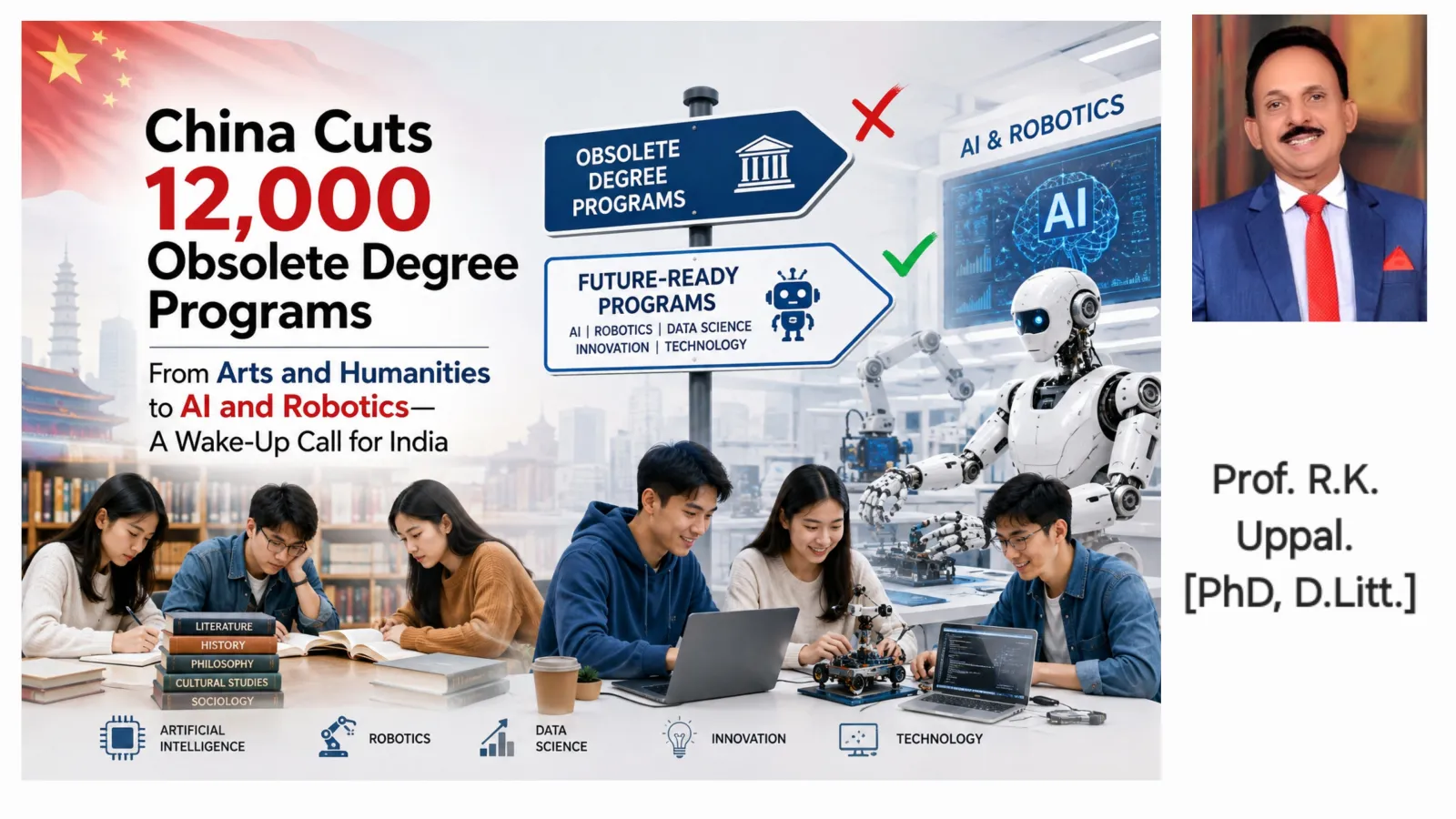
China Cuts 12,000 Obsolete Degree Programs: From Arts and
Humanities to AI and Robotics—A Wake-Up Call for India
Prof. R.K. Uppal. [PhD, D.Litt.]
China’s decision to restructure thousands of university degree programs offers a powerful lesson for countries struggling to align higher education with the rapidly changing world of work. Between 2021 and 2025, Chinese universities reportedly cancelled or suspended around 12,000 undergraduate programmes while introducing thousands of new programmes in emerging areas such as artificial intelligence, robotics, data science, intelligent manufacturing and other technology-driven fields. The scale of this restructuring sends a clear message: universities cannot remain frozen in the past while economies are being transformed by technology.
The real issue is not simply the number of programmes removed. The deeper question is whether a degree remains relevant when the economy, technology and employment structure have changed dramatically. China appears to be asking this question much more aggressively than many other countries. Instead of continuing to offer programmes merely because they have existed for decades, universities are being encouraged to respond to emerging industries and future employment requirements.
Arts and humanities have received particular attention in this restructuring. However, it would be wrong to conclude that China is declaring these disciplines useless. History, philosophy, literature, sociology, political science and other humanities subjects remain important for developing critical thinking, communication, ethics and social understanding. The problem arises when universities continue producing large numbers of graduates in programmes with weak employment prospects while failing to provide them with contemporary skills.
This distinction is extremely important for India. India has expanded higher education enormously over the past few decades. Thousands of colleges and universities now offer undergraduate, postgraduate and doctoral programmes across virtually every discipline. But expansion in the number of programmes has not always been accompanied by a corresponding expansion in quality, employability, innovation or industry relevance. In many institutions, programmes continue because they are traditional, not necessarily because students or employers need them.
The danger is that universities can become degree-producing institutions rather than knowledge-producing and skill-building institutions. A student may spend three or four years obtaining a degree and still graduate without adequate digital skills, communication abilities, analytical thinking, practical experience or industry exposure. The result is a paradox: India can simultaneously have millions of graduates and employers complaining about a shortage of skilled workers.
China’s restructuring therefore raises a fundamental question for Indian higher education: should universities continue to measure success by the number of programmes, students and degrees, or should success be measured by skills, employment, innovation, entrepreneurship and social impact? Artificial intelligence is making this question even more urgent.
India’s National Education Policy 2020 has already emphasized multidisciplinary education, flexibility, vocational education, technology and skill development. The challenge now is implementation. Policy documents alone cannot transform universities. Institutions must be willing to redesign curricula, close outdated programmes, create new programmes and establish stronger connections with industry. The most difficult reform may be closing programmes that no longer attract students or provide meaningful career opportunities. Every academic program has faculty, infrastructure and institutional interests attached to it. Consequently, shutting an obsolete programme can become politically and administratively difficult. But avoiding difficult decisions does not protect students. It can simply transfer the cost of institutional inertia to young people.
India should therefore consider establishing a systematic mechanism for reviewing university programmes every few years. Employment outcomes, student demand, research activity, industry requirements, technological change and social relevance should be among the criteria. Programmes that consistently demonstrate poor outcomes should be reviewed, redesigned or gradually phased out.
At the same time, new programmes should not be created merely because AI is fashionable. Universities should avoid replacing one form of programme proliferation with another. A degree called “Artificial Intelligence” is not automatically valuable. Its quality depends on curriculum, faculty expertise, laboratories, research opportunities, industry collaboration and student outcomes.
The objective should be transformation, not rebranding.
India also needs to rethink the relationship between universities and industry. Too many academic programmes remain disconnected from real workplaces. Students often study theoretical concepts without meaningful internships, live projects, apprenticeships or interaction with professionals. Industry should participate in curriculum design, skill development, internships and applied research. Universities should become places where students learn not only what is known but also how knowledge is applied.
The future will not reward institutions merely for preserving old programmes. It will reward institutions capable of anticipating change.
India has enormous advantages: a young population, a large higher-education system, a growing digital economy, a strong technology sector and a vast pool of talented students. But these advantages will become a demographic dividend only if education produces the capabilities required by the future economy.
The central question is no longer how many degrees India can offer. The question is how many graduates it can prepare for meaningful work, innovation and leadership. China’s message is clear: when the economy changes, universities must change too. India should not blindly copy China, but it should learn from the willingness to review, restructure and modernize higher education.
The era of producing degrees simply because they have always existed is coming to an end. Universities must move from degree expansion to educational relevance, from rote learning to critical thinking, from certificates to capabilities, and from outdated curricula to future-ready skills.
India does not need fewer universities merely for the sake of reducing numbers. It needs better universities, smarter programmes and stronger connections between education, research, industry and employment.The ultimate goal should be simple: do not produce graduates for yesterday’s economy; educate young people for tomorrow’s world.