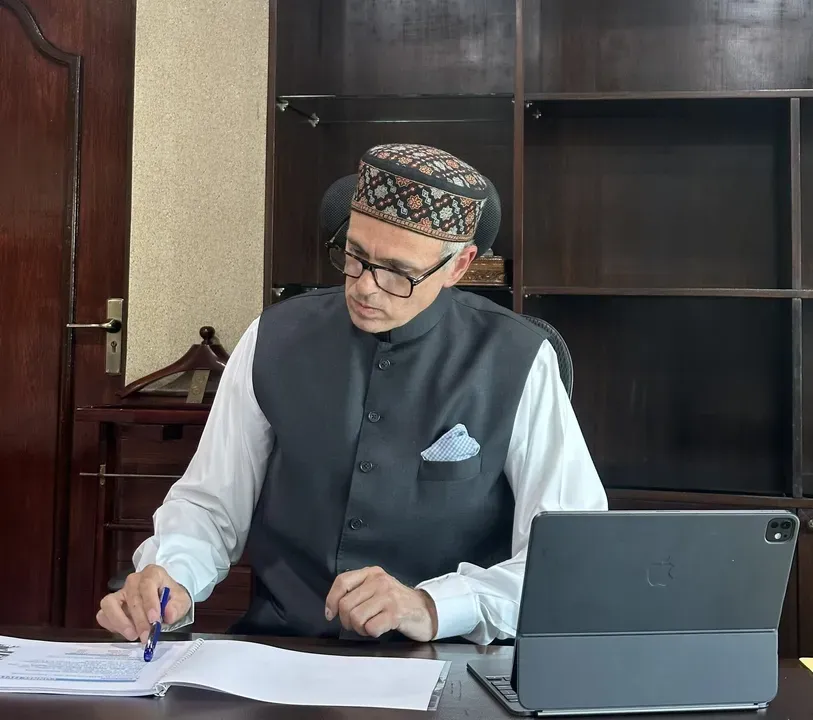
Srinagar, May 23: In Kashmir, the language of disappearance is not metaphorical. Here, even satire acquires a darker echo.
So when the Bharatiya Janata Party (BJP) circulated ‘Omar Abdullah Missing’ posters on social media, the campaign appeared destined to become yet another forgettable episode in Kashmir’s permanently overcrowded theatre of political melodrama.
The posters claimed Chief Minister Omar Abdullah had been “missing for the last 10 days,” triggering a predictable political row.
National Conference (NC) President and three-time chief minister Farooq Abdullah quickly dismissed the campaign with the exhaustion of a man who has survived enough political eras to know that outrage in Kashmir has the shelf life of milk.
However, the problem for the government was that the posters landed in Kashmir, already struggling with a far more consequential disappearance: governance itself. While Chief Minister Omar Abdullah reportedly remains abroad on a personal visit, large parts of Srinagar continued experiencing erratic power cuts, bureaucratic paralysis, rising public frustration, and an administration increasingly accused of functioning like an emotionally unavailable relative who sends occasional assurances but never actually arrives when needed.
Meanwhile, nothing much has changed for Kashmir, which now searches for governance with candles during power outages. The symbolism is especially cruel because the CM himself holds the portfolio of the Power Development Department. While households battle outages, inflation, and unemployment, the government demonstrated astonishing administrative efficiency in expanding official vehicle fleets for ministers and legislators. Meanwhile, inside government offices, people continue navigating the timeless bureaucratic obstacle course – a system where files travel like snails and ordinary people spend entire days seeking signatures that migrate mysteriously between departments.
Officially, this arrangement is called ‘Ease of Doing Business.’ Unofficially, it resembles a reality television endurance challenge sponsored by paperwork, while the administration seems “digitally advertised but manually paralysed.” The bureaucracy, in fairness, has developed its own unique architectural beauty. It moves slowly enough to make geological activity appear impatient. However, for Kashmir’s educated youth, the humour increasingly carries exhaustion beneath it. The government had promised employment, opportunity, and relief.
Instead, thousands of graduates continue drifting between coaching centres, examination forms, and recruitment notifications like pilgrims trapped in a bureaucratic purgatory. Another aspirant, preparing for competitive examinations, mocked the silence surrounding the long-promised increase in quota for Open Merit candidates.
“That promise has now entered folklore as the government seems to have even corrupted the parliamentarian who used to raise a voice for it,” he said.
As Eid approaches, public resentment has sharpened over the government’s failure to release salaries and dues a few days early despite precedents set by earlier administrations during major festivals.
The government is seen as one that only knows how to brag on X posts, government advertisements, and sponsored bulletins.
Locals summarise the contrast most brutally. “The rulers are sightseeing in London and Madrid while people are window-shopping in Srinagar,” they said. Even within the ruling establishment, frustration now leaks through private conversations with increasing frequency. Several legislators privately admit they feel politically abandoned, sent to pacify angry constituents while the government appears consumed by constitutional debates and public performances of helplessness.
One MLA from the ruling alliance described the situation bluntly. “We go to the leadership with issues related to roads, electricity, schools, jobs, and administration,” he said. “But the seriousness seems reserved only for discussions about restoring statehood.”
Another legislator sounded visibly exhausted. “People did not elect us merely to keep explaining our helplessness,” he said. “They elected us to govern with whatever powers still exist.” A third MLA offered what may be the most devastating metaphor circulating inside political circles. “This government behaves like a man refusing to repair his leaking roof because he first wants ownership papers revised,” he said. The criticism is not necessarily directed at the demand for restoration of statehood or powers themselves.
Even many critics acknowledge those concerns as politically legitimate. The anger instead stems from the growing perception that governance has effectively been suspended pending constitutional satisfaction. Local says that they already knew the constitutional limitations before voting and only expected governance within those limitations.
Meanwhile, much of the day-to-day political management appears to have drifted toward CM Omar’s Advisor Nasir Aslam Wani, further reinforcing public perceptions of an absent leadership structure.
Across tea stalls, office corridors, and social media timelines, sarcasm has now become Kashmir’s most efficient parallel institution.
“‘March ahead, my men’ is a magnificent battle cry,” said a government officer in Srinagar. “But only when the General is standing in the trenches, not when he is issuing instructions from a Madrid night club or a London café.”
Another resident invoked an older cliché. “The government seems deeply committed to sitting on its laurels,” he said. “The only problem is that the people are not sitting in darkness, unemployment, and government queues.” Even political analysts who dismiss opposition campaigns as routine theatrics admit the present public mood did not emerge from posters alone. “The danger begins when satire starts sounding more believable than official statements,” said a Srinagar-based political observer. And perhaps that is the real political crisis confronting Kashmir today.
Not merely a Chief Minister abroad, not merely a social media campaign, not merely delayed salaries, missing electricity, or bureaucratic paralysis, but the slow, enforced disappearance of accountability itself.
A government elected with hope now feels emotionally unavailable, a leadership that promised accessibility increasingly resembles an automated response email, and a people who once believed democracy would finally make governance visible again now find themselves staring into the familiar Kashmiri void, asking the question Kashmir knows too well.
Silence at the top
The ruling National Conference (NC) top brass is growing more conspicuous with its absence.
Deputy Chief Minister Surinder Kumar Choudhary’s phone remained switched off throughout Saturday, while Advisor to the Chief Minister Nasir Aslam Wani and veteran NC leader and Speaker of J&K Legislative Assembly Abdul Rahim Rather repeatedly remained out of reach.
Senior NC leaders Ali Muhammad Sagar and Chaudhary Muhammad Ramzan, along with NC chief spokesman TanvirSadiq, did not respond to multiple attempts to reach them.
The only response came from senior NC leader and MLA Pampore, HasnainMasoodi, who said he was busy at the Khankah shrine.