Srinagar, June 29: A new research study conducted across four districts of Kashmir has raised a massive red flag over a creeping digital epidemic among adolescents.
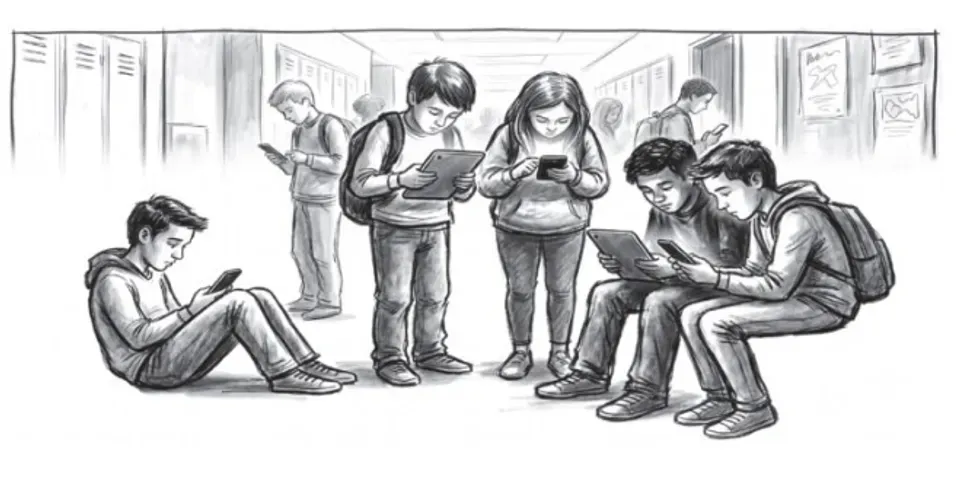
The comprehensive report, titled ‘Digital Distractions and Developing Minds,’ reveals that a staggering 75 percent of school-going adolescents in Kashmir spend more than four hours every day glued to their smartphone screens.
This excessive digital immersion is triggering severe concentration deficits, chronic morning fatigue, and an alarming spike in cyber-safety concerns among the youth.
The study was conducted by a nine-member student research team from the Department of Public Administration and Political Science, Cluster University of Kashmir (Amar Singh College), led by Shahid Ahmad Thoker and Umais Mudasir Farooqi.
The team comprised Shahid Ahmad Thoker, Umais Mudasir Farooqi, Shunaida Mubeen, Shakira Javid, Safia Aashiq, Mustafa Tahir, Farhan Rafiq, Uzair Hussain Reshie, and Labeeb bin Zaffar Wani, who jointly carried out the field survey, data collection, analysis, and preparation of the report examining the impact of excessive social media use on adolescent students in Kashmir.
To capture a diverse demographic, the researchers surveyed 400 students aged between 13 and 18 years and enrolled in Classes 7 to 10 from four prominent educational institutions: New Green Land Educational Institute in Shopian, Ayesha Ali Academy in Kulgam, Oxford Presentation School in Anantnag, and Government Boys Higher Secondary School, Natipora in Srinagar.
One of the most troubling revelations of the report is the direct, detrimental impact of digital addiction on the cognitive development and academic focus of young Kashmiris.
According to the findings, students categorised as “heavy users”, spending four or more hours on screens daily, are disproportionately affected.
The data shows that 41 percent of these heavy users frequently struggle to concentrate on their studies due to stress, compared to just 8 percent of light users.
Overall, more than half of the surveyed students (52.36 percent) acknowledged that stress and digital distractions consistently or frequently interfere with their classroom activities and study sessions.
Furthermore, the burden of this digital lifestyle is severely hampering students’ decision-making abilities.
A staggering 80.75 percent of respondents reported feeling “highly” or “slightly” confused when making decisions under stress, indicating a profound level of cognitive strain.
To explain this phenomenon, the researchers introduced the concept of the “brain-drain principle,” which suggests that cognitive strain and attention loss accelerate drastically as screen exposure becomes increasingly excessive.
The late-night scrolling habits of Kashmir students are giving rise to a chronically exhausted generation.
Half of the surveyed teenagers (50 percent) reported waking up feeling “tired” or “very tired” each morning, while only a dismal 12.25 percent wake up feeling “energetic”.
The researchers established a direct link between this exhaustion and device dependency.
Students exhibiting frequent or extreme “phone anxiety”, the fear of being separated from their devices, wake up tired 56 percent of the time, compared to just 18 percent among those with no phone anxiety.
This digital dependency has also drastically altered how teenagers spend their leisure time.
Nearly 72 percent of the respondents admitted that screen time has either directly (47 percent) or occasionally (24.75 percent) reduced their participation in outdoor sports, physical exercises, and recreational activities.
The report warns that this shift toward a sedentary digital lifestyle could have long-term consequences for the physical fitness and overall health of Kashmiri youth.
Beyond physical health, the social media landscape is taking a heavy toll on the emotional well-being of young students.
The pervasive nature of platforms like Instagram, Snapchat, and Facebook has led to an epidemic of social comparison.
The study found that 51.8 percent of students frequently or occasionally feel that other people's lives are better than their own after viewing carefully curated social media profiles.
This feeling of inadequacy jumps to 67 percent among heavy screen users.
Furthermore, the psychological attachment to digital devices has reached addictive proportions for many.
Nearly 44.5 percent of the students reported experiencing moderate to extreme levels of irritability, anxiety, or feelings of emptiness when they are forced to be away from their phones or computers.
Despite spending hours on the internet, the vast majority of students feel highly vulnerable in digital spaces.
A significant 66.5 percent of students said that they feel “much less safe” or “slightly less safe” expressing their true thoughts and personality online compared to real life.
The researchers noted that many adolescents possess only a basic understanding of online safety practices, leaving them highly vulnerable to cyberbullying, phishing attempts, identity theft, and privacy violations.
The research team also conducted qualitative case studies, revealing the complex realities of digital access in Kashmir.
In one instance, a student from Ayesha Ali Academy in Kulgam demonstrated high digital resilience, saying that they consciously choose alternative activities like reading and helping at home over excessive screen time.
Conversely, researchers encountered absolute digital exclusion in Srinagar.
A student from Government Boys Higher Secondary School in Natipora reported having zero access to smartphones or internet at home, highlighting the persistent digital divide that can hinder a student's access to modern educational resources.
In another extreme case from Anantnag’s Oxford Presentation School, a student whose family strictly prohibited any social media use reported experiencing severe social isolation and feelings of exclusion from peer conversations, proving that total digital restriction can be just as socially damaging as digital addiction.
The study concluded that social media and digital technology are not inherently harmful, but their unchecked and unregulated usage is devastating the developmental milestones of adolescents.
The authors of the report have strongly recommended the implementation of “digital diets” and balanced screen-time guidelines for teenagers.
They urge Kashmiri schools to aggressively integrate cyber-safety and digital literacy into their daily curricula.
Additionally, the report calls upon parents in Kashmir to engage in active intergenerational modeling, noting that children often mimic the excessive smartphone habits of their parents and older siblings.
“The future of students depends not on avoiding technology, but on developing the knowledge, discipline, and awareness necessary to use it wisely,” the report says.