Employability Crisis: Why Indian Graduates Struggle in the Job Market
Prof. R. K. Uppal
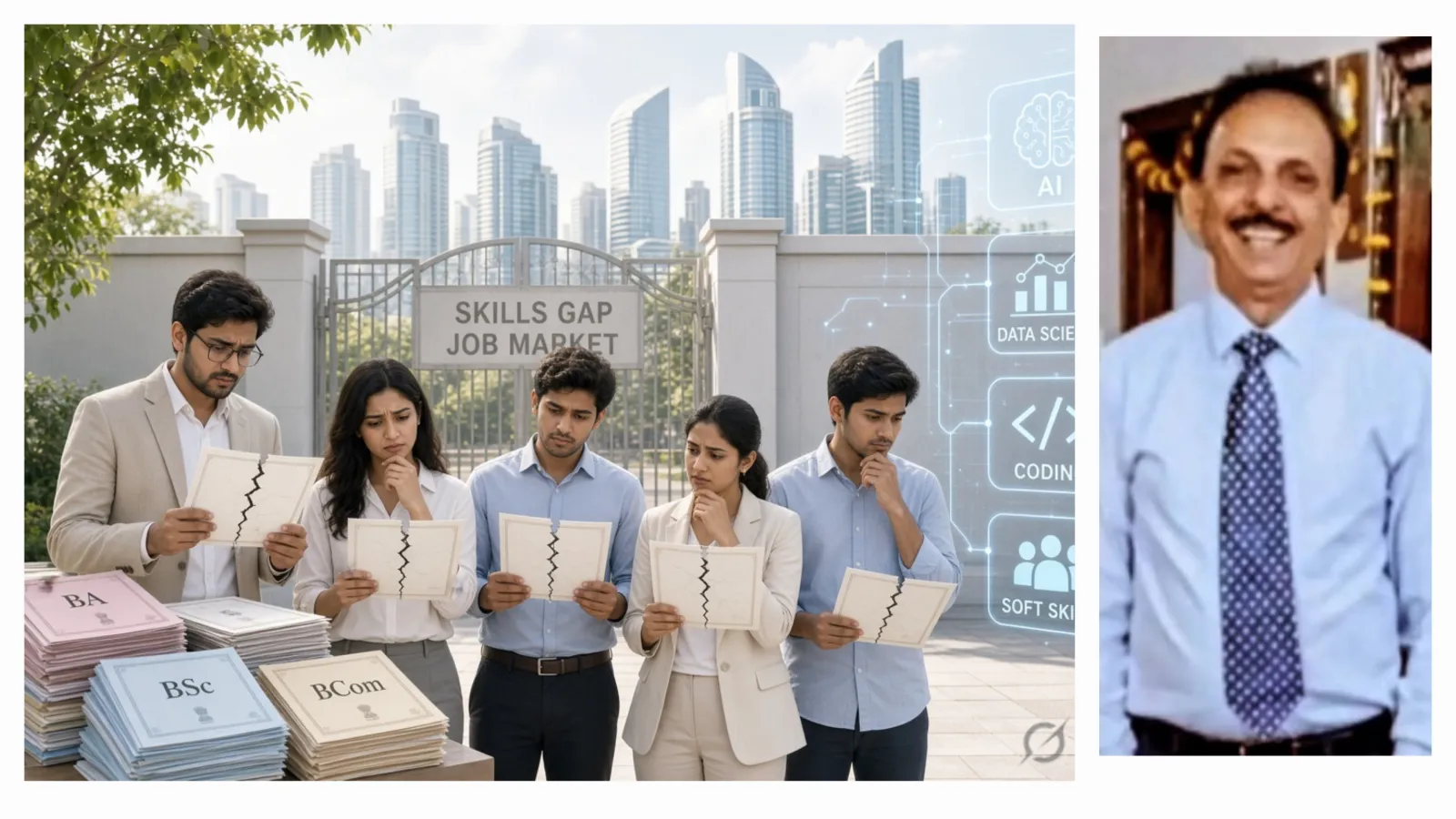
India is producing graduates at an unprecedented pace, yet the transition from college to employment remains deeply troubling. Every year, millions of young people obtain degrees, diplomas and professional qualifications, but a significant proportion struggle to secure stable, meaningful and adequately paid employment. The contradiction is stark: India has no shortage of educated youth, but it continues to face a shortage of job-ready graduates. This growing employability crisis raises fundamental questions about the relevance of higher education, the quality of learning and the country's approach to skill development.
The central problem is not simply unemployment. It is the widening gap between education and employability. A degree may certify that a student has completed a prescribed curriculum, but it does not necessarily demonstrate that the graduate can communicate effectively, solve problems, work in teams, use technology, analyze information or adapt to changing workplace requirements.
For decades, India's higher education system has placed considerable emphasis on examinations, marks, certificates and theoretical knowledge. Students are frequently trained to remember information rather than apply it. Classroom success is often measured by examination performance, while employers increasingly demand practical competence. A student may score excellent marks in economics, commerce, management or engineering but still struggle when asked to analyze a real business problem, prepare a professional presentation, interpret data or communicate with a client.
This disconnect has become more serious in the age of artificial intelligence, automation and digital transformation. Employers are no longer hiring merely for academic qualifications. They want individuals who can combine technical knowledge with creativity, critical thinking, communication and adaptability.
One major weakness is the continued dominance of rote learning. Students often spend years preparing for examinations in which reproducing textbook material is rewarded. Projects, internships, field studies, simulations, case studies and industry exposure receive comparatively less importance in many institutions. As a result, students graduate with theoretical knowledge but limited experience of applying that knowledge to real-world situations.
large numbers of unemployable graduates should be compelled to improve. The responsibility, however, does not rest entirely with educational institutions. Employers also need to participate actively in curriculum development, internships, apprenticeships and campus training. Industry should not simply complain that graduates lack skills; it should help universities develop those skills.
The government, too, has a crucial role. Skill-development programmes must be integrated with mainstream higher education rather than operating as disconnected initiatives. India's demographic advantage can become an economic advantage only when young people possess skills that match actual employment opportunities. There is also a need to rethink the obsession with degrees. India cannot solve its employability crisis by producing more certificates. A graduate with multiple qualifications but inadequate practical competence may remain unemployed, while someone with strong technical and entrepreneurial skills can create employment for others.
Entrepreneurship should therefore become a meaningful component of higher education. Students should be encouraged to identify problems, develop solutions, test ideas and create enterprises. Colleges can establish innovation laboratories, incubation centers and startup mentoring programmes. Even small local businesses can provide valuable opportunities for students to learn management, marketing, finance and technology.
Artificial intelligence adds another dimension to the challenge. AI will eliminate some routine tasks, transform many occupations and create entirely new categories of work. Graduates who merely possess memorized knowledge will be particularly vulnerable. Those who know how to use AI as a tool for analysis, creativity, research and decision-making will have a significant advantage.
Consequently, AI literacy should become a basic employability skill across disciplines. But AI cannot replace human capabilities. Communication, ethics, leadership, emotional intelligence, creativity and judgment will remain critical.
The crisis also exposes inequalities in India's education system. Students from wealthy families can often access better coaching, internships, digital resources, professional networks and international exposure. Students from rural and economically weaker backgrounds may have degrees but lack these additional opportunities. Employability reforms must therefore ensure that practical learning and career opportunities reach students irrespective of their socioeconomic background. India's colleges must also strengthen career counseling. Many students choose courses without understanding labour-market trends. Career guidance should begin early and continue throughout higher education. Students should know what skills different professions require, what qualifications are genuinely valuable and where employment opportunities are emerging.
Ultimately, India's employability crisis is a warning that education without application is incomplete education. A university cannot declare victory merely because students pass examinations. Its real responsibility begins when graduates enter society. India has a young population, ambitious economic goals and enormous human potential. But demographic strength alone cannot guarantee development. If millions of educated young people remain unemployed or underemployed, the demographic dividend can become a demographic burden.
The solution is not fewer graduates; it is better graduates. India needs an education system that rewards curiosity rather than memorization, competence rather than certificates, innovation rather than imitation and problem-solving rather than examination performance. The future belongs to institutions that can connect classroom learning, workplace skills and real-world problems. Degrees will remain important, but degrees alone will no longer be enough. India must therefore move decisively from “What degree do you have?” to “What can you do?” That is the question that should define the future of Indian higher education—and the employability of its next generation.