From Promise to Practice : Making Gender Equality Enshrined
Prof. (Dr.) Sunil Goyal
Eminent Social Scientist, Professor and Columnist
Department of Higher Education, Government of Madhya Pradesh
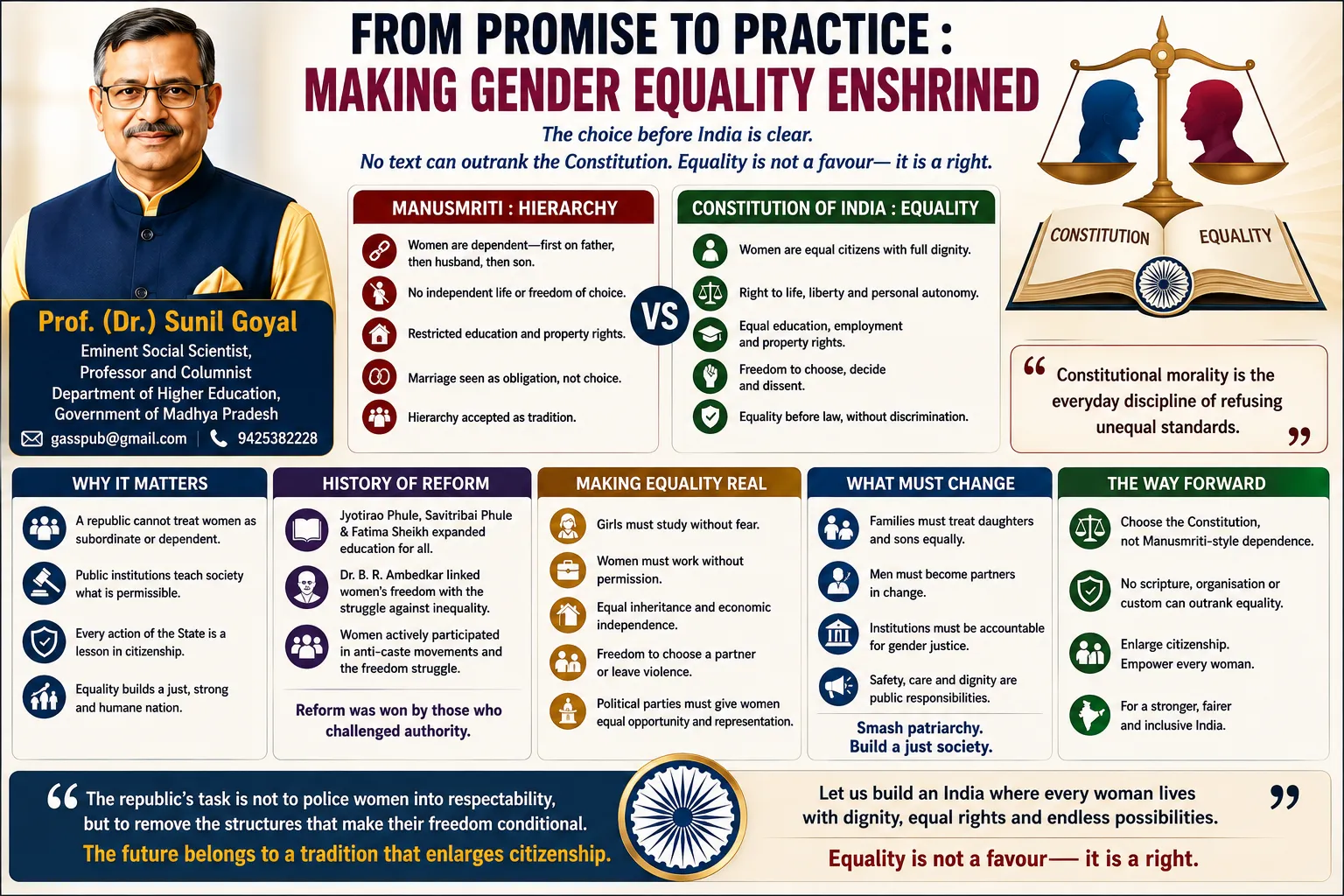
India’s argument over gender equality is not a quarrel between an old book and a new one. It is a choice between two ideas of citizenship. One treats women as persons with an equal claim to freedom. The other places them permanently under supervision: first of a father, then a husband, and finally a son. A republic cannot pretend that these ideas are compatible.
The Manusmriti’s injunctions, are unambiguous about dependence. They deny women an independent life, restrict their learning, subordinate property to male authority, and make marriage a condition from which a woman cannot freely escape. The problem is not merely that these rules are ancient. The deeper problem is that hierarchy becomes respectable when it is presented as tradition, and public power begins to accommodate it.
The Constitution chose another path. It made equality before law, non-discrimination and equal citizenship the foundations of the Indian state. That choice was neither ornamental nor hostile to India’s past. It was a deliberate answer to a society scarred by caste, gender and inherited privilege. The Constitution does not ask whether a woman is a daughter, wife or mother before recognising her rights. It recognises her first as a citizen.
That distinction also matters because public institutions do not merely administer society; they teach it what is permissible. When a minister, party or community excuses control as protection, it validates the idea that women cannot be trusted with their own choices. When a court, school or police station insists on consent and equal treatment, it expands the republic’s moral horizon. Every official response is therefore a lesson in citizenship. The State must teach freedom through its conduct, not celebrate equality in speeches while rewarding obedience in practice.
That distinction must guide public debate today. When a girl’s clothing is judged more harshly than a boy’s language, when a woman is expected to adjust to violence, or when her marriage is treated as family property, the issue is not etiquette. It is the survival of a double standard. The State cannot enforce constitutional equality in courts while tolerating social messages that women exist to be controlled.
The history of reform shows that progress was won by people who challenged authority, not by those who waited for hierarchy to soften. Jyotirao Phule, Savitribai Phule and Fatima Sheikh expanded the meaning of education. Ambedkar placed women’s independence within the larger struggle against graded inequality. Women participated in anti-caste movements and the freedom struggle because citizenship was never meant to be a male inheritance.
Yet legal equality is only the beginning. A constitutional promise becomes real when girls can study without fear, work without permission, inherit without negotiation, choose a partner without threats, and leave a violent marriage without being shamed. It becomes real when political parties nominate women in numbers that match their claims about empowerment, and when legislatures treat safety, care and dignity as public responsibilities rather than private matters.
The answer to the present contest is therefore clear. India must not allow Manusmriti-style dependence to masquerade as national culture. No scripture, organisation or family custom can outrank the Constitution. Constitutional morality is not an abstract phrase for judges and lawyers; it is the everyday discipline of refusing unequal standards.
Choice remains ours.
The republic’s task is not to police women into respectability. It is to remove the structures that make their freedom conditional. In that work, women must lead, men must change, and institutions must be held accountable. The future belongs to the tradition that enlarges citizenship. India should choose the Constitution, without apology and without ambiguity.
The author is an Eminent Social Scientist, Professor and Columnist, presently working at Department of Higher Education, Government of Madhya Pradesh.
Prof. (Dr.) Sunil Goyal, He can be reached at email:gasspub@gmail.com
Mobile 9425382228