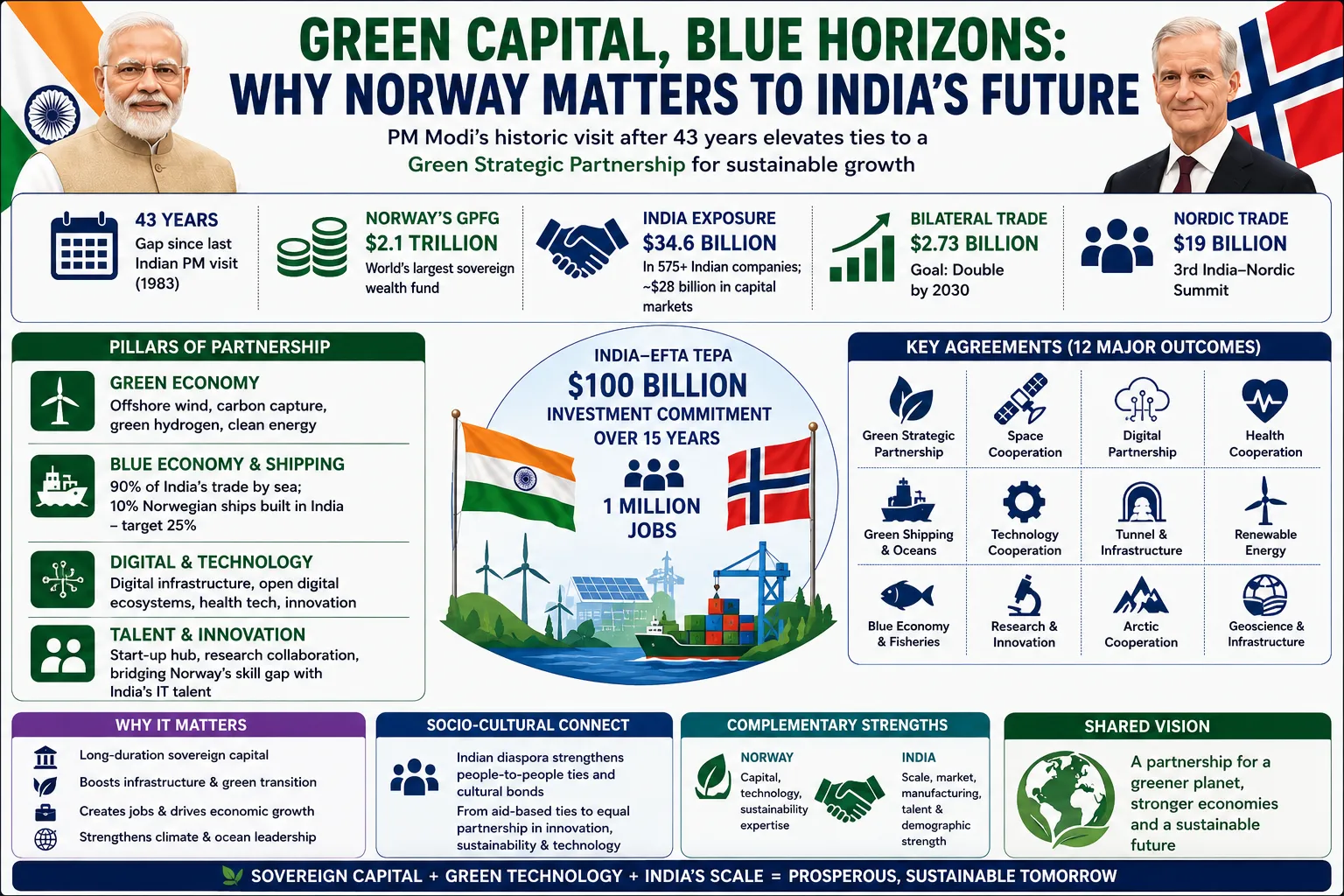
Dr. Sunil Goyal Eminent Social Scientist, Professor and Columnist Department of Higher Education, Government of Madhya Pradesh Email gasspub@gmail.com Mobile 9425382228 Prime Minister Narendra Modi recently visited Norway. This was not a friendly visit. It was a deal for Indias economic diplomacy. It was the time an Indian Prime Minister had visited Norway in 43 years. The visit was about creating a "Green Strategic Partnership" between India and Norway. This partnership includes: Finance, Clean technology, Maritime innovation, Digital infrastructure, and Long-term investment cooperation. At first Norway and India seem very different. Norway has 5.5 million people. India has over 1.4 billion people. Sometimes different countries can work well together. Norway has a large sovereign wealth fund called the Government Pension Fund Global (GPFG). It is worth over $2.1 trillion. India is one of the growing major economies. It can use a lot of capital. Norway’s wealth model is good at managing resources for generations. The GPFG was funded by oil revenues. It now has assets to more than half of Indias GDP. The fund has already invested $34.6 billion in over 575 Indian companies. It has also invested about $28 billion in capital markets. The visit sent an economic message. Norway wants long-term investment destinations. India needs sovereign capital for its next development stage. This partnership is important as India expands its 2 infrastructure. There are investment opportunities across sectors like: Toll roads, Renewable energy, Ports, Logistics, Airports, Development, and Green hydrogen projects. Norway’s GPFG is good for these projects. It likes long-term returns. It does not like term speculative gains. The visit also renewed focus on the India-EFTA Trade and Economic Partnership Agreement (TEPA). India signed this agreement with the European Free Trade Association. Norway, Switzerland, Iceland and Liechtenstein are part of this association. This agreement includes a commitment to invest $100 billion in India over 15 years. This could create over a million jobs. India faces challenges in generating employment. The TEPA could be an economic tool. Sectors that could benefit include: Energy, Pharmaceuticals, Logistics, Digital infrastructure, Green manufacturing, Shipping, Semiconductors, and Advanced technologies. The visit highlighted the importance of the " economy" and "blue economy". India and Norway signed agreements on: Offshore wind energy, Ocean energy systems, Carbon capture technologies, Sustainable fisheries, Shipping corridors, and Climate innovation. Norway is known for its expertise in maritime sustainability and decarbonization technologies. India offers scale, manufacturing capacity, engineering talent and a large market. Shipping cooperation is important. Most of Indias trade relies on routes. As global shipping shifts toward low-emission technologies, partnerships with countries like Norway become valuable. The visit also focused on technological cooperation. India and Norway established a Digital Development Partnership. This partnership focuses on: Digital infrastructure, Open digital ecosystems, Healthcare technology, Research collaboration, and Innovation networks. The partnership combines Norway’s capital and technical skills with Indias human resources. Norway faces labour shortages in advanced 3 technology sectors. India has a pool of IT professionals, engineers and digital talent. The visit had geopolitical implications. Norway’s decision to join the Indo-Pacific Oceans Initiative indicates a growing interest in the Indo- Pacific region and maritime stability. The Indian diaspora played a role in the visit. The warm welcome to Prime Minister Modi in Oslo highlighted the increasing confidence and visibility of Indian communities. Success in the India-Norway Green Strategic Partnership will depend on implementation. India must work on policy predictability, ease of doing business, infrastructure efficiency and regulatory transparency. Norway is looking for investments that align with sustainability, good governance and long-term returns. The partnership between India and Norway sets a model for economic diplomacy. This model combines capital, green technology, sustainable infrastructure and strategic collaboration. If executed well this partnership could serve as a framework for India’s engagement, with economies. *** Dr. Sunil Goyal The author is an Eminent Social Scientist, Professor and Columnist, presently working at Department of Higher Education, Government of Madhya Pradesh. He can be reached at email gasspub@gmail.com