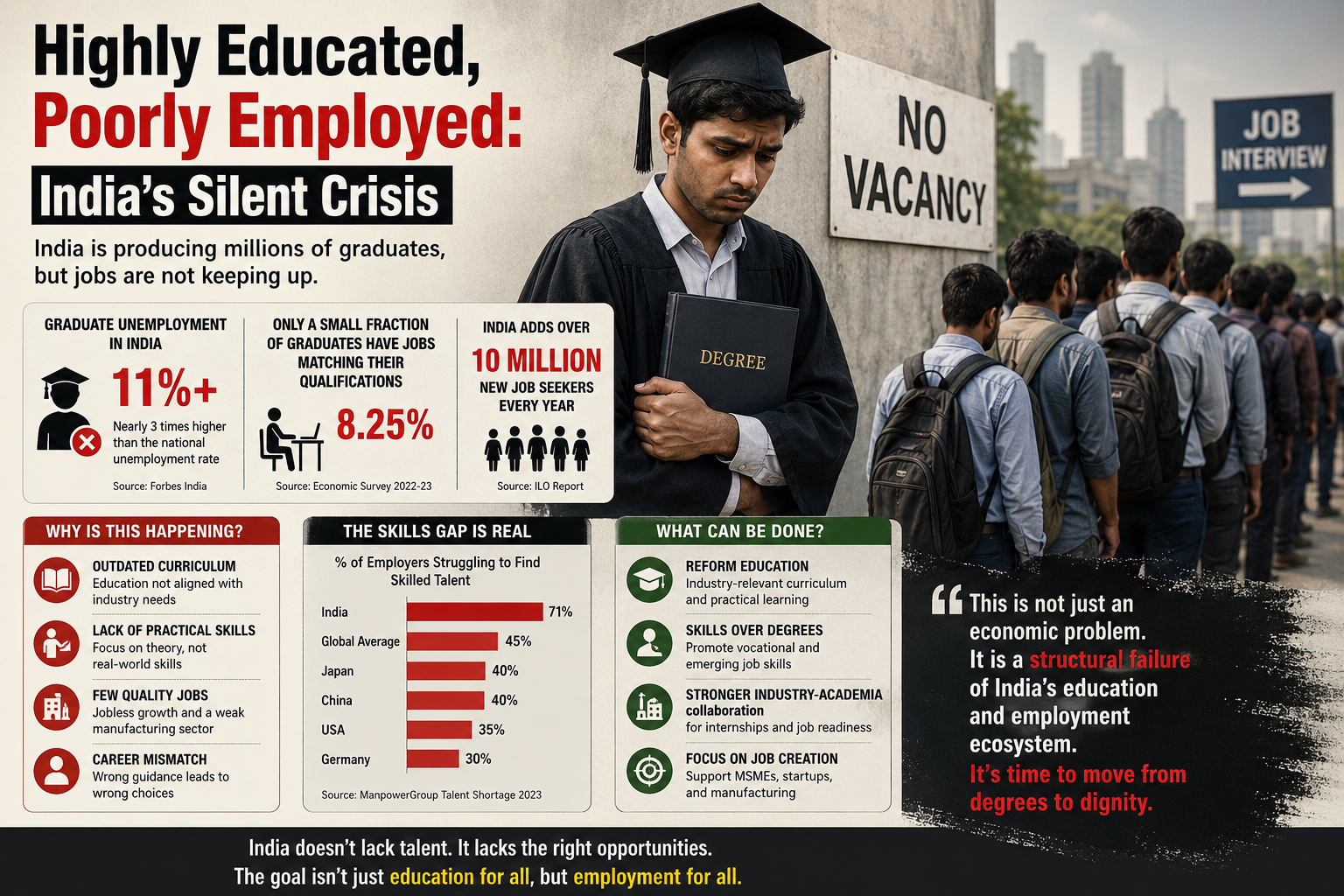
India proudly calls itself one of the world’s youngest and fastest-growing knowledge economies. Every year, millions of students graduate from universities, colleges, engineering institutes, and management schools with hopes of building successful careers and secure futures. Educational expansion has become a symbol of national progress. Degrees, diplomas, certifications, and rankings dominate public discussions about development. Yet behind this impressive educational growth lies a troubling reality that receives far less attention: millions of educated Indians are either unemployed, underemployed, or trapped in jobs far below their qualifications.
This is India’s silent crisis — a nation producing more graduates than ever before, but struggling to create meaningful employment for them.
For decades, education was seen as the safest route to economic mobility and social respect. Parents encouraged children to pursue higher education because degrees were believed to guarantee stable employment and upward movement in society. A university degree once represented competence, opportunity, and security. Today, however, that relationship has weakened dramatically. Higher education no longer guarantees employability.
Across India, countless graduates hold impressive qualifications but remain unable to secure stable and well-paying jobs. Engineering graduates prepare for government clerical examinations. MBA holders compete for entry-level sales jobs. Postgraduates and even PhD holders face years of uncertainty, temporary contracts, or unemployment. Many educated young people eventually accept positions unrelated to their qualifications simply to survive economically.
This growing disconnects between education and employment has created frustration among youth and concern among employers. Industries frequently report that despite large numbers of applicants, finding skilled and job-ready candidates remains difficult. The problem is therefore not only unemployment, but unemployability.
One of the biggest reasons behind this crisis is the nature of India’s education system itself. Much of higher education still revolves around rote learning, memorization, outdated syllabi, and examination-based evaluation. Students are rewarded for reproducing textbook content rather than developing practical understanding, critical thinking, creativity, or communication skills. As a result, many graduates possess theoretical knowledge but lack the ability to apply it in real-world situations.
Employers today seek adaptability, problem-solving ability, teamwork, digital literacy, and practical competence. But many educational institutions continue to prepare students for an economy that existed decades ago. Technology, automation, artificial intelligence, and globalization are transforming workplaces rapidly, while academic systems often change slowly. This creates graduates who are academically qualified but professionally unprepared.
The engineering sector clearly illustrates this problem. India produces one of the largest numbers of engineering graduates in the world. Yet employability studies repeatedly suggest that only a limited percentage are ready for high-skill industry roles. Many students’ complete technical degrees without sufficient coding skills, laboratory exposure, project experience, or industry interaction. The result is a workforce rich in certificates but weak in practical competence.
The crisis extends beyond engineering. Business graduates frequently lack communication and leadership abilities. Arts and humanities students struggle to find opportunities linked to their academic training. Research degrees often emphasize publication quantity more than innovation or problem-solving. Even professional education has increasingly become commercialized, focusing more on enrollment numbers than learning outcomes.
Another serious concern is the mismatch between educational aspirations and economic realities. Indian society continues to glorify a narrow set of career paths, particularly white-collar office jobs, government employment, engineering, medicine, and management. Meanwhile, vocational education, technical trades, manufacturing skills, and entrepreneurship remain socially undervalued. As millions chase similar qualifications and occupations, competition intensifies while job creation fails to keep pace.
Ironically, India faces both unemployment and skill shortages at the same time. Employers in sectors such as manufacturing, healthcare, logistics, cybersecurity, data analytics, and skilled trades frequently report shortages of capable workers. Yet educated youth remain unemployed because their qualifications do not match market demands. This paradox exposes the structural weakness of a degree-centric economy.
The commercialization of higher education has further worsened the situation. Many private institutions market attractive campuses, modern buildings, and placement promise, but fail to deliver quality teaching or practical training. Education increasingly functions as a business industry where degrees are sold as products rather than earned through rigorous intellectual and professional development.
The psychological impact of educated unemployment is equally serious. Young people who spend years studying often face disappointment, anxiety, and declining self-confidence when employment opportunities remain limited. Families that invest heavily in education experience financial strain when expected returns do not materialize. This frustration can gradually weaken public trust in educational institutions and social systems.
India’s demographic advantage could become a demographic burden if this trend continues. A large young population can drive economic growth only when it is productive, skilled, and employable. Otherwise, educated unemployment may fuel economic dissatisfaction, social instability, and wasted human potential.
The solution does not lie in discouraging higher education. India still needs universities, researchers, scientists, professionals, and intellectual development. However, the country urgently needs to rethink what education is meant to achieve. Degrees alone cannot remain the primary measure of capability.
Educational institutions must move beyond rote learning and focus on practical application, internships, innovation, digital competence, communication skills, and industry collaboration. Curricula must evolve continuously to reflect changing economic realities. Skill development should not exist separately from higher education but become integrated into it.
Vocational and technical education also deserve greater dignity and investment. Countries with strong economies respect skilled technicians, craftsmen, and vocational professionals as essential contributors to national development. India cannot become globally competitive while continuing to treat practical skills as secondary to academic qualifications.
Most importantly, education must shift from producing certificate holders to producing capable individuals. A degree should represent competence, not merely completion of coursework.
India’s silent crisis is therefore not simply unemployment. It is the growing gap between education and employability, between qualifications and capability, between academic success and economic opportunity. Unless this gap is addressed seriously, the country risks creating an entire generation that is highly educated on paper but poorly employed in reality.
The future of India will depend not on how many degrees it distributes, but on how effectively it transforms education into genuine human capability.
Dr. R.K. Uppal [Professor of Emeritus]