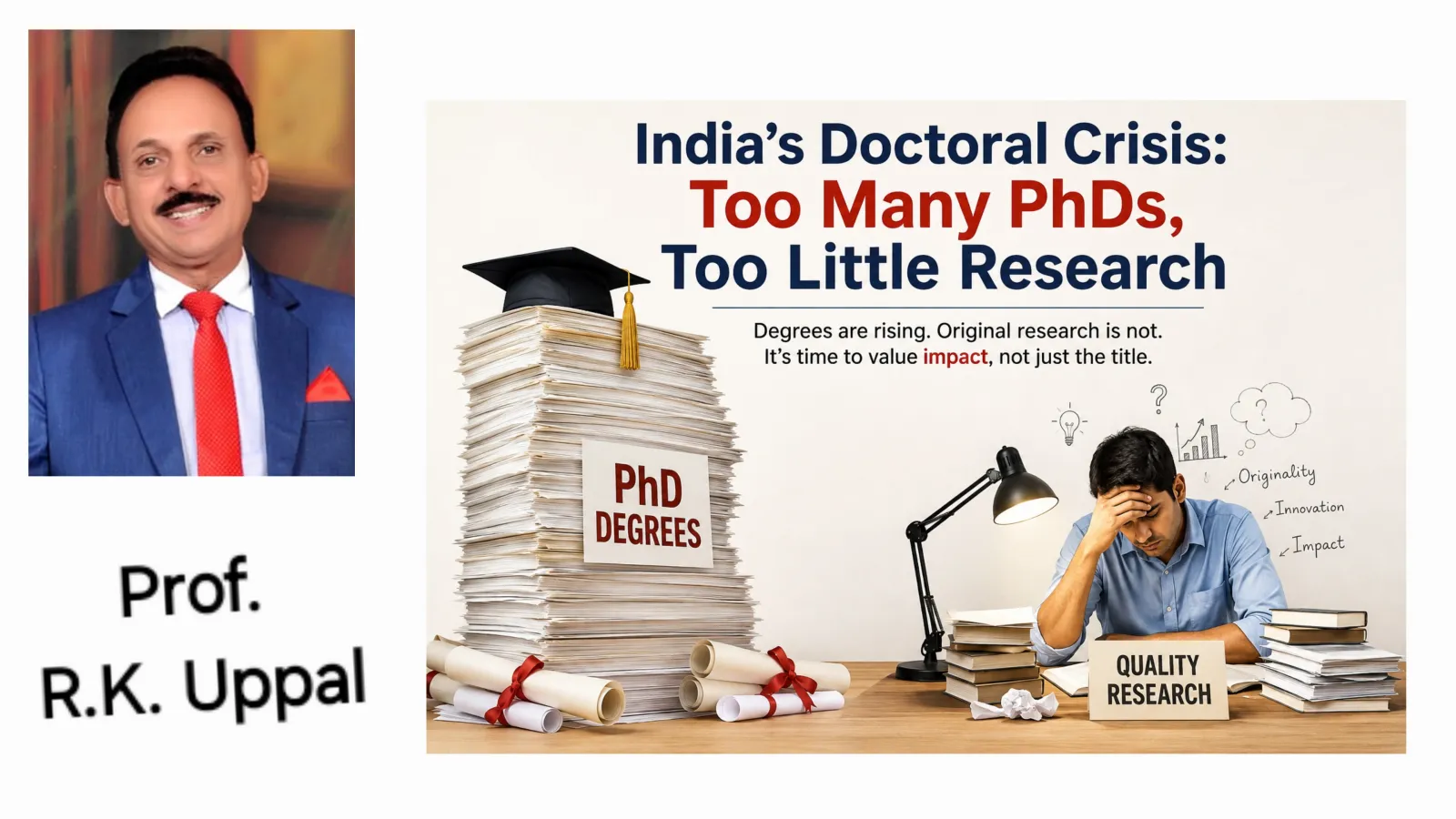
India’s Doctoral Crisis: Too Many PhDs, Too Little Research
Prof. R.K. Uppal
India has witnessed a remarkable expansion of higher education over the past few decades. Universities, colleges, research institutions and doctoral programmes have grown rapidly, creating opportunities for thousands of students to pursue advanced academic qualifications. Yet beneath this expansion lies a troubling question: Are we producing more PhDs than we are producing meaningful research? A doctorate is supposed to represent the highest level of academic training, intellectual independence and original contribution to knowledge. Unfortunately, in many cases, the PhD is increasingly being treated as a degree to be obtained rather than a research mission to be accomplished.
The central problem is not that India has too many scholars. India needs millions of highly trained researchers if it wants to become a knowledge-driven economy. The real problem is the possibility of too many low-impact PhDs and too little original, innovative and globally competitive research. When doctoral education becomes focused primarily on completing a dissertation, publishing a minimum number of papers and obtaining the degree, the fundamental purpose of research is weakened.
A PhD should answer an important question, solve a meaningful problem, develop a new theory, create a useful technology, generate new evidence or contribute substantially to society. Instead, some doctoral projects become repetitive exercises in literature review, questionnaire collection and statistical analysis, followed by lengthy dissertations that may have little practical or academic impact. A 200-page thesis is not necessarily better research than a 100-page thesis. The real measure should be originality, rigor, relevance and impact.
One of the biggest challenges is the commercialization of doctoral education. In parts of the private higher-education sector, concerns have been raised about whether doctoral programmes are always being operated with the same academic seriousness expected from internationally competitive research universities. Where the number of admissions becomes more important than research capacity, quality can suffer. A PhD cannot be treated like an ordinary academic programme in which increasing enrolment automatically represents institutional success.
The quality of supervision is another critical issue. A research scholar requires an experienced and committed supervisor who can challenge ideas, improve methodology, encourage independent thinking and maintain academic standards. If supervisors are overloaded with scholars, administrative responsibilities and teaching duties, meaningful mentorship becomes difficult. The result can be a system in which students are left to complete formal requirements rather than being trained as genuine researchers.
The evaluation of doctoral theses also deserves serious scrutiny. External examination should not become a routine formality. A doctoral dissertation should face independent, rigorous and intellectually demanding evaluation. Examiners must ask fundamental questions: Is the research genuinely original? Does it address an important problem? Is the methodology appropriate? Are the conclusions supported by evidence? Does the work contribute anything new? If the answer to these questions is weak, the thesis should be revised or rejected, regardless of the candidate’s time, institutional pressure or other considerations.
Another major concern is the culture of “publish or perish.” Publication is important, but publication alone cannot be the definition of research quality. The obsession with counting papers can encourage superficial research, fragmented publications and work aimed at satisfying institutional requirements rather than solving real problems. India needs to move from a publication-count culture to an impact culture.
The same principle should apply to doctoral dissertations. Instead of asking only whether a scholar has completed the required number of chapters, papers and formalities, universities should ask what the research has actually achieved. Has it influenced policy? Has it created a new model? Has it generated a patent or prototype? Has it helped an industry solve a problem? Has it contributed to a new dataset, methodology or theoretical insight? Has it been recognized internationally? These questions can transform doctoral education.
India also needs stronger integration between universities, industry, government and society. Many doctoral scholars work on topics that remain disconnected from practical challenges. Industry-linked PhDs, interdisciplinary research centers and problem-based doctoral programmes could help change this situation. A PhD in management, economics, engineering, agriculture, finance, technology or social sciences should increasingly address problems that matter beyond the university campus.
Artificial intelligence adds another dimension to the doctoral-quality debate. AI can assist researchers with literature discovery, data analysis, language improvement and research organization. But it cannot substitute for intellectual originality, ethical responsibility and independent scholarly judgment. Universities must establish clear standards for responsible AI use while ensuring that the researcher—not the machine—remains accountable for the research question, methodology, analysis and conclusions.
India does not need a race to produce the largest number of PhDs. It needs a race to produce the best research. Quantity without quality can damage the credibility of the entire doctoral system. A weak doctorate does not merely affect one student; it can enter academia, influence future students, shape institutions and weaken the country's research ecosystem.
The solution is not to discourage talented students from pursuing doctoral education. Instead, India should make the PhD more rigorous, selective, research-intensive and outcome-oriented. Admission should be based on genuine research potential. Supervisors should be carefully evaluated. External examination should be independent and demanding. Research funding should reward originality and impact. Universities should track the long-term outcomes of doctoral research rather than simply counting degrees awarded.
India's ambition to become a developed and knowledge-driven nation cannot be achieved through degrees alone. Degrees create credentials; research creates knowledge; innovation creates transformation. The country therefore needs fewer incentives for producing dissertations merely for completion and stronger incentives for producing research that changes industries, institutions, policies and lives.
The real question is not whether India is producing enough PhDs. The real question is whether India's PhDs are producing enough new knowledge, innovation and global impact. If the answer is no, the doctoral system requires urgent reform. India does not need a bigger PhD factory. It needs a stronger research culture. The future of Indian higher education should be measured not by how many doctorates are awarded, but by how many doctoral researchers genuinely contribute something new to the world.