Professor (Dr.) R.K. Uppal, [PhD, D.Litt.]
………………………………………………………………………
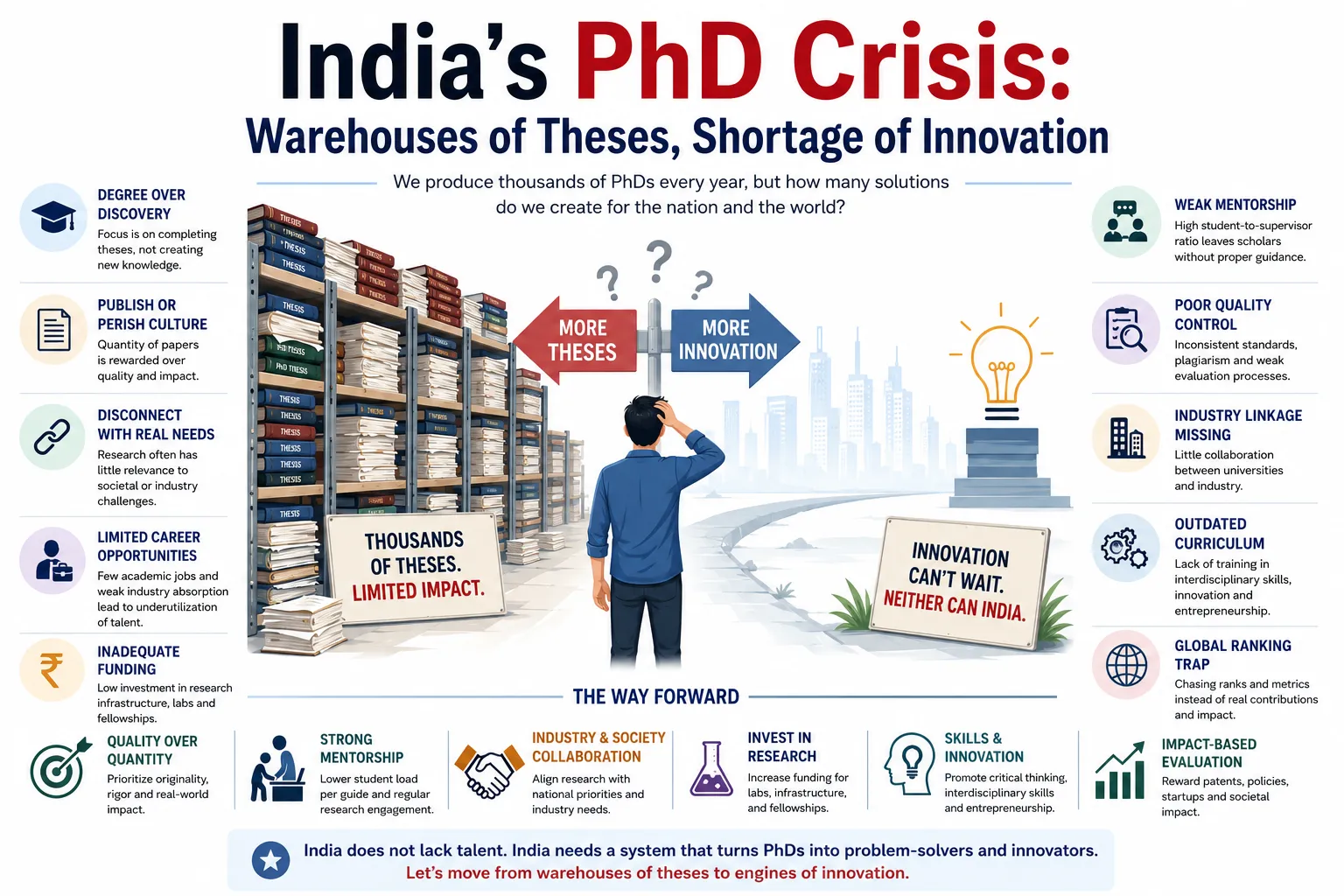
India prides itself on having one of the world's largest higher education systems and an ever-growing pool of highly educated young people. Every year, thousands of scholars are awarded doctoral degrees across disciplines, reflecting the country's academic expansion and aspirations to become a global knowledge leader. Yet, a troubling question deserves urgent attention: Why is the rapid growth in PhD degrees not translating into a comparable growth in innovation, patents, technological breakthroughs, or evidence-based policymaking? India's doctoral education system appears to be producing warehouses of theses but falling short of creating an ecosystem of innovation.
A PhD is intended to be the highest level of academic training, designed to generate original knowledge and solve complex problems. In advanced economies, doctoral research drives scientific discoveries, industrial innovation, and social transformation. Universities work closely with industries and governments to ensure that research addresses practical challenges. In India, however, a significant proportion of doctoral research remains confined to university shelves and digital repositories, with limited impact on society or the economy.
The problem is not that India produces too many PhDs. A country of more than 1.4 billion people requires a large community of researchers and innovators. The real problem is that the system often prioritizes the completion of a thesis over the creation of new knowledge. Success is frequently measured by the number of PhDs awarded rather than by the quality, originality, and usefulness of the research produced. One of the major reasons behind this crisis is the excessive emphasis on quantity. Universities are under pressure to improve rankings and increase research output, while faculty promotions often depend on supervising doctoral students and publishing papers. As a result, doctoral admissions have expanded rapidly, but research infrastructure, laboratory facilities, and supervisory capacity have not grown at the same pace. In some institutions, supervisors are responsible for an excessive number of research scholars, making meaningful academic mentorship difficult.
The pressure to publish has created another challenge. Instead of encouraging innovative and high-quality research, the academic system often rewards the number of publications. This has fuelled the growth of low-quality and predatory journals that promise quick publication for a fee. Many scholars focus on meeting formal requirements rather than pursuing ambitious research questions. Consequently, thousands of research papers are published every year, but only a limited number influence scientific advancement, industrial development, or public policy.
Another concern is the disconnect between doctoral research and national priorities. India faces enormous challenges in healthcare, agriculture, water management, renewable energy, artificial intelligence, climate change, urban development, and public administration. These sectors require innovative solutions and evidence-based policy interventions. However, many doctoral projects have little connection with these pressing issues. Universities, industries, and government agencies often work independently rather than collaboratively, limiting the practical application of research findings.
The employment situation further highlights the weaknesses of the current system. Every year, thousands of PhD graduates aspire to academic careers, but permanent faculty positions remain limited. Many highly qualified scholars spend years in temporary appointments, contractual jobs, or postdoctoral positions with uncertain futures. Industry, meanwhile, has not fully integrated doctoral talent into its research and development strategies, particularly outside science and technology fields. This mismatch between doctoral education and labour market demand creates frustration and underutilization of highly skilled human resources.
Funding is another critical issue. Quality research requires modern laboratories, advanced equipment, fieldwork, digital databases, and international collaboration. While India has increased support for research through various schemes, investment in research and development remains modest compared with major innovation-driven economies. Limited funding often forces scholars to undertake less ambitious projects or delays the completion of their research.
Academic governance also contributes to the crisis. Delays in admissions, cumbersome administrative procedures, prolonged thesis evaluations, and inconsistent quality standards across institutions reduce the efficiency of doctoral programmes. Cases of plagiarism and unethical research practices further damage the credibility of the system. A doctoral degree should symbolize intellectual excellence and integrity, but maintaining these standards requires strong institutional mechanisms. The irony is that India does not lack talent. Indian scientists, engineers, economists, and scholars have made remarkable contributions around the world. Many Indian researchers working abroad lead globally recognized projects and innovations. Their success demonstrates that the problem lies not in the capability of Indian scholars but in the ecosystem within which they operate. Talent flourishes when supported by good institutions, adequate funding, effective mentorship, and a culture that values creativity over conformity.
“ “
“Reforming India's doctoral education system is therefore a national priority. Admission to PhD programmes should focus on research aptitude and motivation rather than simply increasing enrolments. Supervisors should mentor a manageable number of scholars to ensure quality guidance. Evaluation systems should reward originality, societal impact, patents, policy contributions, and technological innovation instead of merely counting publications. Universities must also strengthen partnerships with industry and government. Doctoral research should address real-world challenges and contribute to economic development. Collaborative research centers, industrial internships, and interdisciplinary projects can bridge the gap between academic inquiry and practical application.”
---------------------------------------------------------------------------------------------------------------------
Investment in research infrastructure and funding should increase substantially. Modern laboratories, digital libraries, international collaborations, and access to advanced technologies are essential for creating a vibrant research culture. Equally important is the creation of diverse career opportunities for PhD graduates in industry, public policy, consulting, entrepreneurship, and the social sector.
India can draw valuable lessons from countries that have successfully linked doctoral education with innovation and national development. Their experience shows that universities become engines of progress when research is connected with industry, government, and society. Ultimately, the value of a PhD cannot be measured by the number of theses submitted or degrees awarded. It should be measured by the discoveries made, the technologies developed, the policies improved, the businesses created, and the lives transformed. A thesis gathering dust in a library may satisfy an academic requirement, but it does little to advance a nation's progress.
India stands at a critical moment in its educational journey. If the country wishes to become a global leader in innovation and knowledge creation, it must move beyond a culture of producing doctoral degrees for statistical success. The challenge is to transform India's higher education system from warehouses of theses into laboratories of ideas and engines of innovation. India's future prosperity will depend not on how many PhDs it produces, but on how many of those PhDs produce discoveries that shape a stronger, smarter, and more self-reliant nation.