Dr. Reyaz Ahmad
Faculty of Mathematics,
Department of General Education SUC, Sharjah, UAE
Email: reyaz56@gmail.com
WhatsApp No: 00971542454219
-----------------------------
India’s Second School: The Coaching Classroom
Once intended to support weak students, private tuition has evolved into a
parallel education system—one that exposes the failures of formal schooling
while deepening inequality, stress and financial insecurity.
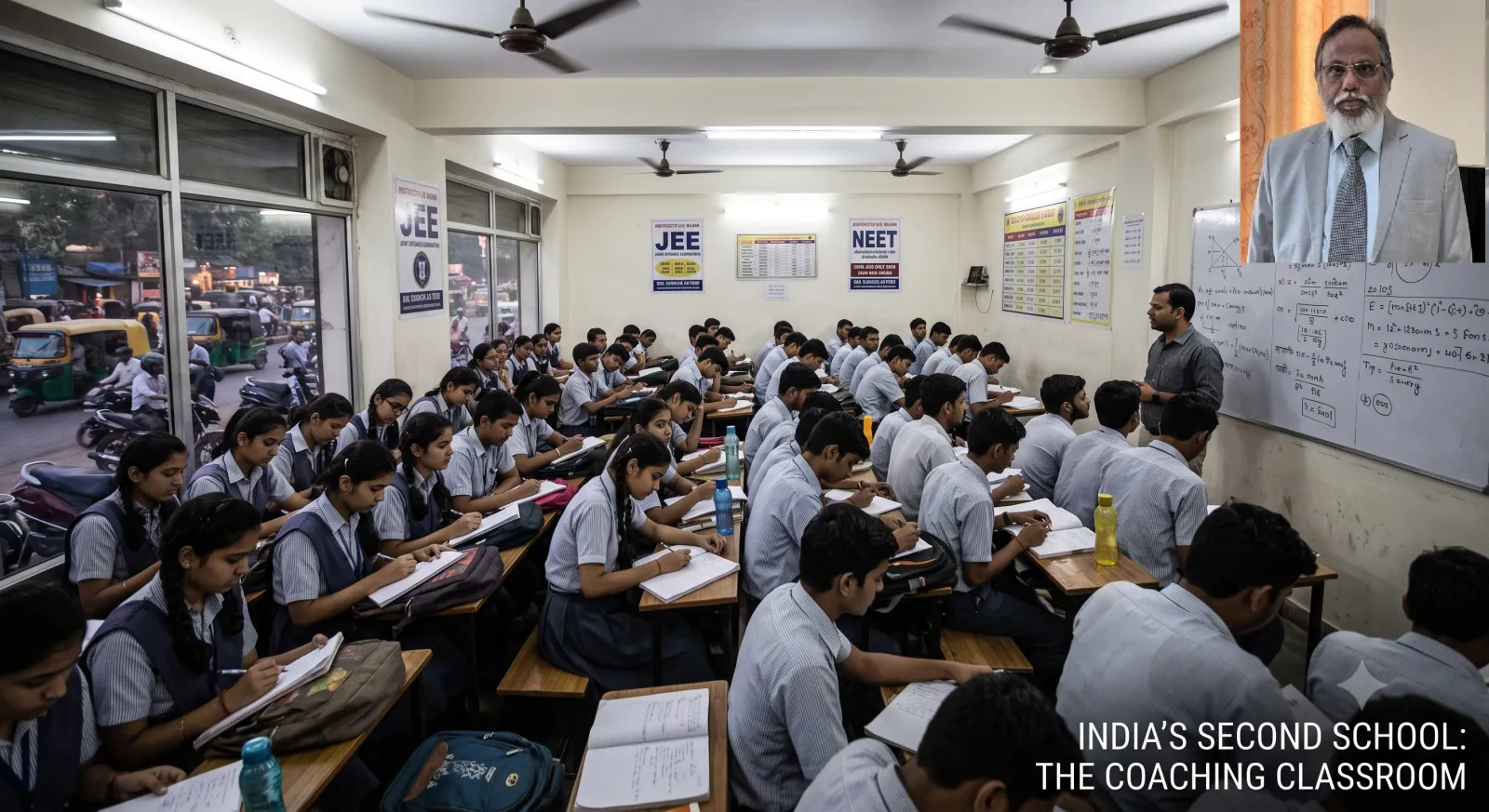
Every afternoon, a familiar scene unfolds across India. A child returns from school,
hurriedly eats a meal, changes clothes and leaves again—this time for tuition. The
school bag may remain the same, but the classroom changes. For the next two or
three hours, the student sits in another crowded room, studies many of the same
subjects and prepares for many of the same examinations.
This second journey has become so normal that few people pause to ask an
uncomfortable question: If children must attend another classroom after
spending six hours in school, what exactly is the first classroom failing to
provide?
Private tuition was once considered remedial support for students who struggled with
a particular subject. Today, it has become an almost compulsory extension of
schooling. From neighbourhood tutors teaching primary children to giant coaching
institutes preparing teenagers for engineering, medicine, civil services and university
entrance examinations, India has created an enormous parallel education system.
The coaching classroom is no longer merely supporting the school. In many cases, it
is replacing it.
A symptom of the learning crisis
Parents do not spend their savings on coaching without reason. They do so because
they fear that ordinary schooling will not be enough. Large classes, unfinished
syllabi, teacher shortages, uneven instructional quality and examination-oriented
curricula frequently leave students with unresolved learning gaps.
The Annual Status of Education Report 2024 demonstrates the scale of the problem
in rural India. Only 48.7 per cent of children in Class V could read a Class II-level
text, while just 30.7 per cent could perform a basic division problem. The same
report shows that paid tuition has become widespread even among younger
children: approximately three out of every ten primary and upper-primary students in
several major categories were receiving private tuition.
These figures reveal a serious contradiction. Children are progressing from one
class to another, but many are not acquiring the competencies expected at those
levels. Promotion continues; learning does not always follow.
Coaching enters this gap and promises to repair it. The tutor reteaches what was not
understood in school, provides additional worksheets, predicts examination
questions and offers individual attention that a teacher handling 40 or 50 students
may be unable to provide.
The success of coaching, therefore, is partly built upon the weakness of formal
schooling. Every child sent to tuition is not necessarily evidence of parental ambition;
sometimes, it is evidence of institutional failure.
From supplementary help to compulsory consumption
A troubling change has taken place in parental thinking. Tuition is increasingly
purchased not only when a child is weak, but also when the child is performing well.
Parents fear that while their son or daughter studies independently, competitors are
receiving additional notes, mock tests, shortcuts and examination strategies.
This produces what economists call a positional race. Families spend more not
necessarily because education has improved, but because they are afraid of falling
behind those who are spending more.
A child who attends one tuition class begins to feel disadvantaged when classmates
attend two. A student preparing through free online material feels insecure when
others enrol in expensive residential coaching. Coaching thus changes from an
optional academic service into a form of educational insurance.
The question is no longer, “Does my child need tuition?” It becomes, “Can we afford
not to provide it?”
That fear sustains the tuition economy.
The financial burden on families
The cost of education is no longer limited to school fees, uniforms, transport and
books. Families must now budget for subject tutors, test series, digital subscriptions,
entrance-examination packages, transportation to coaching centres and, in some
cases, accommodation in coaching hubs.
An analysis by the Centre for Economic Data and Analysis, based on the
government’s 2025 Comprehensive Modular Survey on Education, found that rural
households were spending approximately ₹7,000 to ₹7,300 annually on private
tuition or coaching for each child, in addition to school-related expenditure. In urban
areas, average coaching expenditure was about ₹12,500 to ₹13,600. By Classes XI
and XII, coaching accounted for almost as much household expenditure as formal
schooling itself.
For wealthy families, such expenses may be manageable. For lower- and middle-
income households, they can determine the entire family budget.
Parents reduce healthcare spending, postpone repairs, avoid social obligations,
borrow money or sacrifice retirement savings because education is viewed as the
only reliable path to upward mobility. In families with several children, difficult
decisions arise: Who will receive the best coaching? Which subject can be dropped?
Should the daughter receive the same expensive preparation as the son? Can the
family risk investing in another year of entrance-examination preparation?
The tuition economy is therefore not merely an educational phenomenon. It is a
system that redistributes household income towards an increasingly commercialised
race for limited opportunities.
When money determines preparation
The greatest danger is not that coaching exists. Additional academic help can be
useful and, in many cases, transformative. The danger is that access to quality
preparation is increasingly determined by purchasing power.
Two equally talented students may sit for the same competitive examination, but they
do not necessarily approach it from the same starting line. One may have trained
teachers, personalised mentoring, repeated mock examinations, updated study
material and a quiet room. The other may depend on an overcrowded school,
borrowed books and an unstable internet connection.
The examination treats them as equal on test day, even though the preparation
system has treated them very differently for several years.
This weakens the principle of merit. What society calls “merit” may actually be a
combination of talent, family income, location, parental education, access to
information and the ability to purchase sustained preparation.
When premium coaching becomes the unofficial entrance fee to prestigious
institutions, education stops functioning as a ladder of mobility. It begins reproducing
the inequalities it was expected to remove.
The hidden cost paid by children
There is another price that does not appear in household accounts: the loss of
childhood.
A typical student may spend the morning in school, the evening in tuition and the
night completing assignments from both. Weekends are consumed by tests.
Holidays become crash courses. Recreation is treated as laziness, and sleep is
sacrificed in the name of discipline.
Children are repeatedly ranked, compared and divided into batches. Their identity
becomes attached to marks, percentile scores and projected examination ranks. A
temporary academic setback is interpreted as a judgement on their intelligence and
future worth.
Learning under such conditions becomes an act of fear rather than discovery.
A mathematics problem is no longer something to explore; it is a possible mark to
lose. A scientific concept is not studied because it explains the world, but because it
may appear in an entrance examination. Literature, art, sport and conversation are
pushed aside because they are not considered “scoring subjects.”
The result may be examination competence without intellectual curiosity—students
trained to select the correct option but hesitant to question, create or think
independently.
Coaching centres cannot carry the entire blame
It would be unfair to portray every tutor or coaching institute as exploitative. Many
dedicated tutors help students who would otherwise remain behind. They provide
flexibility, motivation and individual attention. Some coaching institutions have
enabled students from disadvantaged backgrounds to enter professions previously
beyond their reach.
The industry is responding to a genuine demand.
But genuine demand does not justify unregulated expansion, misleading success
claims, excessive fees or systems that profit from anxiety. India’s Ministry of
Education acknowledged these concerns in its 2024 model guidelines, referring to
exorbitant fees, undue student stress, safety failures and other malpractices. The
guidelines proposed reasonable fees, pro-rata refunds, counselling support,
restrictions on classes during school hours and safeguards concerning younger
students.
Regulation is necessary, but regulation alone will not resolve the deeper problem.
Even the best-regulated coaching centre will continue to flourish if families have little
confidence in schools.
Repair the first school
The solution is not to abolish tuition. It is to make tuition optional again.
Schools must identify learning gaps early rather than allowing them to accumulate
over several years. Remedial support should be provided within the school timetable
and without additional charges. Teachers need manageable class sizes, continuous
professional development and freedom from excessive administrative duties.
Assessment must move beyond memorisation and predictable question patterns.
When examinations reward mechanical repetition, coaching centres will
understandably specialise in that repetition. When examinations test reasoning,
application, communication and creativity, both schools and coaching institutions will
have to change their methods.
Public libraries, community learning centres and free high-quality digital resources
can provide academic support to children whose families cannot afford private tutors.
Schools can also organise supervised study periods, peer-learning groups and
teacher consultation hours.
Most importantly, the number of quality opportunities in higher education must
expand. When millions of students compete desperately for a limited number of
seats, anxiety becomes inevitable and coaching becomes profitable. No reform of
the coaching sector can succeed without addressing the scarcity that fuels the
competition.
Education must not require two schools
India’s tuition economy sends a clear message: families value education deeply and
are willing to make extraordinary sacrifices for it. That commitment should be
respected. It should not be exploited.
A strong education system should not require every child to attend school
twice—once because it is compulsory and again because the first experience was
insufficient.
The true measure of educational progress is not the number of coaching centres
opened, test packages sold or students studying until midnight. It is whether a child,
regardless of family income or postal address, can enter an ordinary classroom and
receive an extraordinary opportunity to learn.
Until that becomes possible, India’s second school will continue to grow—and the
distance between those who can afford it and those who cannot will grow with it.