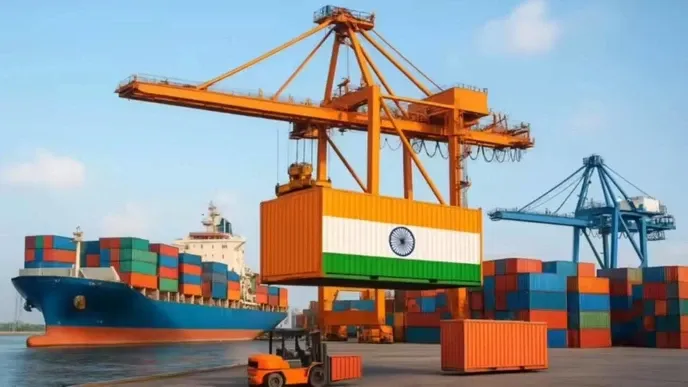
Deficit at 5-month high: India's June trade gap rose to $30.4 billion as imports surged far faster than exports, driven by oil, electronics, and fertilisers.
Import-heavy manufacturing: Electronics and machinery imports soared alongside export gains, underscoring India's dependence on imported components for manufacturing growth.
Risks ahead: Economists flag volatile oil prices, AI headwinds in services, and weak labour-intensive exports as factors that may keep the deficit high.
India's trade gap widens sharply in June
India’s merchandise trade deficit widened to $30.4 billion in June 2026, the highest in five months, as imports grew 31% to $70.8 billion while exports rose 15.5% to $40.4 billion. Crude oil imports jumped over 40% to $19.3 billion, electronics imports surged nearly 59% to $13.4 billion, and fertiliser imports trebled to $2.3 billion. Although gold imports grew only 7% year-on-year, they remained significant, while silver imports plunged due to higher duties and cooling prices. News18
Looking at the data, you would see that merchandise imports in particular have grown by a significant amount and think that this is a matter of concern, but the fact is that these imports are being driven by just a few commodities such as petroleum products and crude oil, gold, and electronics. Gold and oil have increased in value because of higher prices due to the prevailing geopolitical situation, and electronics imports are rising because of higher consumption within the economy and also inputs being used for manufacturing.
Rajesh Agrawal,
The Hindu
Crude oil and electronics drive import surge
High global prices and industrial demand pushed crude oil and electronics to the forefront of India’s import bill. The electronics trade deficit hit a record $8.4 billion in June, with machinery and chemical imports also rising sharply. Analysts note that while electronics exports are growing, they rely heavily on imported components, reflecting deeper integration into global manufacturing supply chains but also import dependence. CNBC-TV18
India-China trade imbalance deepens
Bilateral trade between India and China reached $91.7 billion in the first half of 2026, up 23.6%, but India’s deficit with China widened to $67.1 billion. Chinese exports to India, dominated by electronics, machinery, and chemicals, grew 21.8%, while India’s exports to China rose 37.2%, led by petroleum products, minerals, and electronic goods. Indian officials continue to push for greater Chinese market access for pharmaceuticals and other competitive sectors. ET Now
Obviously, we would like to be able to export more to China. This is nothing unreasonable about suggesting that, particularly in areas where we believe we have a competitive advantage like pharmaceuticals. For instance, we're one of the world's big exporters of pharmaceuticals to advanced markets...We think there is a balance of advantage for both countries, including value for China and, of course, value for the relationship.
Vikram Doraiswami,
ET Now
Possible scenarios for the trade outlook
If oil prices remain stable around $80 per barrel and export diversification to Asia and Africa continues, the current account deficit could narrow towards 1.4% of GDP in FY27. However, a spike in crude prices due to geopolitical tensions, combined with AI-related headwinds to services exports and persistent weakness in labour-intensive sectors, could push the deficit higher. The trajectory of electronics manufacturing—whether it reduces import dependence or continues to expand alongside imports—will be pivotal. Moneycontrol