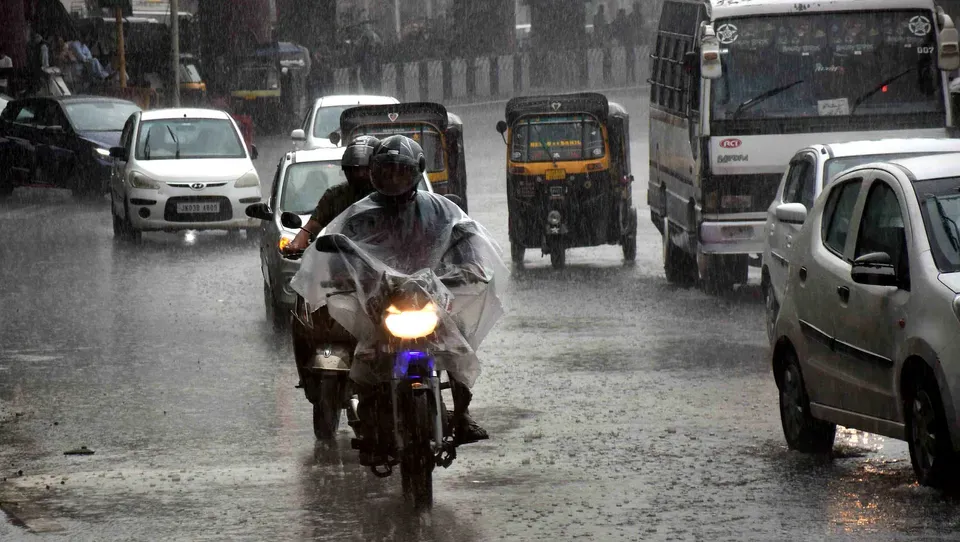
Srinagar, Jun 13: At least six cloudbursts, including five in the Jammu region and one in south Kashmir, were reported across Jammu and Kashmir over the past week, triggering flash floods, damaging houses and agricultural land, and disrupting life in several mountain districts.
The latest cloudburst struck Bathoi village in the Mahore subdivision of Reasi district late Thursday, sending water, mud, and debris into residential areas and damaging several houses, officials said.
No casualties were reported.
The incident followed four cloudbursts reported in Doda, Kishtwar, and Poonch districts during the week.
Two cloudbursts were reported in Kishtwar district - one in the Gahan area of Sarthal and another in Machhipal, while a third struck Thathri in Doda district.
In Thathri, floodwaters entered residential areas, trapped vehicles under debris and forced authorities to shift residents from affected houses. Mudslides also blocked sections of the highway passing through the town.
Heavy rain also triggered flash floods in the Sabzian-Ghorayank area of Mandi in Poonch district, where debris accumulated near a school building.
No loss of life was reported.
On Friday, another cloudburst hit Ranipora, Rakhi-Brah, and Nag Naran villages in the Shangus area of Anantnag district, damaging paddy fields and orchards and forcing residents to move to safer locations. "It happened within seconds," said Mushtaq Ahmad of Ranipora. "We heard a roar and muddy water entered our homes. People barely had time to move out."
Residents said floodwaters damaged agricultural land and orchards in the area. MLA Anantnag East-Shangus Reyaz Ahmad Khan said officials would assess the losses caused by the flooding in Shangus.
"The agriculture and horticulture sectors have suffered losses. Assessment teams will complete the exercise and compensation will be provided under government norms," Khan said. Experts attribute the rise in such events to a combination of increasing temperatures and environmental degradation. "Rising temperatures increase atmospheric moisture, resulting in intense rainfall over short periods," said Riyaz Ahmad Mir, a geologist at the National Institute of Hydrology, Jammu.
"In mountainous terrain, water moves rapidly downslope. That increases the chances of flash floods and landslides," he said. Mir said deforestation has added to the risk by reducing the capacity of slopes to absorb water.
According to Global Forest Watch data, Jammu and Kashmir lost about 212 sq km of tree cover between 2001 and 2023. Mukhtar Ahmad, Director of the Meteorological Department in Srinagar, said higher temperatures allow the atmosphere to hold more moisture.
"With every one-degree Celsius increase in temperature, the atmosphere can hold about seven percent more moisture," Ahmad said. "That can lead to more intense rainfall events." Ahmad said weather monitoring systems have improved through radar and satellite-based observations, enabling authorities to issue more timely warnings.
He said the frequency of cloudbursts and flash floods generally increases during the pre-monsoon and monsoon period. "As the pre-monsoon summer progresses, the possibility of short-duration, high-intensity rainfall events increases, particularly in the mountainous districts of Jammu," Ahmad said.
Climatologist Sonam Lotus said cloudbursts in the region are often associated with interactions between western disturbances and moisture-bearing winds. "The interaction of these weather systems can produce intense rainfall over a small area within a short period," Lotus said. "Such events become more common during the pre-monsoon and monsoon months." Independent weather observer Faizan Arif said changes in land use and weather patterns should be factored into planning for mountain districts.
"The Himalayan ecosystem is sensitive to both climatic and land-use changes. Planning and development need to take these factors into account," Arif said. Last year, several districts of Jammu witnessed cloudbursts and flash floods between April and September, causing damage to houses, roads and agricultural land.
Among the major incidents was the Aug. 14 cloudburst in Chisoti village of Kishtwar district along the Machail Mata Yatra route, where nearly 70 people were killed and dozens, mostly pilgrims, went missing.
According to figures shared by the Ministry of Home Affairs in the Rajya Sabha earlier this year, floods and heavy rains claimed 199 lives, killed 11,693 livestock, damaged 8404 houses, and affected 77,915 hectares of agricultural land across Jammu and Kashmir during the year.