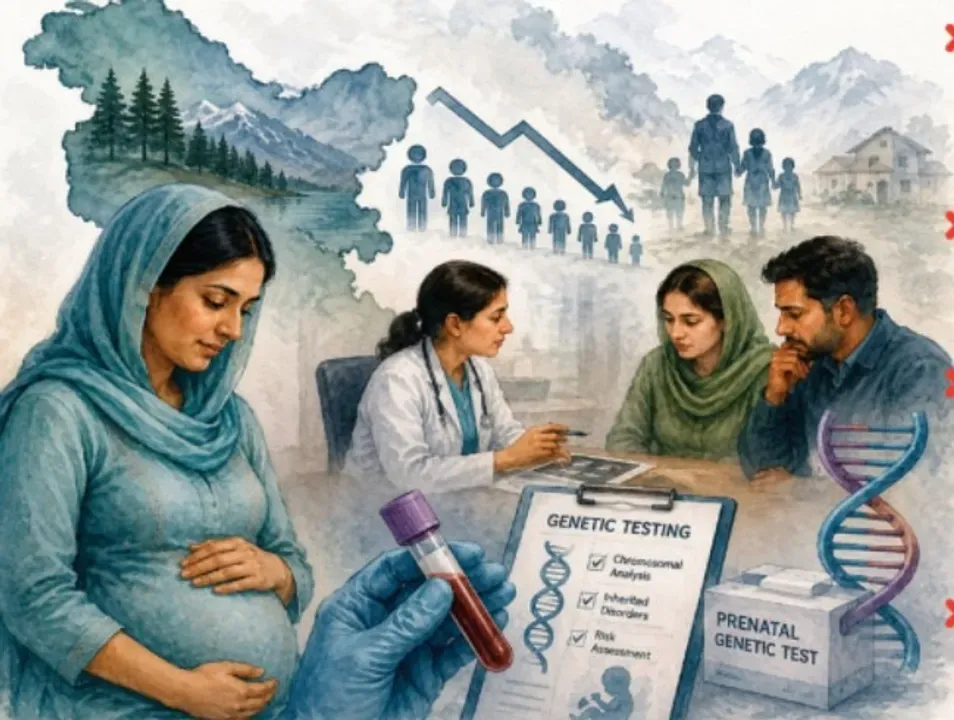
Srinagar, May 30: J&K’s Total Fertility Rate (TFR) has risen to 1.8 children per woman, according to the National Family Health Survey-6 (NFHS-6), a major change in the fertility rate trends documented over the decades for J&K.
The latest health data from the most awaited health survey in the country has revealed changing contours of the society, and it’s health profile.
The latest survey, data for which was collected in 2023-24, places J&K’s fertility rate higher than the 1.4 recorded in NFHS-5. NFHS 5 had data pertaining to around 2019-21.
There is a modest reversal after years of steady decline in family size.
The TFR here was last around 1.8 during the NFHS-4 survey of 2015-16.
The latest Sample Registration System (SRS) Bulletin for 2023 released in September 2025, also estimated J&K’s TFR at approximately 1.5, quite lower than what NFHS 6 data states.
The NFHS 6 survey, has shown a complex public health picture for J&K.
The NFHS is one of India’s largest household health surveys.
It is considered a crucial benchmark for assessing demographic, health and nutrition trends across states and UTs.
Perhaps the most striking finding is the decline in use of family planning methods among “currently married women aged 15-49 years”.
According to the survey, use of any family planning method has fallen to 40.4 percent from 53 percent in NFHS-5.
The changes are related to changing fertility preferences, delayed marriages, migration trends, gaps in contraceptive access.
This could also be linked to possible shifts in survey methodology and reporting patterns. However, no explanation could be accessed immediately.
The survey has also shown exceptionally high caesarean section rates in J&K.
Nearly 51 percent of births in J&K were delivered through C-section (CS).
This is far above the levels considered medically necessary.
The divide between private and public health facilities is particularly striking: as many as 90 percent of births in private health facilities were delivered through CS, compared to 48.6 percent in public health facilities.
Despite these concerns, maternal and child healthcare indicators continue on the positive stride.
Institutional deliveries stood at 93.6 percent and approximately 95 percent deliveries were attended by skilled health personnel.
Child nutrition and vaccination indicators remain on the upward trajectory.
However, lifestyle diseases such as obesity, hypertension and high blood sugar levels are emerging as major health concerns.
Vaccination coverage among children has been improving over the decades: nearly 90 percent children aged 12-23 months were fully vaccinated.
The coverage for measles, hepatitis-B and rotavirus vaccines recorded major improvement.
Stunting among children under five years has dropped from 26.9 percent to 21.4 percent.
Wasting has also declined sharply from 19 percent to 10.6 percent.
Underweight prevalence too has slumped thankfully.
The nutrition profile of children, on the broader picture, show noticeable improvement compared to NFHS-5.
On the flipside though, more than one-third women in J&K are now overweight or obese.
Over a quarter men fall in the same category. The elevated blood pressure was reported among 25 percent women and 20.9 percent men.
A significant proportion of population was found to have high to very high blood sugar levels.
Reflecting implementation of government-backed insurance schemes, the households with at least one member covered under a health insurance rose dramatically from 13.8 percent in NFHS-5 to over 96 percent in NFHS-6.