JU hosts Hands-on Workshop on HPLC & Automated Karyotyping with 100+ Participants
Jammu, September 2, 2026: The Department of Zoology, University of Jammu, is organising a two-day hands-on training workshop on “HPLC and Automated Karyotyping Workstation” under the DBT-BUILDER Programme of the Department of Biotechnology (DBT), Government of India.The workshop has received an overwhelming response, with more than 100 participants from universities, colleges and research institutions across Jammu and Kashmir taking part in the programme. The participants comprise students, research scholars, faculty members and researchers, reflecting the growing interest in acquiring practical expertise in advanced analytical and cytogenetic techniques.
Participants from several prominent institutions, including Shri Mata Vaishno Devi University (SMVDU), Central University of Jammu, Cluster University of Jammu, Government Degree College (GDC) Doda, GDC Kishtwar, GDC Samba, GDC Hiranagar, GDC Khour, GGM Science College, Jammu, Institute of Human Genetics, University of Jammu, and School of Biotechnology, University of Jammu, besides other academic and research institutions from across the regionare attending the workshop. The workshop commenced with a welcome address by Prof. Seema Langer, Head, Department of Zoology, and Coordinator, DBT-BUILDER Programme. Prof. Langer welcomed the participants and the invited expert and underlined the importance of hands-on training programmes in strengthening practical competence, developing research skills and ensuring optimum utilisation of sophisticated scientific infrastructure. She emphasised that exposure to modern instrumentation is essential for preparing students and young researchers to address contemporary challenges in biological and biomedical sciences.
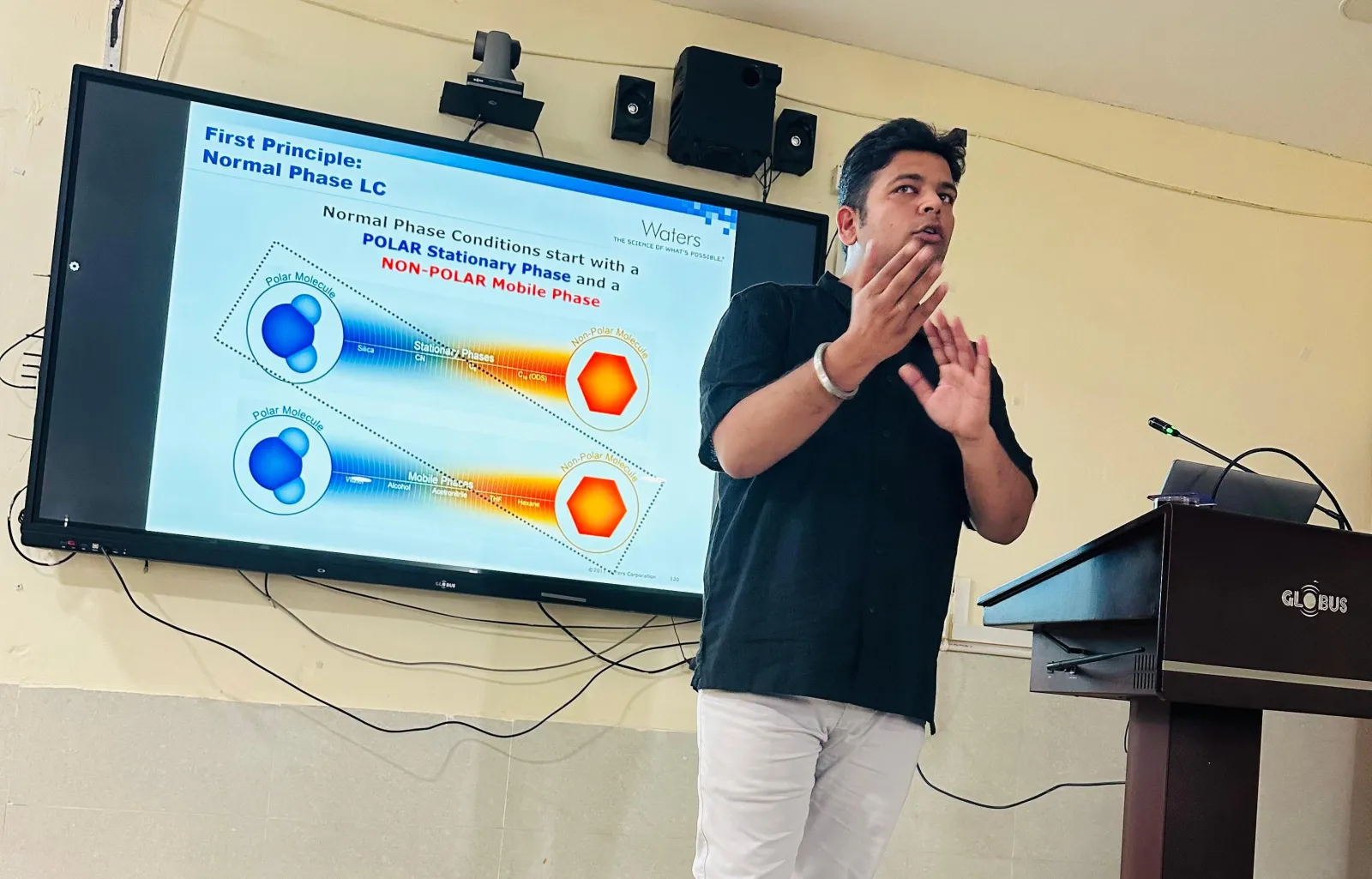
Dr Amit Gupta introduced the invited expert, Mr Navdeep Sharma, Application Specialist, Waters India Pvt. Ltd., who delivered an expert lecture on High-Performance Liquid Chromatography (HPLC). The lecture provided participants with an overview of the principles, instrumentation and diverse applications of HPLC in biological, biochemical and biomedical research.The technical lecture was followed by an extensive hands-on demonstration of the HPLC system, enabling participants to gain practical exposure to instrument operation, chromatographic separation, sample analysis and interpretation of chromatographic data.In view of the large number of participants, the hands-on training was organised in two groups to facilitate closer interaction with the expert and provide better access to the instrument. The practical sessions covered the basic principles of HPLC, components of the instrumentation, sample handling, chromatographic separation, method execution and important considerations involved in analysing and interpreting HPLC-generated data.
The workshop was organised by the faculty of the Department of Zoology, University of Jammu. Faculty members present on the occasion included Prof. Pankaj Kumar, Dr Arti Dogra, Dr Parvinder Kumar, Dr Sarbjeet Kour, Dr Ripu Daman Parihar and Dr Shash Pal. Dr Chinmoyee Maharana conducted the proceedings, while Dr Rakesh Kumar Panjaliya coordinated the event.
The second day of the workshop, scheduled for September 3, 2026, will focus on the Automated Karyotyping Workstation. The expert session and hands-on training will be conducted by Dr Sunil Kumar Pollipali, Maulana Azad Medical College (MAMC), New Delhi.
The session will provide participants with practical exposure to chromosome analysis, preparation and interpretation of karyotypes, automated chromosome identification and digital cytogenetic analysis. The training is expected to enhance participants’ understanding of the applications of cytogenetics in human genetics, cancer biology, biomedical diagnostics and related areas of research.
Speaking on the occasion, the organisers observed that the workshop represents an important initiative towards strengthening research capacity, skill development and hands-on scientific training in advanced biological and biomedical technologies. They noted that the participation of more than 100 students, scholars, teachers and researchers from institutions across the region demonstrates the increasing demand for structured practical training in modern analytical and cytogenetic techniques.
The Department of Zoology, University of Jammu, has access to two sophisticated research facilities, High-Performance Liquid Chromatography and the Automated Karyotyping Workstation, established under the DBT-BUILDER Programme. These state-of-the-art facilities significantly strengthen the Department’s capabilities in teaching, research and specialised training and provide opportunities for interdisciplinary and collaborative research in areas such as molecular biology, human genetics, cytogenetics, cancer genetics, biochemistry and biomedical sciences.The availability of such advanced instrumentation is also expected to benefit students and researchers from neighbouring universities, colleges and research institutions by promoting collaborative use of scientific infrastructure and creating opportunities for specialised capacity-building programmes.
The organisers expressed their gratitude to the Department of Biotechnology, Government of India, for supporting the establishment of advanced research infrastructure under the DBT-BUILDER Programme and for enabling the Department of Zoology to organise training and capacity-building initiatives for the wider academic and research community.The two-day workshop will conclude on September 3, 2026, following the expert session and hands-on training on automated karyotyping, interaction with the invited expert and concluding proceedings. (Press Release).