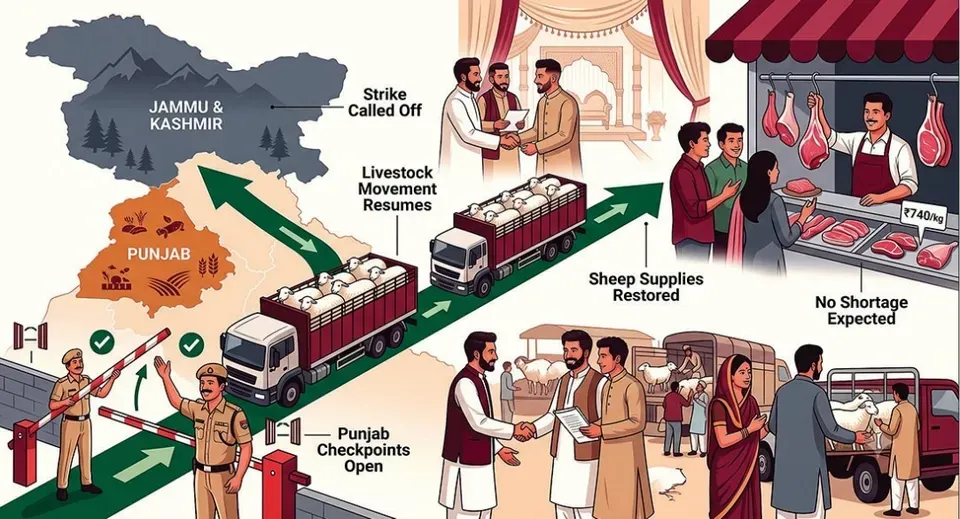
Srinagar, Jul 3: Bringing an end to a week-long disruption in the Valley’s meat supply chain, the Kashmir Mutton Dealers Association (KMDA) on Friday called off its strike after the Punjab government assured that livestock vehicles carrying sheep to Jammu and Kashmir would no longer be stopped at checkpoints. The decision is expected to restore normal supplies of mutton across Kashmir ahead of the peak wedding season, when demand remains at its highest.
The strike had brought the transportation of sheep from Punjab and other northern states to a near standstill, triggering concerns among traders and consumers over a possible shortage of mutton and a sharp rise in prices. Kashmir depends heavily on livestock imported from outside the Union Territory, making uninterrupted movement of livestock essential for maintaining regular supplies.
Announcing the withdrawal of the strike, KMDA General Secretary Mehraj-ud-Din said the association had received assurances that the Punjab government had directed its police not to obstruct livestock vehicles and had also instructed livestock mandis to resume normal trade.
“The strike has been called off. We have been informed that the Punjab Police has been directed not to stop our vehicles at checkpoints. The livestock mandis have also been asked to resume supplies,” he said.
Mehraj-ud-Din, however, said the association would continue to monitor the situation closely and was awaiting formal written orders from the Punjab government before treating the issue as fully resolved.
“We are now waiting for the formal orders. After that, we will see how things move on the ground and whether the directions are implemented in letter and spirit,” he said.
Expressing optimism, he said the movement of livestock into Jammu and Kashmir was expected to normalize over the next few days if the directions issued by the Punjab government were implemented without any hindrance.
The protest had been launched after livestock dealers alleged that sheep-laden vehicles entering or passing through Punjab were being stopped at various checkpoints and subjected to unauthorized collections despite carrying valid documents. The dealers maintained that livestock transportation is exempt from GST and argued that the alleged levy had significantly increased transportation costs, making the trade economically unviable.
The issue soon escalated into a major concern for the Valley’s meat trade, with wholesalers warning that continued disruption in livestock imports could severely impact supplies during the ongoing marriage season. Retailers had also expressed concern over depleting stocks as fresh consignments failed to arrive.
President of the Mutton Retailers Association Kashmir, Khazir Mohammad Rigoo, said the dispute had been resolved after the Punjab authorities revoked the alleged levy imposed on Kashmiri livestock traders.
Rigoo thanked the media, political leaders, trade bodies and members of the coordination committee for extending support to the traders during the agitation. He said fresh supplies had already started moving towards Kashmir and assured consumers that mutton would continue to be sold at the government-approved retail price of Rs 740 per kilogram.
“There will be no shortage of mutton during the ongoing wedding season. Supplies have resumed and consumers will get mutton at the prescribed rate,” Rigoo said.
The issue had also prompted intervention at the highest level of the Jammu and Kashmir government. Chief Minister Omar Abdullah had taken up the matter with his Punjab counterpart, Bhagwant Mann, describing the reported action against Jammu and Kashmir’s livestock traders as “unjustified” and seeking immediate intervention to ensure the unhindered movement of livestock vehicles.
The Chief Minister had also urged the Punjab government to look into the complaints of unauthorised collections from livestock transporters and ensure that legitimate trade was not disrupted. His intervention came after trader bodies warned that the prolonged impasse could adversely affect both consumers and thousands of families dependent on the livestock trade.
The breakthrough has been welcomed by traders across Kashmir, who believe the withdrawal of the strike will restore confidence in the supply chain and stabilize the wholesale and retail meat markets. Fresh consignments of sheep are expected to start reaching the Valley over the coming days, easing concerns over availability during one of the busiest periods for meat consumption.