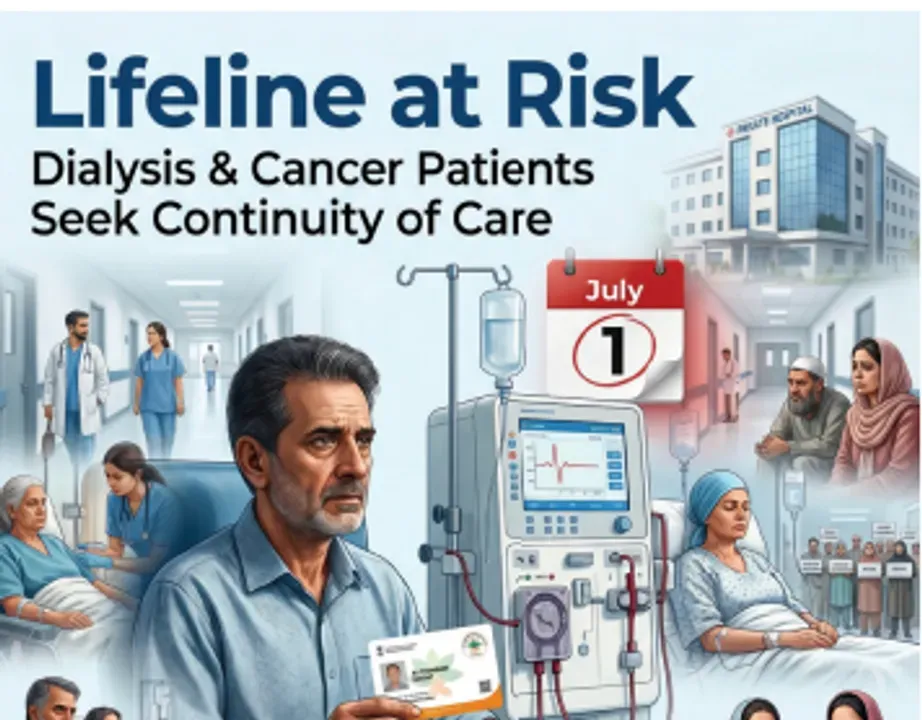
For 52-year-old Abdul Rashid, a kidney patient from Soura, the dialysis machine is more than a medical device—it is what keeps him alive. Three times a week, he travels to a private hospital in Srinagar for treatment under the Ayushman Bharat-SEHAT scheme. Now, with private hospitals threatening to de-empanel themselves from the scheme from July 1 over unpaid dues, Rashid fears his lifeline may soon be cut off.
“I cannot afford dialysis on my own. If the hospital stops providing treatment under SEHAT, I don’t know where I will go. Missing even a few sessions can put my life at risk,” he said.
Rashid is among hundreds of dialysis and cancer patients who have announced a peaceful silent protest at Srinagar’s Press Enclave on June 27, urging the government to intervene and prevent private hospitals from withdrawing from the Ayushman Bharat-SEHAT scheme.
The protest comes in the wake of a decision by the Jammu and Kashmir Private Hospitals and Dialysis Centres Association (JKPHDA) to de-empanel member hospitals, citing non-payment of dues by the State Health Agency (SHA).
For patients battling chronic kidney disease and cancer, the dispute has triggered anxiety and uncertainty.
“My husband has been undergoing chemotherapy for the last eight months. We sold our jewellery before the SEHAT scheme helped us access treatment. If private hospitals stop accepting the card, we simply cannot bear the cost,” said Shabnam Begum, whose husband is receiving cancer treatment in Srinagar.
Patients say government hospitals are already struggling with heavy patient loads and limited infrastructure, making an abrupt shift nearly impossible.
“Dialysis is not something that can wait. We need treatment every week without interruption. Government hospitals do not have enough machines or slots for all of us,” said a patient from Pulwama who requested anonymity.
According to patient groups, thousands of beneficiaries depend on private empanelled hospitals for dialysis, chemotherapy and other specialised treatments. They warn that any disruption could force families into financial distress or jeopardise ongoing treatment cycles.
“Ayushman Bharat-SEHAT has been a lifeline for poor patients. De-empanelment without alternate arrangements is a death sentence for many of us,” a group of patients and attendants said in a joint statement.
The protestors are demanding continuation of cashless treatment services in private hospitals until adequate public-sector capacity is created. They have also sought a time-bound transition plan to ensure that no dialysis or chemotherapy patient's treatment is interrupted midway.
“We are not protesting for politics or money. We are protesting for our right to survive,” said a young cancer patient from south Kashmir. “The government must ensure that patients do not become casualties of an administrative dispute.”
The patients have appealed to Chief Minister Omar Abdullah, Lieutenant Governor Manoj Sinha and the Health Department to immediately release pending payments to hospitals and ensure uninterrupted treatment beyond July 1.
As the deadline approaches, many patients say their greatest fear is not the disease they are fighting, but the possibility of losing access to the treatment that keeps them alive.