Professor R.K. Uppal, [PhD, D.Litt.]
………………………………………………………………………………………………………
A professor earns that title after years of relentless study, research, publications, teaching, and the successful completion of a Ph.D.—a journey that demands immense dedication and sacrifice.
In reputed institutions, professors are primarily valued for their expertise in teaching, research, mentoring, and academic leadership. However, in many private institutions, the role is often reduced far beyond academics. Professors are expected to function as admission officers, tele-callers, administrative assistants, event managers, clerical staff, and, at times, even undertake duties that have little or nothing to do with higher education.
When highly qualified academics are treated as multipurpose employees instead of scholars, it diminishes not only the dignity of the profession but also the quality of education itself. If institutions truly aspire to excellence, they must first learn to respect the people who create it. A Ph.D. is not just another employee—it represents years of intellectual commitment that deserves professional respect and appropriate academic responsibility
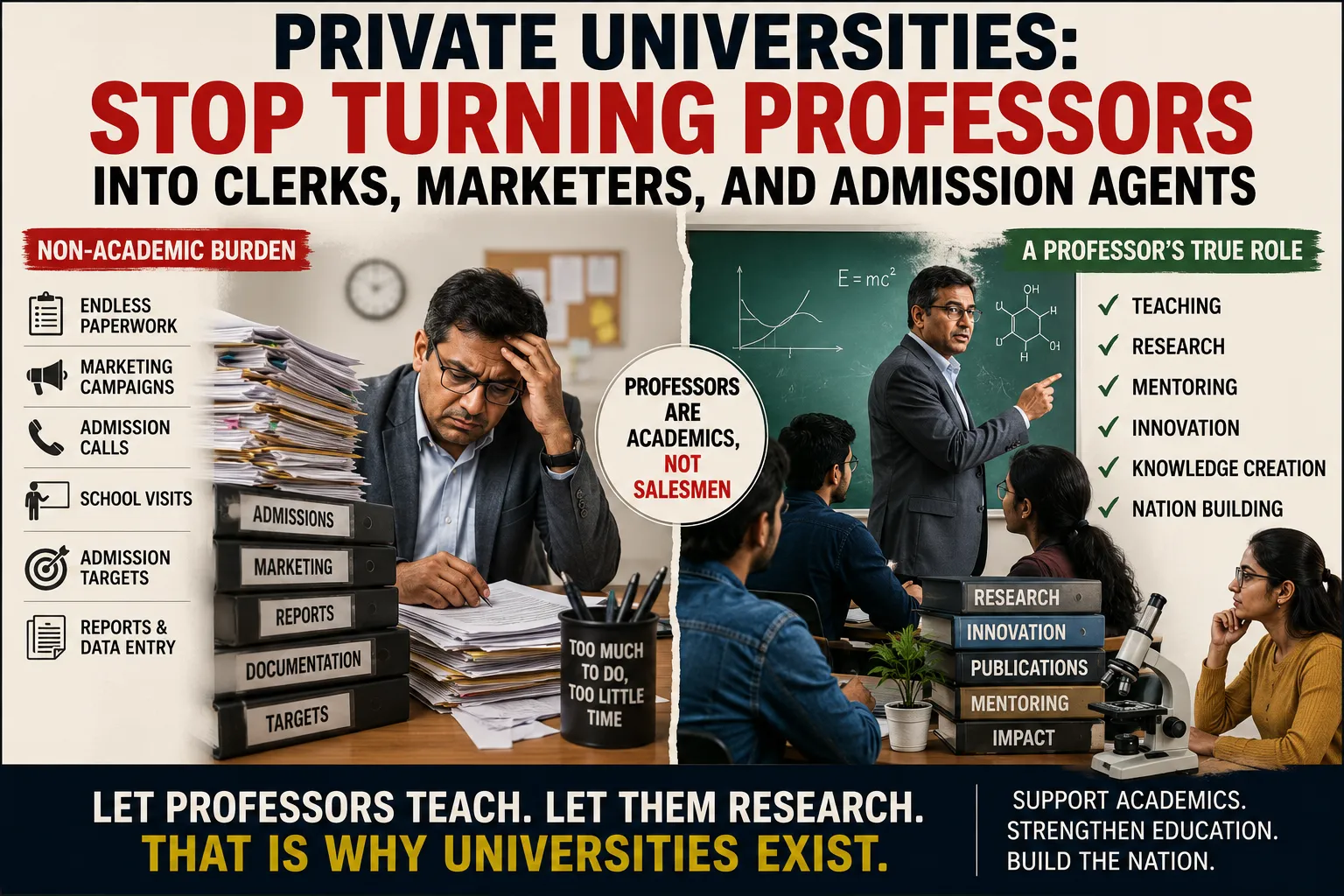
The strength of any university lies in the quality of its professors. A professor is appointed to teach, conduct research, mentor students, develop innovative ideas, and contributes to society through knowledge creation. Unfortunately, in many private universities today, this noble academic role is being overshadowed by commercial priorities. Instead of being recognized as scholars, professors are increasingly expected to perform clerical tasks, marketing activities, and admission-related work that have little to do with their professional expertise.
This growing trend raises an important question: Are universities nurturing academic excellence, or are they treating professors as multi-purpose employees responsible for everything except their core academic mission? Teaching and research are the two pillars of higher education. Students join universities expecting to learn from experienced academicians who inspire critical thinking, promote innovation, and guide them toward successful careers. Research, on the other hand, generates new knowledge, solves real-world problems, and contributes to national development. When professors spend a significant portion of their time preparing admission reports, attending promotional campaigns, making recruitment calls, organizing marketing events, or completing repetitive paperwork, both teaching quality and research productivity inevitably suffer.
Many faculty members today are assigned admission targets, expected to participate in marketing campaigns, visit schools to recruit students, manage social media promotions, and perform numerous administrative tasks. Such responsibilities consume valuable academic time that should be devoted to lesson preparation, student mentoring, laboratory work, curriculum development, writing research papers, securing research grants, and supervising postgraduate and doctoral scholars.
The commercialization of higher education has intensified this problem. In a highly competitive educational market, some institutions prioritize student enrollment and revenue generation above academic quality. As a result, professors are increasingly evaluated not only on their teaching performance and research contributions but also on their ability to attract admissions. This approach fundamentally changes the nature of the academic profession and risks undermining the very purpose of a university.
Students are among the biggest losers in this system. When professors are overburdened with non-academic responsibilities, classroom preparation becomes inadequate, student consultations become limited, research supervision declines, and opportunities for innovation diminish. Students deserve access to knowledgeable, motivated, and academically engaged teachers—not faculty members constantly distracted by administrative deadlines and marketing obligations.
Research also suffers significantly. High-quality research requires uninterrupted time, intellectual freedom, collaboration, and institutional support. Professors who spend much of their working day on non-academic assignments have less opportunity to undertake meaningful research, publish in quality journals, develop patents, collaborate with industry, or contribute to national policy. Institutions that neglect research eventually lose academic credibility, rankings, and their ability to attract talented faculty and students.
Universities certainly require effective administration, student outreach, and admission management. However, these functions should primarily be handled by trained administrative professionals, marketing teams, and admissions offices. Professors can contribute their academic expertise during open houses, orientation sessions, curriculum discussions, and interactions with prospective students, but they should not become the primary workforce for institutional marketing or routine clerical work.
Internationally respected universities maintain a clear distinction between academic and administrative responsibilities. Professors are evaluated primarily on the quality of their teaching, research, publications, innovation, mentorship, and academic leadership. Administrative support systems exist to enable faculty members to focus on scholarship rather than bureaucracy. Such an approach strengthens institutional reputation, enhances student learning, and promotes sustainable academic excellence.
Private universities have played an important role in expanding access to higher education in India. Many have established excellent infrastructure, introduced modern academic programs, and fostered industry collaborations. However, long-term success cannot depend solely on aggressive admissions or marketing strategies. Sustainable growth requires investment in faculty development, research infrastructure, academic freedom, and a learning environment where professors can devote their energies to teaching and knowledge creation.
University governing bodies should therefore review faculty workload policies and ensure that professors are not routinely assigned excessive non-academic responsibilities. Dedicated administrative staff should manage clerical work, admissions, documentation, and promotional activities. Faculty evaluation systems should emphasize teaching effectiveness, research quality, innovation, mentorship, community engagement, and professional development rather than admission figures or marketing performance.
The future of higher education depends on restoring the dignity of the academic profession. Professors are not clerks, sales representatives, or admission agents. They are educators, researchers, mentors, and innovators whose knowledge shapes future generations and drives national progress. When universities allow professors to concentrate on their true academic mission, students receive a better education, research flourishes, institutional reputation improves, and society benefits from a stronger and more vibrant higher education system. Private universities must therefore reaffirm a simple but powerful principle: a professor's primary responsibility is teaching, research, and academic mentorship. Administrative support should enable this mission—not replace it. Only then can higher education fulfill its true purpose of creating knowledge, nurturing talent, and contributing meaningfully to national development.