By Excelsior
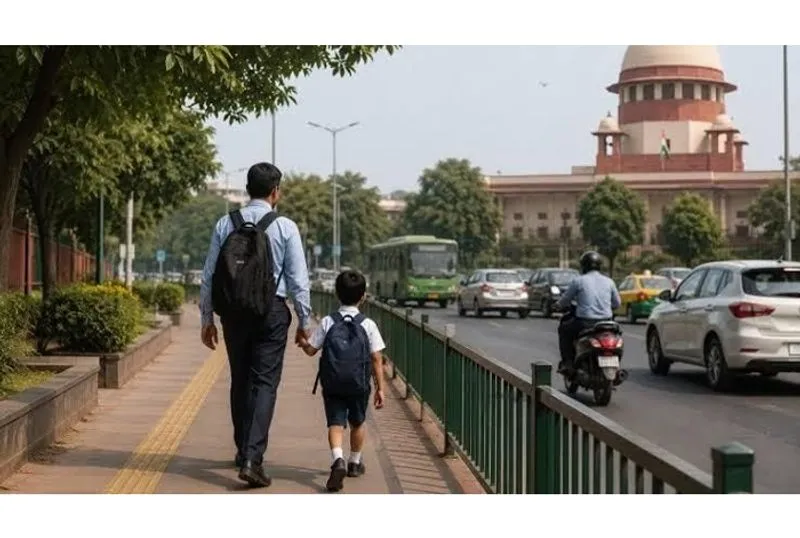
The Supreme Court has done what successive Governments failed to do for decades - it has formally recognised the right to walk as a fundamental right. In a landmark ruling delivered last week, a bench declared that a citizen's right to walk on a demarcated footpath is primary, flowing from Article 19(1)(d) and Article 21 of the Constitution, and shall take precedence over motorised vehicles. The verdict is a legal milestone: safeguarding every pedestrian. Consider the irony: pedestrians constitute the overwhelming majority of road users in India, yet they command the least space and enjoy the least protection. Footpaths, where they exist at all, have long been colonised by shopkeepers who treat them as extensions of their establishments, by hawkers who set up stalls with a brazenness that speaks of complete institutional impunity, and by vehicles parked with contemptuous ease. The result is that the pedestrian - the very person the footpath was built for - is pushed onto roads choked with traffic, where the odds of a fatal encounter are unconscionably high.
The Court itself observed that it is rather strange how little attention has been paid to securing this most basic of rights. One need not look far for the answer. It is, as the bench aptly noted, a matter of entrenched elitism - roads were historically designed around those who could afford wheels, and that hierarchy has never been meaningfully challenged. The encroacher on the footpath has, in practice, enjoyed more rights than the pedestrian who owns it.
This absurdity is particularly visible in Jammu, Srinagar and every city where the Jammu & Kashmir and Ladakh High Court has already directed the JMC to clear the clutter from Old Jammu City. Yet the footpaths remain encumbered. The directive, like so many before it, has been absorbed into the bureaucratic silence that greets inconvenient court orders. Crores of rupees have been spent under the Smart Cities Mission constructing footpaths, only to see them surrender to encroachment within months.
The SC has now removed any ambiguity: the duty to demarcate, construct, maintain, and safeguard footpaths rests squarely with urban development authorities, municipal corporations, and local bodies. Citizens may now seek constitutional remedies, not merely motor accident claims, when this right is violated. It is now incumbent upon citizens-resident welfare associations, civil society groups, and ordinary walkers-to hold local authorities accountable wherever footpaths remain blocked.