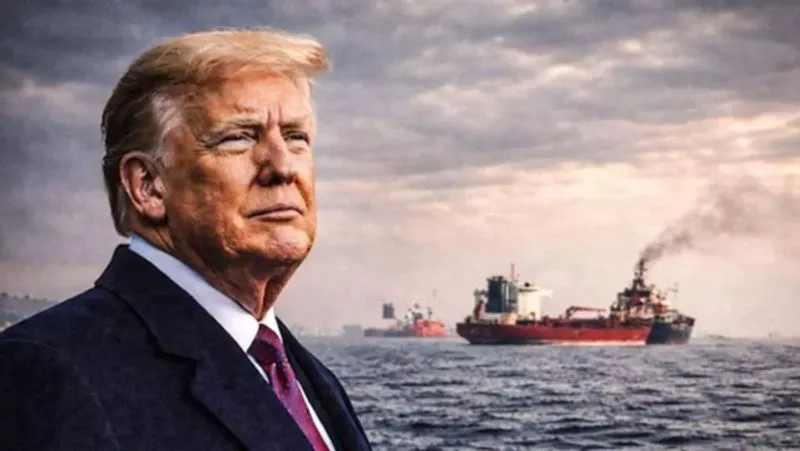
WASHINGTON, Jun 15 : US President Donald Trump said on Monday that commercial shipping was beginning to move through the Strait of Hormuz, following reports that a preliminary agreement between Washington and Tehran had been digitally signed.
"Ships are starting to move, many loaded up with Oil, out of the Strait of Hormuz," Trump wrote on Truth Social.
"They are going along the Southern 'Highway,' which is totally safe, secure, and pristine. There are other areas of travel, also!!!"
His comments came after Vice President JD Vance said the US and Iran had already signed the agreement electronically.
"We already signed the deal digitally yesterday," Vance said during an interview on Good Morning America.
However, uncertainty remains over when normal shipping operations will fully resume.
Vance said discussions on the long-term status of the Strait of Hormuz, including Trump's proposal for permanently toll-free passage, would continue during upcoming technical negotiations.
Simultaneously, semi-official Iranian news outlets affiliated to Iran's IRGC reported that Tehran would permit free transit during the 60-day negotiation period, but afterwards intends to introduce transit fees.
The agreement is still expected to be formally signed in Switzerland on Friday.
Despite the diplomatic progress, major shipping organisations have warned that traversing the strait remains a very risky prospect.
Jakob Larsen, head of safety and security at BIMCO, one of the world's largest shipping associations, said naval mines deployed during the war remain a serious concern.
"Detecting and destroying deployed naval mines require highly specialised naval capabilities," Larsen told CNN, warning that cleared routes could be mined again relatively quickly.
He said the industry requires much clearer guidance from both Washington and Tehran regarding shipping routes, transit procedures and security arrangements before confidence can be restored.
"The best the industry can hope for is a joint announcement from US and Iran backed up by clarification on practical points such as which route to use, the leaving sequence of ships, timings, nature of coordination with navies, and contingency planning," he said.
Iran's extensive mining of the strait has left only narrow transit corridors available, creating the potential for significant congestion even if shipping resumes.
Larsen calling the current security situation as "volatile" said that existing public statements from both sides did not provide sufficient operational detail for shipowners.
Meanwhile, French President Emmanuel Macron said France and the UK were prepared to lead an international mission for securing navigation through the vital waterway.
Speaking to French broadcaster TF1, Macron said France could deploy fighter aircraft, a frigate, mine-clearing assets and the aircraft carrier Charles de Gaulle within days if conditions permit.
"If the next few days show us that it's good," Macron said, referring to the agreement, "we will deploy ourselves with the British. We will lead this mission."
(UNI)