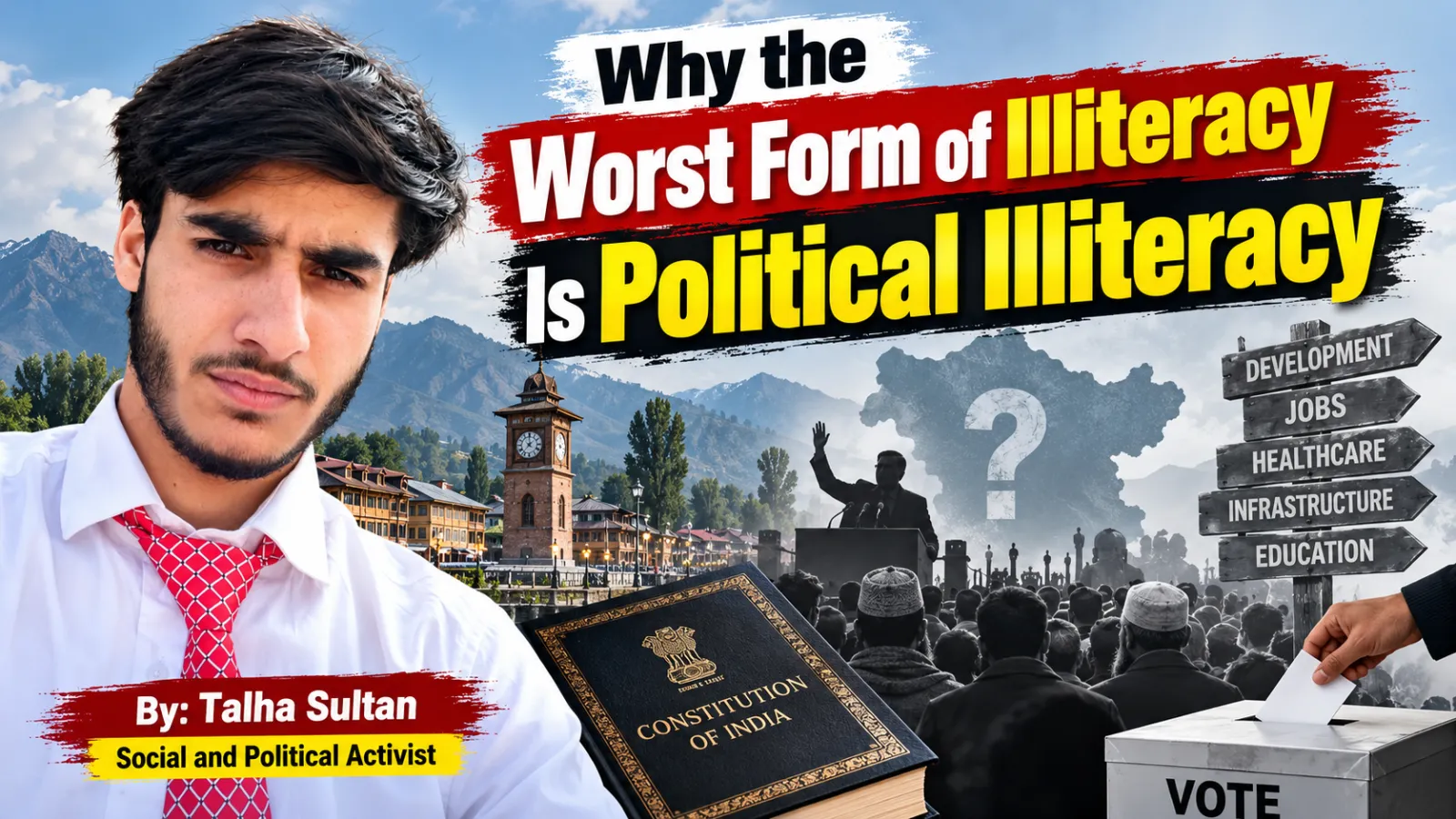
Why the Worst Form of Illiteracy Is Political Illiteracy
By:Talha Sultan
Social and Political Activist.
Since Partition, Kashmir has rarely experienced a period without one problem or another. Every few years, a new issue emerges, taking people in different directions and shifting their attention from one concern to another. While our literacy rate has improved significantly over the years, this progress has not been equally reflected in our political understanding.
Our political environment has largely remained ideology-based rather than focused on citizens’ rights, duties, and the constitutional framework. One of the major reasons behind this has been political instability, which our politicians have often used to their advantage.
Whether it is mainstream parties such as the NC, PDP, and JKPC, or separatist organisations such as the Hurriyat and JKLF, political narratives have largely revolved around ideology. Our votes should also be influenced by development, public services, and the performance of our representatives. However, our attention has often been directed towards ideological differences instead.
The consequences of this approach are visible around us. From shortcomings in the healthcare sector to inadequate infrastructure and basic public facilities, many concerns remain unresolved. Even today, many people are not fully aware of the rights guaranteed to them by the Constitution. Our political attention often remains focused on politicians who share our ideologies, and we have frequently voted such leaders into power without giving equal importance to their performance and accountability.
The lack of industrial development and private-sector employment opportunities has also remained a major concern in Kashmir. Article 370 was often presented as an obstacle to Kashmir’s development. However, its removal has not, by itself, resolved the wider concerns surrounding development and employment.
Article 370 and Statehood have also become powerful campaign slogans for mainstream politicians and political parties. They are repeatedly brought up in speeches, promises, and election campaigns. But the real question is: What has actually changed in the lives of ordinary Kashmiris?
When we had Article 370 and Statehood, our situation was still far from ideal. And today, after losing them, many of our fundamental concerns remain unanswered. The circumstances may have changed, but the struggle for basic justice continues.
So, a question must be asked: If we are fighting to restore what we lost, what guarantee do we have that its restoration will finally deliver the justice we have been waiting for?
Are Article 370 and Statehood the ultimate destination of our struggle, or are they supposed to be the means through which we secure our rights, dignity, and justice?
The people of Kashmir deserve more than emotional speeches, political slogans, and promises repeated during elections. They deserve accountability. They deserve answers. Above all, they deserve basic justice—not just promises of a better tomorrow.
Because the real tragedy is not only that we lost something, but that even when we had it, so many of our fundamental concerns remained unresolved.
This brings us to another important question: why have our political representatives rarely faced sufficient public scrutiny for their performance in overall development? Political illiteracy is clearly visible in election campaigns, where political parties often build their manifestos around the very ideological concerns that dominate public discussion. Instead of encouraging voters to examine their records, policies, and achievements, these campaigns frequently return to familiar narratives.
Even today, our political representatives often defend their limitations by pointing towards the Central Government and arguing that the conversion of Jammu and Kashmir into a Union Territory restricts their ability to function freely. These limitations and the distribution of powers between the Centre and the elected government deserve serious discussion. However, they should not become a reason for the public to stop asking questions about performance, responsibility, and accountability.
At the same time, we cannot place the entire blame on politicians. To a considerable extent, we Kashmiris must also examine our own role. Our limited interest in understanding the political system and our lack of confidence in democracy as a means of addressing public issues have contributed to this situation.
A healthy political environment cannot develop without public participation. When citizens remain distant from political processes, avoid meaningful discussions, or believe that their participation cannot bring change, political awareness suffers. As a result, political literacy remains limited, despite improvements in general education.
Even today, when we begin a political discussion with an ordinary Kashmiri, the conversation often turns towards ideological issues. There is comparatively less focus on understanding constitutional provisions, the responsibilities of elected representatives, public policies, and the practical functioning of democratic institutions.
The limited involvement of scholars in political discussions, along with the lack of meaningful debate within educational institutions, has also contributed to this gap. Educational institutions should not merely prepare students for examinations and careers; they should also help them understand the society in which they live and the political system that affects their lives.
To rebuild public trust in elected governments, the involvement of educated individuals and those who genuinely care about public welfare is essential. People who are sincere towards society and willing to engage beyond ideological divisions can contribute to a more informed political environment.
Our young people often criticise lawmakers and question their decisions. Criticism is necessary in a democracy, but criticism alone is not enough. We must also understand how the system works, participate in democratic processes, and contribute towards improving it. If we consider participation itself pointless or undesirable, how can we expect meaningful change?
One practical way to improve political literacy is to introduce discussions and debates at the school level. Students could be encouraged to discuss public issues, understand constitutional rights and duties, and learn how democratic institutions function.
Schools could also organise role-play activities in which students represent different political personalities or public representatives. Such activities could help them understand different viewpoints, develop an interest in politics, and learn the importance of respectful disagreement and informed decision-making.
The purpose should not be to encourage students to support a particular party or ideology. Instead, it should be to help them ask questions, examine arguments, understand their rights, and make decisions based on knowledge rather than emotion alone.
Ultimately, political literacy is not simply about knowing the names of political leaders, remembering historical events, or supporting a particular ideology. It is about understanding the relationship between citizens and the state, knowing our rights and duties, questioning those in power, and recognising our own responsibility in a democracy.
Kashmir has witnessed significant political changes throughout its history, but political change alone cannot guarantee social progress. For meaningful development, citizens must also develop the ability to evaluate political promises, understand constitutional principles, and hold their representatives accountable.
Perhaps the greatest challenge before Kashmir today is not merely political instability, but the gap between general education and political understanding. Until we begin to bridge that gap, our political discussions may continue to revolve around familiar slogans while many of our basic concerns remain unanswered.
Because being educated and being politically literate are not the same thing. And unless we understand the difference, we may continue to know how to read and write without fully understanding the system that governs our lives.
Email:
abutalhah120@gmail.com
Ph:+91 9622099905