Srinagar, Jun 7: Jammu and Kashmir is producing thousands of graduates every year, but a significant proportion of them are struggling to find suitable employment, exposing a widening disconnect between educational attainment and workforce participation.
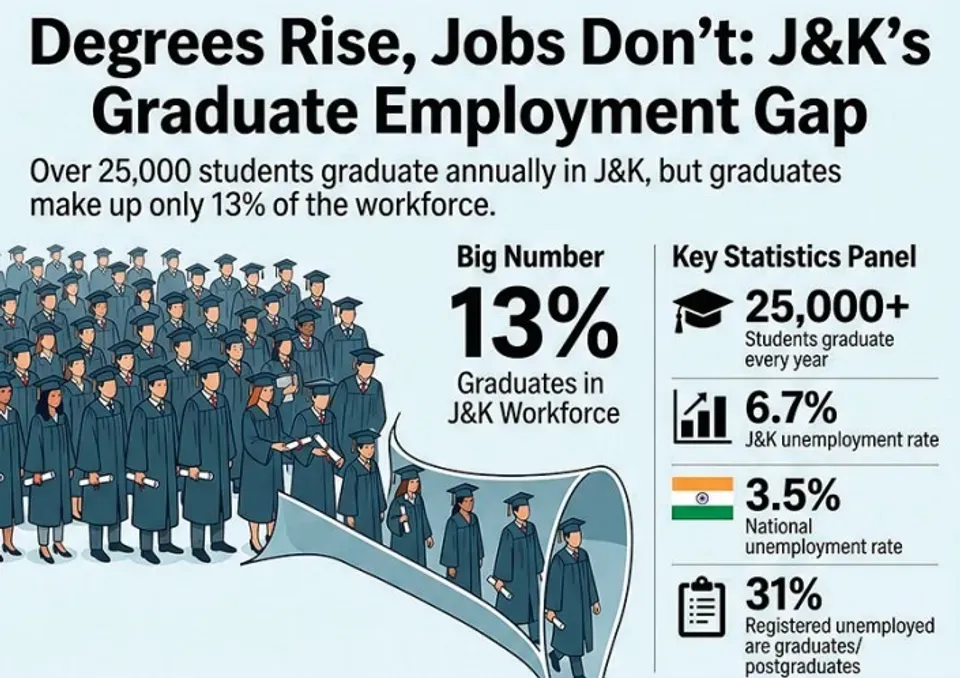
According to the Periodic Labour Force Survey (PLFS) 2023-24, graduates constitute only 13 per cent of J&K’s workforce, underscoring the challenges faced by educated youth in securing gainful employment.
The figures come at a time when the Union Territory’s unemployment rate stands at 6.7 per cent, nearly double the national average of 3.5 per cent. While unemployment affects all sections of society, its impact is particularly pronounced among educated young people.
Data insights recently shared by DataForIndia show that the low representation of graduates in the workforce is part of a broader national trend. However, experts say the problem is more acute in Jammu and Kashmir due to limited industrialisation, a small organised private sector and persistent mismatches between educational qualifications and market requirements.
Official data shows that more than 25,000 students graduate annually from colleges and universities across J&K. Thousands more complete postgraduate, professional and technical courses each year. Yet the modest 13 per cent share of graduates in the workforce suggests that many degree holders are either unemployed, underemployed or engaged in jobs that do not require higher education qualifications.
The challenge of creating employment opportunities has become increasingly critical as the number of educated youth entering the job market continues to rise.
The PLFS data also reveals that between 58 and 67 per cent of workers in J&K are self-employed, largely engaged in agriculture, family-run enterprises, small retail establishments and services. The dominance of self-employment reflects the limited availability of formal salaried jobs in the economy.
Nationally, around 57 per cent of graduate workers are employed in salaried positions, compared to only 6 per cent among illiterate workers. Although similar disaggregated data is not available for J&K, official records indicate that nearly 31 per cent of the Union Territory’s registered unemployed are graduates and postgraduates.
The employment challenge is even more severe for women. According to survey estimates, unemployment among women in the 15-29 age group ranges between 46 and 53 per cent in J&K. Many educated women remain outside formal employment and are engaged in unpaid family work or subsistence self-employment due to limited opportunities and social constraints.
Female unemployment in urban areas is estimated between 20 and 28 per cent, substantially higher than the male unemployment rate of 4.6 per cent.
Sector-wise employment patterns further highlight the structural challenges facing the economy. Agriculture continues to employ more than 80 per cent of rural workers, while construction accounts for around 23 per cent of employment across rural and urban areas. Manufacturing, a key driver of quality jobs in many economies, employs less than 7 per cent of J&K’s youth.
The organised private sector remains particularly weak, accounting for less than 3 per cent of total employment, limiting opportunities for skilled and educated workers.
The pressure on government employment remains intense as a result. Last week, the Jammu and Kashmir Government informed the Legislative Assembly that around 77,000 gazetted and non-gazetted posts are lying vacant across departments.
Of these, 6,409 are gazetted posts, 24,451 fall in the non-gazetted category, while 5,573 Multi-Tasking Staff (MTS) posts are under the promotion quota. The government has stated that the vacancies will be filled in a time-bound manner.
Economists say the figures highlight the urgent need for faster industrial growth, greater private investment and stronger alignment between education and market requirements. Without significant expansion in employment-generating sectors, they warn, the gap between rising educational attainment and workforce absorption is likely to widen further in the coming years.