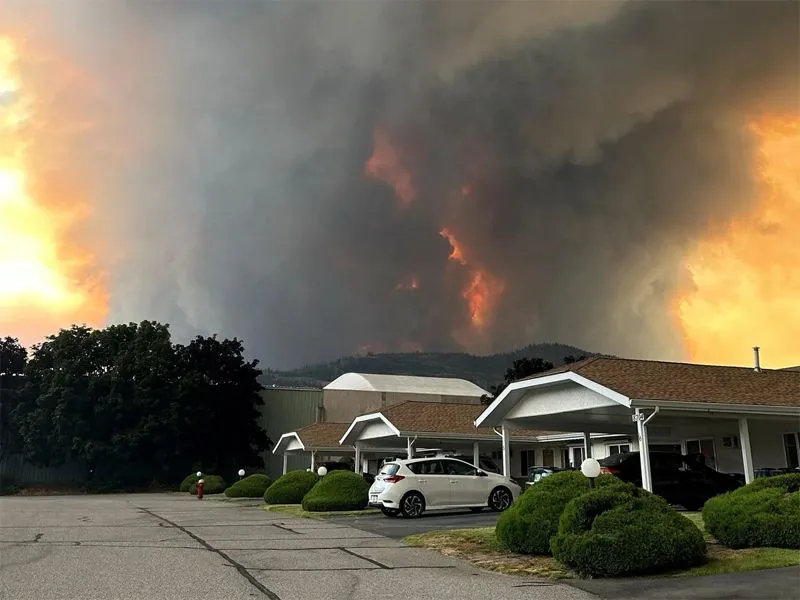
OTTAWA, Aug 9 : British Columbia today declared a province-wide state of emergency as fast-moving wildfires tore through parts of western Canada, destroying homes and forcing nearly 22,000 people to evacuate, with authorities warning that hot, dry and windy conditions could trigger further rapid growth.
Premier David Eby announced the emergency on Saturday as 105 wildfires burned across the province, including 70 that started over the past week. About 70 of the fires were considered out of control, officials said.
The Bald Range wildfire, which has triggered the largest evacuation event in British Columbia this summer, has spread rapidly across the Okanagan region, prompting evacuation orders for entire communities. The fire was first detected at about 5:30 p.m. local time on Friday and grew to 50 square kilometres within three hours. It nearly doubled in size overnight and had burned more than 103 square kilometres by Saturday afternoon, according to the BC Wildfire Service.
The blaze is burning across the Summerland, Peachland and surrounding districts. Summerland, with a population of about 12,000, ordered all residents to evacuate as the fire advanced rapidly towards the community. Peachland has about 6,500 residents, according to the 2021 census.
More than 20,000 people had already fled their homes across British Columbia, while the number under evacuation orders had risen to nearly 22,000 by Saturday afternoon. Another roughly 9,700 people were on alert and told to be prepared to leave at short notice.
Eby urged residents under evacuation orders to leave immediately, warning that the fires were moving "incredibly quickly."
At a news conference, Eby said a fire official had compared the Bald Range blaze to "a bomb going off". He said the intensity of the flames had been so extreme that the fire was creating its own weather systems, including lightning, further complicating firefighting efforts.
Dozens of people have been rescued by aircraft as crews battled to contain the fires. Thousands of residents fled through congested roads as authorities warned that "explosive" fire conditions could threaten additional communities.
The state of emergency gives the provincial government access to special powers, including imposing travel restrictions, protecting supplies and taking measures to prevent price gouging. It also allows authorities to mobilise additional resources and coordinate emergency and rescue operations.
The fires have also created a major challenge for residents trying to evacuate livestock, particularly horses, in the Okanagan region. Canadian broadcaster CBC reported that some owners who were unable to relocate their animals left gates open in the hope that the horses would find their own way to safety. Some residents also painted identifying markings on their animals so they could be recognised later, CBC reported.
British Columbia is among several parts of Canada to have experienced a severe wildfire season this summer. Hundreds of fires have burned across the country, including nearly 200 in Ontario in July, when smoke pushed air quality in Toronto to among the worst levels in the world for several days.
Smoke from Canadian wildfires has also drifted into parts of the United States, including Minnesota and New York, prompting US President Donald Trump to threaten new tariffs on Canada, the country's northern neighbour. (UNI)