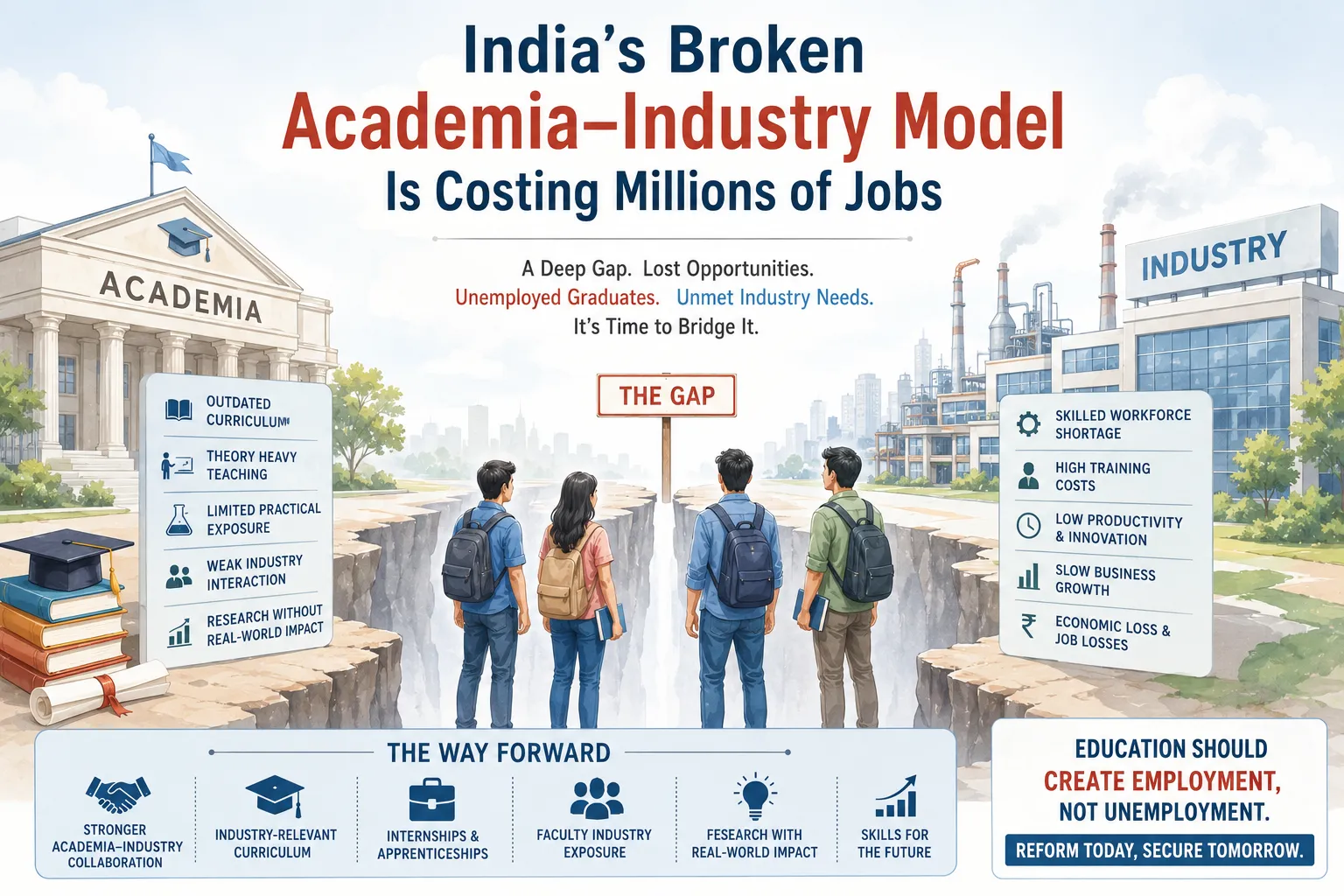
Broken Academia–Industry Integration Is Killing Innovation and Employability.
Prof. R.K. Uppal. [PhD, D.Litt.]
……………………………………………………………………………………………….
India aspires to become a global knowledge economy and a developed nation by 2047. It has one of the world's largest youth populations, thousands of higher educational institutions, and a rapidly growing industrial sector. Yet, despite these strengths, a serious structural weakness continues to undermine the country's economic ambitions—the broken integration between academia and industry. Universities continue to produce millions of graduates every year, while employers struggle to find candidates with the knowledge, skills, and practical experience required in today's workplace. This widening gap is not only hurting graduate employability but also weakening India's innovation ecosystem.
The purpose of higher education extends far beyond awarding degrees. Universities are expected to create knowledge, develop skilled professionals, promote research, and contribute to national development. Industries, on the other hand, require a workforce that can solve real-world problems, adapt to technological changes, and drive productivity. When these two pillars operate independently instead of collaboratively, the result is predictable: graduates remain unemployed or underemployed, industries face talent shortages, and innovation suffers.
One of the primary reasons for this disconnect is the outdated nature of many academic curricula. While industries are embracing Artificial Intelligence, robotics, data analytics, cybersecurity, automation, renewable energy, and digital technologies, numerous colleges continue to teach programs that have changed little over the years. Students often graduate with strong theoretical knowledge but limited practical exposure. Employers are therefore forced to spend additional time and resources retraining new recruits before they become productive.
The lack of meaningful industry participation in curriculum design further aggravates the problem. In many institutions, syllabi are revised infrequently and without adequate consultation with employers. As a result, students acquire qualifications that do not fully match current labour market requirements. The emphasis should shift from simply completing courses to developing competencies that industries genuinely value.
Internships, apprenticeships, and live industry projects are among the most effective ways of preparing students for professional careers. Unfortunately, these opportunities remain inadequate in many institutions. In some cases, internships exist merely to fulfil academic requirements rather than providing genuine workplace learning. Every student should graduate with substantial practical experience, enabling a smooth transition from classroom learning to professional employment.
Faculty members also need stronger engagement with industry. Many talented teachers spend their entire careers within academic institutions without exposure to changing industrial practices. Continuous interaction with businesses through consultancy, industrial training, collaborative research, and faculty exchange programs can significantly enrich classroom teaching. Teachers who understand contemporary industry challenges are better equipped to prepare students for future careers.
Research represents another area where academia–industry collaboration remains weak. Indian universities publish thousands of research papers annually, yet relatively few result in commercial technologies, innovative products, patents, or successful start-ups. Research often remains confined to journals instead of addressing pressing industrial and societal problems. Industries seek practical solutions that improve productivity, reduce costs, and enhance competitiveness. Universities should therefore encourage problem-oriented research with measurable economic and social impact.
Innovation thrives when universities and industries work together. Globally, many of the most significant technological breakthroughs have emerged from close partnerships between researchers and businesses. Collaborative innovation ecosystems encourage knowledge transfer, technology commercialization, and entrepreneurship. India's higher education institutions must become centers of innovation rather than merely examination and degree-awarding bodies.
The consequences of poor academia–industry integration extend beyond employment statistics. A nation that fails to align education with economic needs cannot fully utilize its demographic dividend. Every unemployed graduate represents lost productivity, reduced consumer spending, lower tax revenues, and slower economic growth. At the same time, industries facing skill shortages may delay expansion, reduce investment, or relocate operations to regions where qualified talent is more readily available.
The National Education Policy (NEP) 2020 recognizes the importance of multidisciplinary education, vocational training, internships, and stronger industry linkages. These reforms have the potential to improve employability and innovation. However, successful implementation requires commitment from universities, regulatory bodies, industries, and governments. Policy declarations alone cannot bridge the gap without measurable institutional action.
Industries also have a crucial role to play. Employers should actively participate in curriculum development, establish Centers of Excellence, sponsor research laboratories, provide internships, mentor students, and support faculty development programs. Instead of viewing universities merely as suppliers of graduates, industries should treat them as long-term strategic partners in innovation and workforce development.
Entrepreneurship education deserves equal attention. Not every graduate will secure salaried employment, nor should that be the only measure of educational success. Universities should cultivate entrepreneurial thinking by establishing incubation centers, innovation labs, business accelerators, and start-up support systems. Industry mentors and investors can help transform student ideas into commercially viable enterprises that generate employment for others.
International experience offers valuable lessons. Countries such as Germany, South Korea, Singapore, and Finland have successfully integrated education with industrial development through structured apprenticeships, dual education systems, collaborative research, and continuous curriculum modernization. These models demonstrate that sustained cooperation between academia and industry strengthens both economic competitiveness and workforce quality.
Digital technology also provides new opportunities to strengthen collaboration. Virtual internships, online certification programmes, joint digital laboratories, AI-enabled learning platforms, and remote industry mentoring can connect students with professionals regardless of geographical barriers. Educational institutions should embrace these innovations to ensure that graduates remain relevant in an increasingly digital economy.
Ultimately, higher education should be judged not by the number of degrees awarded but by the value it creates for students, industries, and society. Graduate employability, research commercialization, start-up creation, patent generation, and industrial partnerships should become key indicators of institutional performance. Universities that produce job creators, innovators, and skilled professionals contribute far more to national development than those focused solely on enrolment and examination results.
India cannot become a global innovation leader while academia and industry continue to function in separate worlds. The bridge between classrooms and workplaces must be rebuilt through dynamic curricula, practical training, collaborative research, faculty development, entrepreneurial ecosystems, and sustained industry engagement. A strong academia–industry partnership will produce graduates who are not only employable but also capable of driving innovation, productivity, and economic growth.
The future of India's workforce depends on what students learn today and how effectively that learning addresses tomorrow's challenges. Broken academia–industry integration is indeed killing innovation and employability. Repairing this relationship is no longer an educational reform—it is an economic necessity. If India is serious about becoming a global knowledge and manufacturing powerhouse, it must ensure that its universities and industries work together as equal partners in building a skilled, innovative, and future-ready nation.