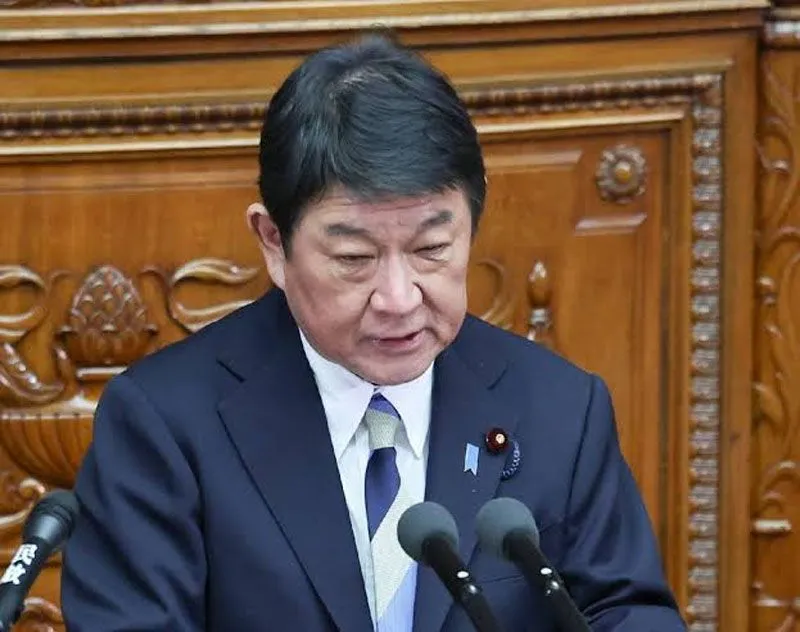
BEIJING, July 12 : China on Sunday strongly criticised Japanese Foreign Minister Toshimitsu Motegi's remarks marking the 10th anniversary of the 2016 South China Sea arbitral award, saying Japan had no right to comment on China's territorial sovereignty and maritime claims in the region.
China's Foreign Ministry spokesperson said Beijing "strongly deplores and firmly opposes" Japan's statement, accusing Tokyo of endorsing what it called an "illegal" arbitration award and of "attacking China's lawful claims and mischaracterizing Japan as a legitimate stakeholder" in the South China Sea.
"Japan is not a party in the South China Sea and is in no position to pass judgment on China's territorial sovereignty and maritime rights and interests in the South China Sea," the spokesperson said.
Pointing to Japan's historical actions during World War II, China alleged that Tokyo had committed 'innumerable crimes' against China, including the "illegal occupation of islands and reefs in the South China Sea."
Now decades later, Japan, in the name of a "stakeholder," is again attempting to meddle in the South China Sea. Beijing said Japan's recent involvement in regional maritime issues raised concerns over what it described as a "neo-militarism agenda."
The ministry reiterated China's position that its sovereignty over the Nanhai Zhudao, or South China Sea islands, and related maritime rights were "established in the long course of history" and were "solidly grounded in the law." "China's activities in the South China Sea are fully legitimate, lawful and beyond reproach," the spokesperson said, adding that China's rights "can by no means be denied by the makeshift arbitral tribunal."
China said it does not accept or recognise the 2016 ruling, arguing that the tribunal exceeded its authority and that the award was "illegal, null and void, and has no binding force."
The ministry accused Japan of double standards by supporting the arbitration ruling while maintaining its own maritime claims. It pointed to the tribunal's finding on Taiping Dao in the Nansha Qundao, also known as Itu Aba in the Spratly Islands, saying the feature was not recognised as an island capable of generating an exclusive economic zone (EEZ). "If that could stand, how could Okinotori - nothing more than two tiny rocks of less than 10 square metres in the Pacific - possibly justify a claim to an EEZ and continental shelf of hundreds of thousands of square kilometres " the spokesperson said.
China argued that Japan's support for the award meant Tokyo had accepted the same standard and should reconsider its own maritime claims. The ministry further accused Japan of using the South China Sea issue to interfere in regional affairs, alleging that Tokyo had increased cooperation with the Philippines and expanded weapons exports.
"What Japan really cares about is not the international rule of law, but meddling in and destabilising the South China Sea," the spokesperson said. China also criticised Japan's overseas military activities, saying they went beyond self-defence and challenged the post-war international order. "
"We urge Japan to stop smearing China, stop sowing disinformation in the South China Sea, and stop undermining peace and stability in the region," the statement said.
"China will continue firmly defending its territorial sovereignty and maritime rights and interests in the South China Sea," the spokesperson said, warning that any attempts to challenge China's claims or disrupt regional stability were "doomed to fail." (UNI)