Correspondent
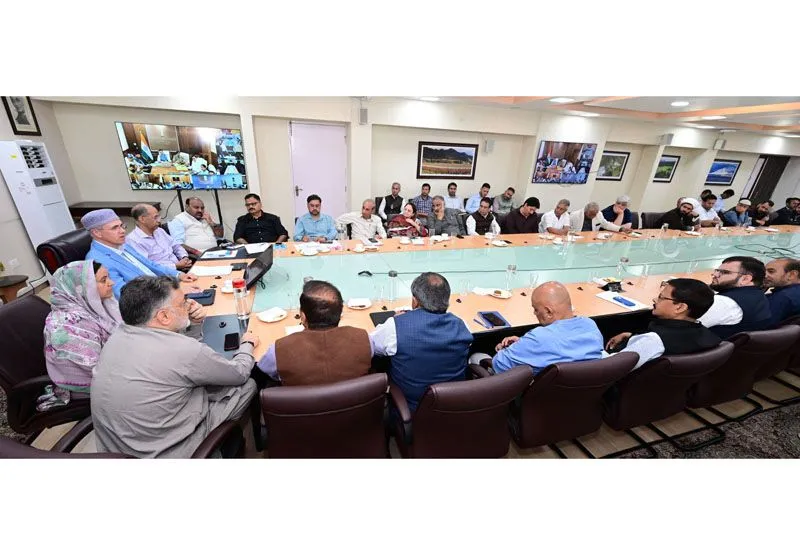
SRINAGAR, June 15: Chief Minister Omar Abdullah today chaired a high-level meeting to review the arrangements being put in place for the smooth observance of Muharram-2026 across Jammu and Kashmir.
The meeting was attended by Deputy Chief Minister Surinder Kumar Choudhary; Ministers Sakeena Itoo, Javed Rana and Javid Ahmad Dar, Advisor to the Chief Minister Nasir Aslam Wani; Members of Legislative Assembly Tanvir Sadiq (Zadibal), Ali Mohammad Dar (Chadoora), Aga Muntazir Mehdi (Budgam), Dr Shafi Ahmad Wani (Beerwah), Javed Reyaz Bedar (Pattan), Hilal Akbar Lone (Sonawari), Shamima Firdous (Habba Kadal) and Salman Sagar (Hazratbal).
President of All J&K Shia Association Imran Raza Ansari, representatives of various Shia organizations, clerics, civil society members and community leaders also participated in the meeting.
Additional Chief Secretary to the Chief Minister Dheeraj Gupta, Additional Chief Secretary, Power Development Department, Ashwini Kumar, Additional Chief Secretary Tourism, Ashish Chandra Verma, administrative secretaries, both the Divisional Commissioners, all Deputy Commissioners, heads of departments and other senior officers were also present. Officers from outside Srinagar attended the meeting through virtual mode.
Addressing the meeting, the Chief Minister emphasized that preparations for Muharram had been underway for considerable time and that today's meeting was aimed at reviewing the progress made so far and identifying any remaining gaps.
The Chief Minister noted that Deputy Commissioners, community representatives, elected representatives and departmental officers had already held extensive consultations at the grassroots level. He said the Government was committed to ensuring that all arrangements are put in place in a coordinated and efficient manner.
"Like every year, the Government will make every possible effort to ensure that there are no shortcomings and that all necessary facilities are provided to the people during Muharram," he added.
Referring to concerns raised by public representatives and community leaders, the Chief Minister directed the Power Development Department to ensure regular electricity supply at all major congregation venues and procession routes.
He stressed the need for adequate backup arrangements, including generators, battery-inverter systems. He also directed that generators be deployed at major congregation points to prevent any disruption in power supply.
Reviewing drinking water arrangements, the Chief Minister directed the Jal Shakti Department to ensure uninterrupted supply of potable water in all affected areas. He emphasized that water tankers deployed during Muharram must provide clean drinking water and that static water distribution points should be established wherever movement of tankers may be difficult or where large gatherings are expected.
On health preparedness, the Chief Minister directed the Health and Medical Education Department to ensure the deployment of adequate medical personnel, ambulances, critical care ambulances, emergency response teams and medical camps at strategic locations.
The Chief Minister also reviewed traffic management plans and instructed the Traffic Police and Civil Administration to ensure smooth movement of processions while minimizing inconvenience to commuters, tourists and the general public. He called for coordinated planning and effective deployment of traffic personnel at critical junctions and congregation points.
Reviewing road infrastructure, the Chief Minister directed the Roads & Buildings Department to undertake necessary repairs and filling of potholes along procession routes and areas expected to witness large gatherings.
To strengthen monitoring and coordination, Omar Abdullah announced that a Chief Minister's Secretariat shall also oversee Muharram arrangements. He said designated officers would continuously monitor the implementation of departmental responsibilities and review complaints received from the public.
Earlier, several legislators, representatives of Shia organizations, clerics, civil society members and community leaders highlighted issues relating to electricity supply, drinking water, road connectivity, sanitation, healthcare facilities and other public services.
During the meeting, the Divisional Commissioners of Kashmir and Jammu gave detailed presentations on the arrangements being made in their respective divisions.