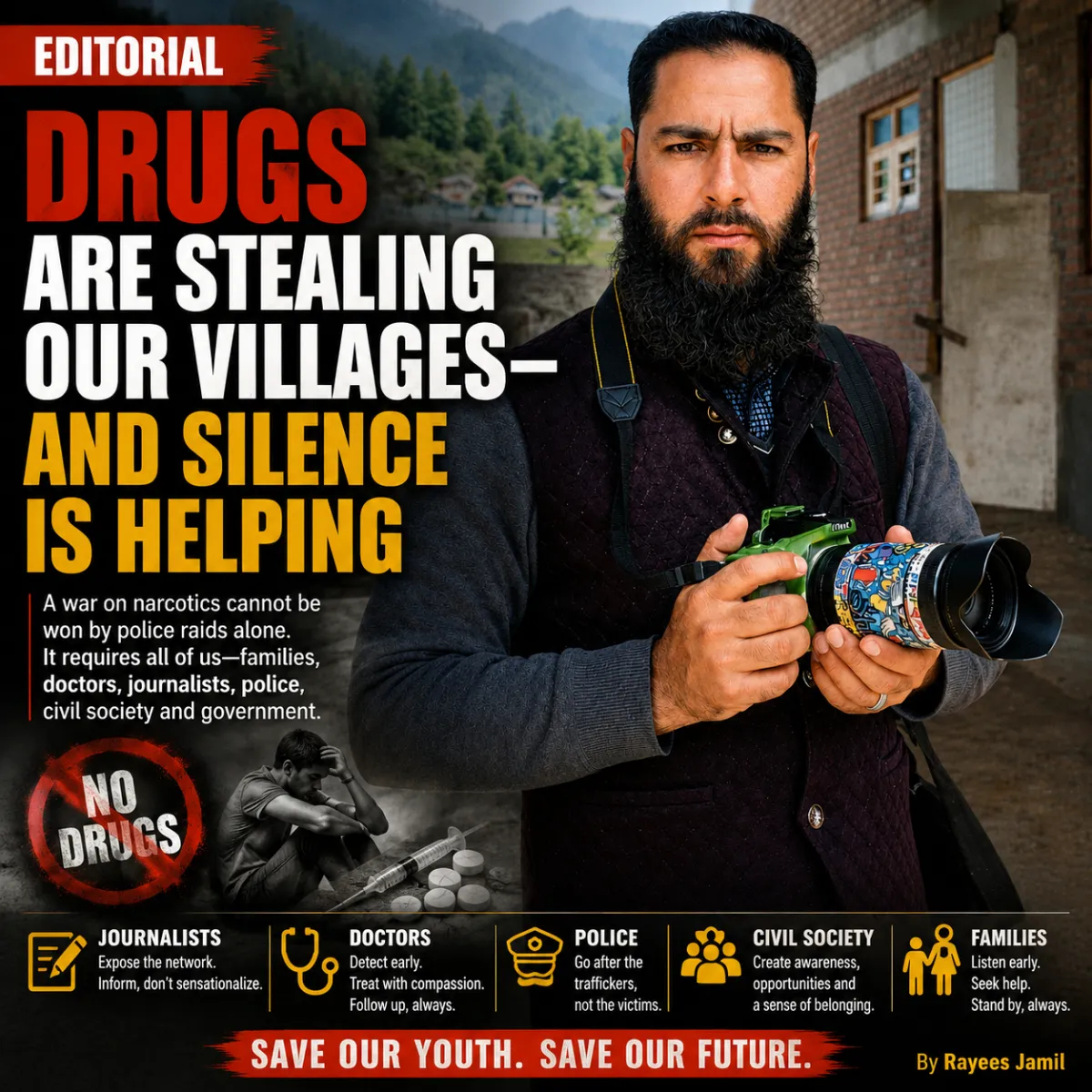
DRUGS ARE STEALING OUR VILLAGES—AND SILENCE IS HELPING
By Rayees Jamil | Inside Kashmir
A village can survive unemployment. It can survive political disagreements. It can survive economic hardship.
But when drugs begin taking away its young people, the damage reaches far deeper.
Today, the narcotics crisis demands much more than periodic police raids and public-awareness slogans. It demands an uncomfortable question from every section of society:
Who is responsible for saving our young generation?
The answer is simple—and uncomfortable.
All of us.
Drug abuse is not merely a police problem. It is simultaneously a public-health crisis, a family crisis, a youth crisis and a social crisis.
And if we continue treating it as somebody else's responsibility, the traffickers will continue winning.
THE VILLAGE MUST WAKE UP
The first signs of addiction often appear long before a police case.
A child changes friends.
A student stops attending classes.
A young person begins demanding unexplained money.
Behaviour changes.
Family relationships deteriorate.
Yet families often remain silent because they fear society more than they fear the disease.
This culture must end.
There is no honour in hiding addiction.
There is honour in recognising the problem early and seeking help.
The family that seeks treatment is not a failed family. It is a family fighting to save a life.
JOURNALISM MUST GO BEYOND THE HEADLINE
The media cannot limit its role to reporting that another drug peddler was arrested.
Responsible journalism must ask:
Where did the drugs come from?
Who supplied them?
Who financed the network?
How are young people being recruited?
Why are certain villages becoming vulnerable?
Are treatment facilities accessible?
What happens after rehabilitation?
And why do some people relapse?
These are the questions that matter.
At the same time, journalism must protect vulnerable people from unnecessary exposure.
Expose the trafficker. Do not sensationalise the victim.
A journalist's job is not merely to create a headline.
It is to help society understand the truth.
DOCTORS MUST SEE BEYOND THE PRESCRIPTION
Doctors can become an important early line of defence.
A patient may never tell the police or even his family about drug use, but he may eventually enter a clinic.
Medical professionals must be prepared to recognise possible substance-use problems, provide appropriate treatment and refer patients for specialised care when necessary.
But treatment cannot end with detoxification.
A person returning from rehabilitation needs follow-up, counselling, family support and a realistic path back into education, employment and society.
Rehabilitation without reintegration is an unfinished job.
POLICE MUST FOLLOW THE MONEY
Police action is essential, but the real measure of success cannot simply be the number of arrests.
The street-level dealer is often only one link in a larger chain.
The investigation must move upward.
Who supplies?
Who finances?
Who transports?
Who profits?
Who controls the network?
The drug business must be attacked as a criminal economy, not merely as a collection of individual offences.
At the same time, communities need safe channels to provide information without fear of retaliation.
And there must be a clear distinction between those who profit from trafficking and those trapped in addiction.
The trafficker needs the full force of the law. The addicted person needs treatment, accountability and a chance to recover.
CIVIL SOCIETY CANNOT REMAIN A SPECTATOR
We cannot tell young people to stay away from drugs while giving them nothing meaningful to replace them.
Villages need sports.
They need libraries.
They need skills.
They need employment opportunities.
They need youth clubs and constructive community activities.
They need counselling and awareness that goes beyond a once-a-year lecture.
A young person needs purpose.
Purpose can be one of the strongest forms of prevention.
PARENTS MUST LISTEN BEFORE THEY PUNISH
Parents are often the first people to notice that something is wrong.
But anger, humiliation and denial can push a struggling child further away.
Parents must learn to talk, listen and observe.
Sudden changes in friends, behaviour, sleep, spending patterns, education and family relationships should not automatically be dismissed as “just a phase.”
Early professional help can prevent a difficult situation from becoming a devastating one.
The objective is not to catch a child. The objective is to save one.
PANChAYATS AND COMMUNITY LEADERS MUST STEP UP
Village representatives, teachers, religious leaders, social workers and community organisations cannot remain silent.
They can help connect families with healthcare services, support awareness programmes, encourage sports and youth engagement, and create an environment in which recovering individuals can return to productive life.
But communities must avoid public humiliation.
A recovering person who is permanently labelled may eventually stop trying to recover.
We must fight the drug trade without declaring war on the people who need help.
THE SECOND CHANCE MATTERS
One of our greatest failures is what happens after rehabilitation.
A young person returns home.
Everyone knows his past.
Nobody trusts him.
Nobody offers employment.
Old contacts remain nearby.
Then relapse occurs.
And society says:
“He never changed.”
But perhaps we never gave him a genuine opportunity to change.
Recovery requires responsibility.
But it also requires dignity and opportunity.
A person's worst chapter should not automatically become the title of their entire life.
THE REAL BATTLE IS PREVENTION
Arrests are necessary.
Seizures are necessary.
Punishment is necessary.
But prevention is better.
We must create systems that identify vulnerable young people before they become dependent on drugs.
Schools, healthcare facilities, families, police, media, panchayats and civil society must share responsibility.
The fight must begin before the first packet is purchased—not after the first arrest.
THE QUESTION IS: WHAT WILL WE DO NOW?
Every institution has a responsibility.
Journalists must investigate.
Doctors must treat.
Police must dismantle networks.
Schools must educate.
Panchayats must mobilise.
Civil society must create opportunity.
Families must listen.
And government agencies must coordinate these efforts instead of working in isolation.
The narcotics crisis will not disappear because we hold another seminar.
It will not disappear because another dealer is arrested.
It will not disappear because another editorial is published.
It will begin to retreat when society decides that prevention, treatment, enforcement and rehabilitation are all equally important.
Our villages are not helpless.
But they must stop being silent.
Because behind every statistic is a young person.
Behind every young person is a family.
And behind every family is a community.
If we lose our youth to narcotics, we do not merely lose individuals. We lose tomorrow.
The time for denial is over.
The time for blame is over.
The time to act is now.
Let the village speak. Let the family listen. Let the doctor treat. Let the journalist expose. Let the police dismantle the network. Let society give the recovering a second chance.
Because saving one young life today may mean saving an entire family tomorrow.