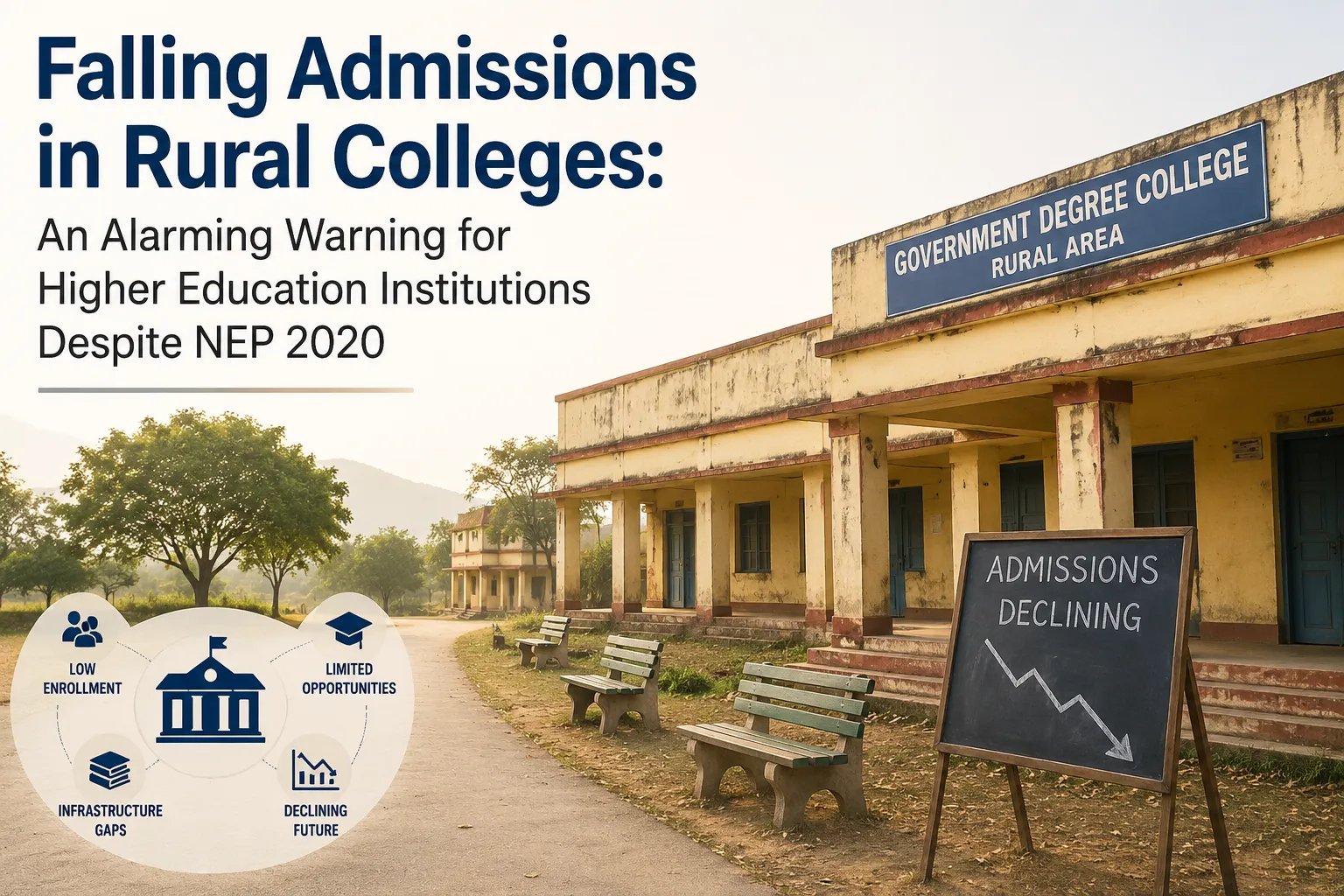
An Alarming Warning for Higher Education Institutions Despite NEP 2020
Prof. R.K. Uppal. [PhD, D.Litt.]
……………………………………………………………………………………
The decline in student admissions in rural colleges is emerging as one of the most serious and
under-discussed challenges in India’s higher education landscape. Despite the ambitious vision
of the National Education Policy (NEP) 2020, which aims to expand access, improve quality, and
enhance the Gross Enrollment Ratio, rural institutions continue to witness a steady erosion of
student strength. This trend is not a temporary fluctuation but a structural warning signal that
reflects deeper systemic weaknesses in the higher education ecosystem.
Rural colleges were established with the fundamental objective of democratizing education and
ensuring that higher learning reaches the most remote and underserved regions. For decades,
they have served as the backbone of first-generation learners, particularly in economically
weaker and geographically isolated areas. However, in recent years, these institutions are
increasingly struggling to attract and retain students, leading to underutilized infrastructure,
shrinking academic environments, and declining institutional relevance.
One of the primary reasons for falling admissions is the widening perception gap between rural
and urban institutions. Students today are far more aware, aspirational, and informed than ever
before. With the rapid expansion of digital access, even rural students are exposed to the
academic culture of metropolitan universities, private institutions, and global education models.
As a result, rural colleges are often perceived as outdated, under-resourced, and lacking
competitive academic ecosystems.
This perception is reinforced by real structural deficiencies. Many rural colleges continue to
operate with limited faculty strength, inadequate laboratories, outdated libraries, and minimal
exposure to industry-relevant learning. While NEP 2020 emphasizes multidisciplinary education,
skill development, and experiential learning, the implementation at the grassroots level remains
uneven. Policy aspirations have not yet translated into consistent institutional transformation.
Faculty shortage is another critical issue driving the decline in admissions. Rural colleges often
face difficulties in attracting qualified and motivated educators due to lower incentives, limited
research opportunities, and poor professional development pathways. In many cases, teaching
staff are overburdened with administrative responsibilities, leaving little scope for pedagogical
innovation or academic enrichment. This directly impacts the learning experience of students,
further discouraging new enrollments.
In addition to faculty constraints, infrastructure remains a persistent challenge. Modern higher
education requires not just classrooms but digitally enabled learning environments, research
facilities, and collaborative academic spaces. However, many rural institutions still lack stable
internet connectivity, smart classrooms, and access to advanced learning management systems.
The digital divide became even more visible during the pandemic, when institutions with limited
technological infrastructure struggled to maintain continuity in learning.
Another major factor contributing to declining admissions is the changing aspiration structure of
students. Today’s youth increasingly prioritize employability, skill acquisition, and career
outcomes over traditional degree programs. Urban colleges and private universities often
advertise strong placement records, internships, and industry collaborations, making them more
attractive to students even at higher costs. In contrast, rural colleges are often unable to clearly
demonstrate tangible career pathways, resulting in reduced student confidence.
Economic considerations further intensify the problem. For many rural families, education is a
significant financial investment. If a degree does not appear to guarantee employment or upward
mobility, families are less likely to invest in it. Even when tuition fees are relatively low, indirect
costs such as travel, accommodation, and opportunity costs of lost labor become decisive factors.
Consequently, students either migrate to vocational training programs, short-term certification
courses, or urban institutions perceived to have better returns.
The implementation gap of NEP 2020 plays a central role in this crisis. While the policy
envisions flexible curricula, skill integration, and multidisciplinary learning, its execution
requires strong institutional capacity, financial support, and administrative commitment. In many
rural colleges, these enabling conditions are still weak or absent. As a result, NEP 2020 remains
more visible in policy documents than in classroom practice.
Another overlooked dimension is the lack of strong institutional branding and outreach by rural
colleges. Urban institutions actively engage in marketing, alumni networking, and digital
outreach to attract students. Rural colleges, on the other hand, often rely on passive admission
processes without actively communicating their strengths or achievements. In an increasingly
competitive education market, visibility plays a crucial role in shaping student choice.
The consequences of declining admissions are severe and far-reaching. Financial instability is the
most immediate impact, as reduced student numbers directly affect institutional budgets, staff
recruitment, and maintenance of infrastructure. Over time, this leads to a cycle of decline where
reduced resources further degrade quality, which in turn leads to even fewer admissions.
Beyond institutional survival, the broader social impact is equally concerning. Rural colleges
play a critical role in ensuring educational equity and regional development. They serve as
catalysts for social mobility, particularly for marginalized communities. A decline in their
relevance risks deepening the urban-rural divide in higher education and limiting opportunities
for large sections of the population.
Addressing this crisis requires urgent and coordinated intervention. First, infrastructure
development must be prioritized, particularly in digital connectivity and modern teaching
facilities. Without this foundation, other reforms will have limited impact. Second, faculty
recruitment and retention policies must be restructured to attract high-quality educators to rural
institutions through incentives, research grants, and career advancement opportunities.
Third, curriculum reform must go beyond theoretical alignment with NEP 2020 and focus on
practical implementation. Courses must be linked with local economic ecosystems such as
agriculture, small-scale industries, rural entrepreneurship, and service sectors. This will improve
employability and restore student confidence in rural institutions.
Fourth, partnerships with industry, skill development agencies, and digital education platforms
must be strengthened. Such collaborations can bridge the gap between academic learning and
real-world employment opportunities. Fifth, governance systems must be made more
accountable through regular audits, performance evaluations, and student feedback mechanisms.
Finally, rural colleges must rethink their identity in the modern education landscape. Instead of
imitating urban models, they should position themselves as context-specific institutions that
combine accessibility with relevance. By aligning education with local needs and national
aspirations, they can regain their importance in the higher education ecosystem.
In conclusion, the declining admissions in rural colleges represent a serious warning sign that
cannot be ignored. Despite the visionary framework of NEP 2020, the reality on the ground
reflects deep structural imbalances, implementation gaps, and changing student expectations. If
left unaddressed, this trend risks weakening the foundation of inclusive higher education in
India. Rural colleges must be revitalized not only to preserve institutional survival but also to
ensure that higher education remains accessible, equitable, and meaningful for all sections of society.