Green Policy, Gigawatt Payoff: India’s Fast-Track to Clean Power
Prof. (Dr.) Sunil Goyal
Eminent Social Scientist, Professor and Columnist
Department of Higher Education, Government of Madhya Pradesh
Email gasspub@gmail.com Mobile 9425382228
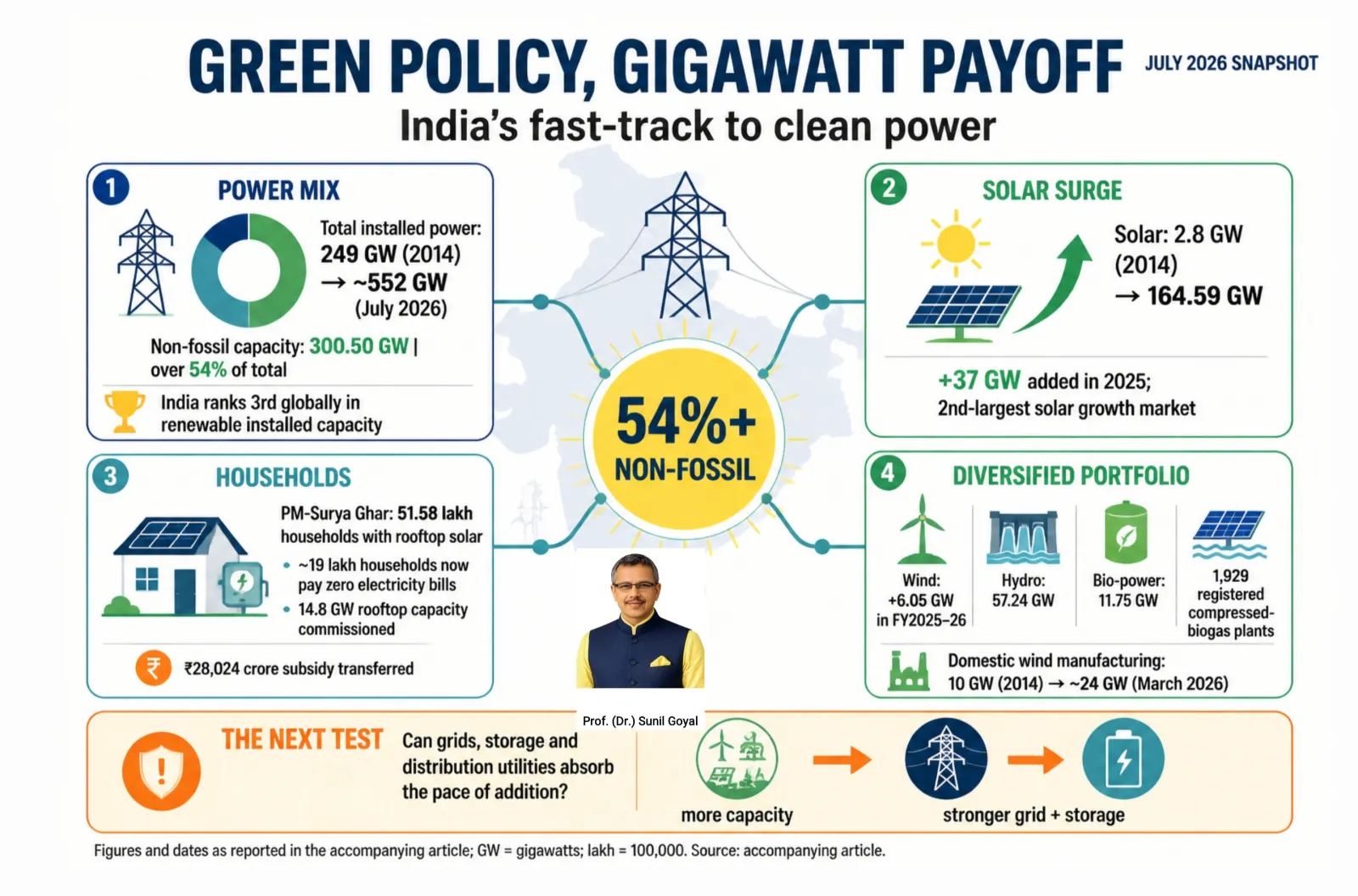
Somewhere in the last decade, India's renewable energy story stopped being a target on a policy document and became a number visible on the grid. As of July 2026, India's total installed power capacity stands at around 552 GW, more than double the 249 GW it had in 2014. What has changed even more dramatically is the composition of that capacity: non-fossil sources now account for 300.50 GW, or over 54% of the total — meaning India has quietly crossed the halfway mark on decarbonising its power mix, years ahead of the timeline most observers expected when the Paris Agreement was signed. India now ranks third globally in renewable energy installed capacity, a position that reflects sustained capacity addition rather than a single good year.
Solar is doing the heaviest lifting. Installed solar capacity has reached 164.59 GW, up from just 2.8 GW in 2014 — a nearly 60-fold increase that has made solar the single largest component of India's renewable portfolio. The pace, not just the stock, is now globally competitive: India became the world's second-largest solar growth market in 2025, adding more than 37 GW of new solar capacity in a single year, ahead of the 34 GW added by the United States. That is a meaningful marker, given the scale of capital and manufacturing base the US solar industry commands.
Behind the aggregate numbers sits a policy architecture built to reach ordinary households, not just utility-scale developers. PM-Surya Ghar: Muft Bijli Yojana, launched in February 2024 with an outlay of ₹75,021 crore targeting one crore households, has now enabled rooftop solar installations for 51.58 lakh households, with roughly ₹28,024 crore in subsidy already transferred and nearly 19 lakh households now paying zero electricity bills. Cumulatively, 14.8 GW of rooftop capacity has been commissioned under the scheme. A newer instrument, the Pradhan Mantri Surya Sarovar Yojana, approved on 31 July 2026 with a ₹5,070 crore outlay, extends this further into floating solar — targeting 5,000 MW of floating photovoltaic capacity co-located with battery storage of at least two hours' duration, a combination aimed squarely at solar's biggest weakness: intermittency.
Wind energy, India's fourth-ranked renewable resource globally, had its strongest year yet in FY2025-26, adding 6.05 GW — the highest annual addition on record and 46% higher than the previous year, with another 28 GW currently under implementation. Equally significant is what is happening upstream of the turbines: domestic wind turbine manufacturing capacity has grown from 10 GW in 2014 to about 24 GW by March 2026, with 70-80% indigenisation now achieved across key components. That is the harder, less visible half of an energy transition — building the supply chain, not just importing finished capacity.
Bioenergy and hydro round out a genuinely diversified portfolio rather than a solar-only bet. Bio-power capacity stands at 11.75 GW, backed by a compressed biogas ecosystem of 1,929 registered plants, and the newly approved GOBARdhan scheme — a ₹23,731 crore, decade-long national circular bioeconomy programme — aims to nearly ten-fold domestic CBG production. Hydropower, still the grid's most reliable flexible-generation source, holds steady at 57.24 GW, with a fresh ₹2,584.60 crore Small Hydro Power scheme targeting 1,500 MW of new capacity concentrated in hilly and North-Eastern states that larger utility projects tend to bypass.
Taken together, these numbers describe something more durable than a renewable-energy headline figure: a policy machine now operating across every technology and every scale simultaneously — utility solar parks and rooftop panels, onshore wind farms and offshore VGF schemes, biogas plants and floating solar. The test ahead is not whether India can keep adding gigawatts; on current form, it clearly can. It is whether grid infrastructure, storage capacity and distribution utilities can absorb this pace of addition without the transition creating new bottlenecks of its own.
Prof. (Dr.) Sunil Goyal
The author is an Eminent Social Scientist, Professor and Columnist, presently working at Department of Higher Education, Government of Madhya Pradesh. He can be reached at email gasspub@gmail.com Mobile 9425382228
**Beyond knowledge: Human skills that define an effective PhD Supervisor