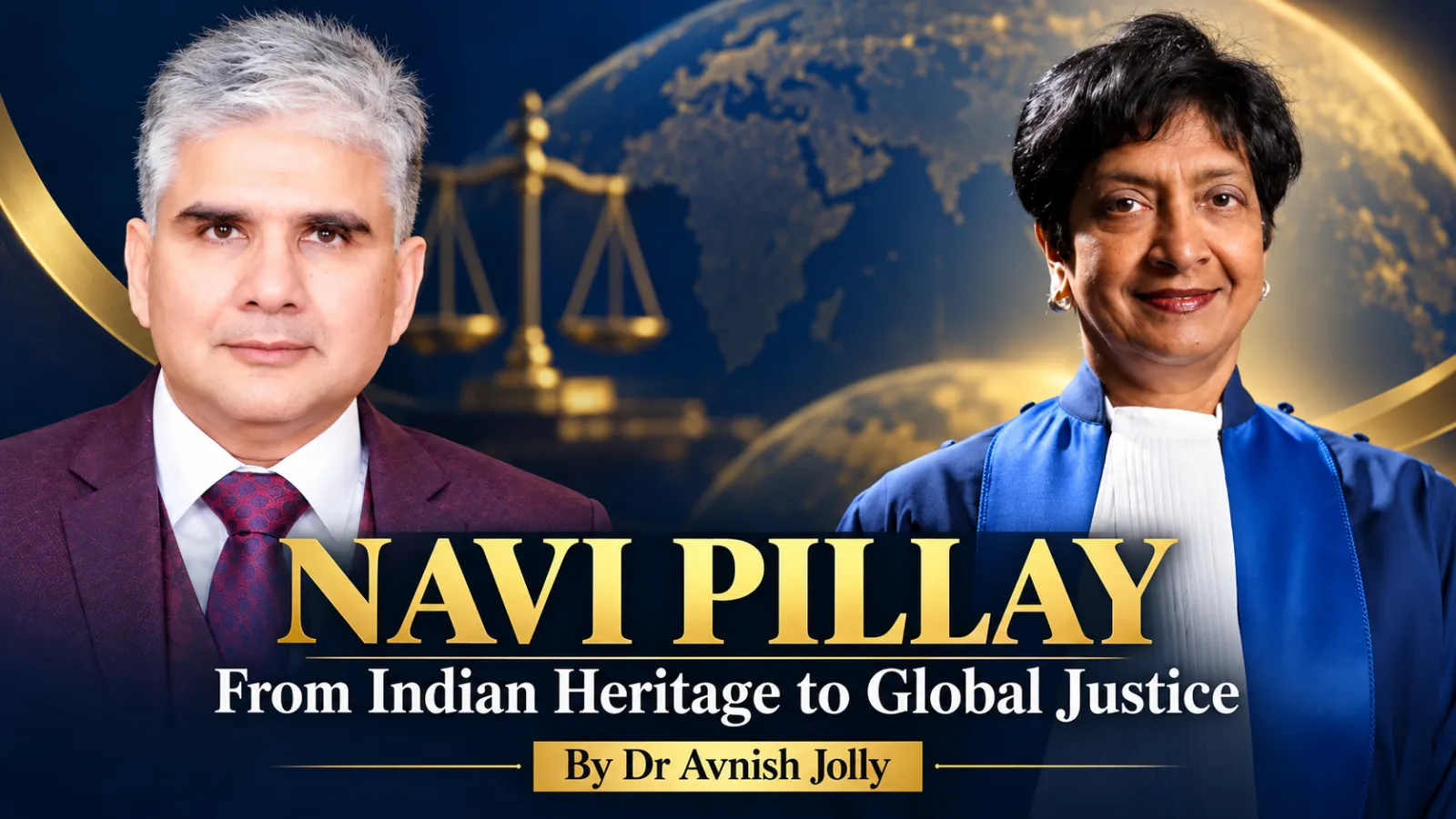
Navi Pillay: From Indian Heritage to Global Justice
Immigration, Human Rights, Women’s Empowerment and the Pursuit of World Peace
By Avnish Jolly, Barrister and Solicitor, Winnipeg, Manitoba, Canada
Introduction: A Life That Transcends Borders
The life and achievements of Navanethem “Navi” Pillay remind us that the pursuit of justice transcends national boundaries, cultural identities and political systems. Born in Durban, South Africa, in 1941, into a family of Indian Tamil origin, Pillay rose from a society profoundly divided by apartheid to become one of the world's most influential jurists and advocates of international human rights.
On 9 October 2026, the Norwegian Nobel Committee announced that Navi Pillay had been awarded the Nobel Peace Prize in recognition of her efforts to advance peace, uphold international law and strengthen accountability for the gravest international crimes. Her career exemplifies how the law, when applied independently and courageously, can protect human dignity, challenge injustice and contribute to lasting peace. [1]
As a barrister and solicitor practising in Winnipeg, Canada, and as a person of Indian origin, I find particular inspiration in her remarkable journey. My commitment to national integration, peace and human rights began in childhood in India and gradually expanded to embrace South Asian cooperation and international understanding. Pillay’s achievements reinforce my conviction that cultural heritage should inspire us to serve humanity rather than restrict our concerns to our own communities.
Viewed through the lenses of immigration and women’s rights, her life raises a fundamental question: how can institutions ensure that gender, racial identity, ancestry or immigration circumstances never become barriers to justice? Pillay’s Indian heritage should not be confused with a claim that she herself immigrated to South Africa. Nevertheless, her experience as a South African woman of Tamil origin offers a valuable perspective on identity, belonging, exclusion and the continuing struggle for equality.
1. Cultural Heritage and Universal Human Dignity
Names often preserve family histories, cultural traditions and ancestral connections. Navanethem Pillay’s name reflects her South African Tamil heritage, although its precise etymology should not be assumed without reliable linguistic evidence. Sanskrit and Tamil are distinct languages, and similarities between words alone cannot establish the origin or meaning of an individual’s name.
Indian philosophical traditions offer enduring insights into human fellowship, non-violence, truth and ethical responsibility. The Sanskrit expression Vasudhaiva Kutumbakam, commonly translated as “the world is one family”, encourages us to extend our concern beyond national, ethnic and communal boundaries. Similarly, the principles of Ahimsa (non-violence), Satya (truth) and Dharma (ethical duty) invite reflection on our responsibilities towards others.
These connections provide an interpretive framework for understanding universal human dignity; they should not, however, be taken as evidence that Pillay’s legal philosophy derives directly from any particular religious or philosophical tradition.
Her career illustrates how cultural identity and universal human values can complement one another. The most meaningful inheritance is not merely the tradition into which we are born, but the ethical choices through which we contribute to society.
For immigrants and their descendants, this relationship is especially important. Belonging should not require the abandonment of one's language, ancestry or cultural memory. Equally, cultural traditions must not be used to justify gender discrimination or restrict women’s autonomy. A genuinely pluralistic society protects cultural expression while safeguarding every individual’s freedom to question, reinterpret or depart from inherited expectations.
2. From Apartheid to the International Rule of Law
Navi Pillay’s professional journey began under apartheid, a system that institutionalised racial discrimination and denied the majority of South Africans equal rights and opportunities.
In 1967, she became the first woman to establish a law practice in Natal Province. She defended opponents of apartheid and subsequently became the first Black woman appointed to South Africa’s High Court. Her distinguished career later included service at the International Criminal Tribunal for Rwanda, the International Criminal Court and the United Nations, where she served as High Commissioner for Human Rights. [6]
Her contribution to the 1998 Akayesu judgment helped establish an important precedent in international criminal law: rape and sexual violence can constitute acts of genocide when the requisite intent and other legal elements are established. This development challenged the historical marginalisation of sexual violence in international criminal proceedings. It did not, however, mean that every act of sexual violence constitutes genocide; the legal classification depends on the evidence and the applicable legal criteria. [7]
Pillay’s career demonstrates that the rule of law must protect the powerless as effectively as it holds the powerful accountable. It must provide avenues for victims to seek justice, ensure that abuses are investigated and prevent serious violations from being met with impunity.
This legal legacy has particular significance for women’s empowerment. Recognising sexual violence as a matter of international criminal accountability affirms that survivors’ experiences cannot be excluded from the pursuit of justice. Meaningful protection also requires safeguards against retaliation, sensitive treatment, accessible procedures and support that enables survivors to participate in legal proceedings without being defined solely by their suffering.
3. Truth, Justice and Accountability
In her 2012 United Nations article on accountability, Pillay emphasised the interconnected importance of truth, justice, effective remedies and reparation. Together, these principles place the experiences and rights of victims at the centre of responses to human-rights violations. [2]
Truth enables societies to acknowledge what happened. Justice establishes responsibility and affirms that serious wrongdoing cannot simply be ignored. Effective remedies and reparation recognise the harm suffered and help restore dignity.
Without these elements, reconciliation risks becoming little more than a demand that victims forget the past while those responsible escape accountability.
This framework is equally relevant to migrant justice and women’s rights. A legal remedy may exist in theory yet remain inaccessible to someone who cannot understand the proceedings, afford legal representation or safely report abuse. Fear of an employer, an abusive partner or possible immigration consequences may discourage individuals from seeking assistance. The United Nations Committee on the Elimination of Discrimination against Women has addressed such vulnerabilities in its guidance on women migrant workers, highlighting the importance of accessible legal protection. [8]
Institutions must therefore examine whose complaints are heard, whose accounts are doubted and whether established procedures expose complainants to further harm.
Interpretation services, accessible information and confidential legal advice can help people exercise their rights. However, these measures are most effective when designed in consultation with the communities they are intended to serve.
4. From Rhetoric to Reality: Making Human Rights Effective
In her Human Rights Day statement of 10 December 2013, Pillay stressed the importance of translating legal commitments into practical outcomes: “The key now is to implement those laws and standards to make enjoyment of human rights a reality on the ground.” [3]
Many countries have constitutions, statutes and international commitments designed to protect fundamental rights. Yet discrimination, exclusion, violence and unequal access to justice persist. The gap between formal guarantees and lived experience remains one of the greatest challenges facing democratic societies.
Immigration brings this challenge into particularly sharp focus. Newcomers may encounter unfamiliar institutions, language barriers and uncertainty about their legal entitlements. Migrant women may experience overlapping disadvantages related to gender, race, income and immigration circumstances. These experiences vary considerably; neither gender nor migrant status automatically determines an individual's circumstances or level of vulnerability. [8]
A rights-based approach must therefore ask whether services are understandable, affordable, physically accessible and safe to use. Institutions should explain eligibility requirements and complaint procedures clearly, provide appropriate language support and involve affected women in evaluating the effectiveness of their services.
Where immigration status affects eligibility for a particular service or protection, the applicable rules and avenues for review should be transparent.
Empowerment means more than the formal recognition of rights. It requires giving people the practical ability to make informed decisions, challenge unfair treatment and obtain effective remedies.
For members of the legal profession, this principle carries a special responsibility. Our role should extend beyond explaining what the law says to helping ensure that its protections are meaningful in practice.
5. Gandhi and Mandela: Justice, Resistance and Reconciliation
Mahatma Gandhi’s philosophy of Satyagraha emphasised truth, non-violence and disciplined resistance to injustice. Nelson Mandela’s struggle against apartheid and his subsequent leadership offer important lessons in political equality, democratic institution-building and reconciliation.
Their historical experiences differed, and neither should be reduced to a convenient slogan or portrayed as an uncomplicated model of reconciliation.
Genuine reconciliation requires an honest acknowledgement of historical injustices, meaningful protection for victims and the creation of conditions in which people can live together as equals.
Pillay’s career complements these traditions by demonstrating how independent legal institutions can translate moral principles into enforceable standards of accountability.
From a women’s rights perspective, peace must also be examined within homes, workplaces and communities. Public appeals for harmony should never pressure women to remain silent about violence, abuse or discrimination. A peaceful relationship requires safety, autonomy and the freedom to disagree without fear of punishment.
The responsibility for addressing injustice must never rest solely on those who have suffered it.
6. Women as Leaders in Justice and Peace
Pillay’s achievements challenge the historical exclusion of women from senior judicial, political and international positions. Her appointment to South Africa’s High Court and her subsequent leadership in international institutions demonstrated that women can shape legal doctrine, strengthen institutions and influence global human-rights standards.
Yet representation alone does not guarantee equality. Women must also enjoy meaningful access to education, employment, professional advancement, political participation and effective protection against violence.
Women’s empowerment should therefore be understood as the ability to exercise rights, make independent choices and influence decisions that affect their lives. The Convention on the Elimination of All Forms of Discrimination against Women (CEDAW) addresses discrimination in political and public life, education, employment and other spheres. Its framework encourages institutions to examine the structural barriers that restrict opportunity rather than simply celebrate exceptional women who overcome them. [9]
For immigrant women, meaningful opportunity may require fair recognition of overseas qualifications, accessible professional training, childcare, mentorship and transparent recruitment procedures. These are potential institutional responses to identifiable barriers, not an assumption that all immigrant women face the same difficulties.
Employers and professional bodies should assess whether their policies unnecessarily exclude qualified applicants and establish credible mechanisms for challenging discrimination.
United Nations Security Council Resolution 1325 recognises women’s role in peace and security and calls for their greater participation in related decision-making. Women, including displaced women and those from communities affected by conflict, must be able to help shape agendas and influence outcomes.
Participation becomes meaningful when women have genuine authority, resources and opportunities to contribute, rather than merely a place in a photograph or on a consultation list. [10]
A peaceful world cannot be built by excluding women from the institutions that determine its future.
7. Education, Malala Yousafzai and Kailash Satyarthi
Education is among the most effective means of advancing human dignity, reducing inequality and strengthening democratic societies.
The 2014 Nobel Peace Prize was jointly awarded to Malala Yousafzai and Kailash Satyarthi for their work against the suppression of children and young people and for the right of every child to education. Malala’s advocacy brought international attention to girls’ education, while Satyarthi’s work challenged child labour and exploitation. [4]
A child denied education loses far more than access to a classroom. The deprivation can undermine opportunities for independence, economic security and meaningful participation in public life.
Education should therefore develop not only professional competence but also critical thinking, ethical responsibility, respect for diversity and the ability to resolve disagreements peacefully.
For girls and women affected by migration, educational inclusion requires attention to interrupted schooling, language learning, financial constraints, disability and caregiving responsibilities. Schools and universities should communicate available support clearly and provide safe, accessible channels through which learners can raise concerns.
Education becomes a powerful instrument of empowerment when learners can participate fully, complete their studies and apply their knowledge to decisions about their own futures.
Human-rights education should also explain how to obtain assistance and challenge discrimination. Knowledge of rights becomes far more effective when accompanied by practical guidance on institutions, procedures and available remedies.
8. Canada’s Charter: Equality in a Multicultural Society
The Canadian Charter of Rights and Freedoms, which forms Part I of the Constitution Act, 1982, provides an important constitutional framework for equality and individual liberty. Section 15 protects equality before and under the law and equal protection and benefit of the law without discrimination, including on grounds such as race, national or ethnic origin, colour, religion, sex, age and mental or physical disability. Section 27 directs that the Charter be interpreted consistently with the preservation and enhancement of Canada’s multicultural heritage. [5]
The scope of individual rights must nevertheless be understood precisely. Section 7 protects the life, liberty and security of the person, subject to the principles of fundamental justice, and applies to everyone. Certain rights, including the right to vote under section 3, are reserved for citizens. Section 6 distinguishes citizens’ mobility rights from the rights it extends to citizens and permanent residents.
Furthermore, the Charter generally applies to government action under section 32. Other human-rights legislation addresses discrimination in specified areas, including employment, housing and services. The precise entitlement in any case depends on the applicable legislation, jurisdiction and circumstances, including immigration status. [5]
These legal distinctions should not obscure the broader ethical obligation to treat newcomers with dignity and fairness.
Substantive equality also requires examining how rules operate in practice. A procedure that appears uniform may create disproportionate barriers for people who need interpretation, disability accommodation or a realistic opportunity to obtain legal advice.
The continuing existence of racism and other forms of discrimination demonstrates that constitutional guarantees require active protection, effective enforcement and sustained public commitment.
Canada’s multicultural aspirations must also be considered alongside the rights and histories of Indigenous Peoples. Building an inclusive society requires recognising the lands on which newcomers settle, understanding the continuing consequences of colonialism and respecting Indigenous rights and self-determination.
Cultural inclusion should form part of a wider commitment to justice rather than become a reason to overlook historical or contemporary inequalities.
9. The Global North, the Global South and Decolonisation
The legacy of colonialism continues to influence economic opportunities, international institutions and political relationships. The terms Global North and Global South provide a broad framework for discussing these inequalities, although neither represents a uniform group of countries or communities.
Both regions contain considerable diversity, and countries across the Global South have made substantial contributions to science, culture, international law and democratic movements.
The central question is how international cooperation can become more equitable, inclusive and accountable.
An immigration perspective raises additional questions: Who can move safely? Whose professional qualifications are recognised? Whose labour is valued, and who remains vulnerable to exploitation?
Migration policies should be assessed for their effects on individuals and families, including women employed in care work and domestic service. CEDAW’s guidance on women migrant workers offers a useful framework for considering protection against exploitation and access to effective remedies. [8]
Decolonisation also requires examining whose knowledge and experiences influence public policy. Women and migrant communities should have meaningful opportunities to define problems and shape solutions.
Consultation must allow disagreement and recognise differences within communities. No single individual or organisation should automatically be assumed to speak for every woman, migrant or newcomer.
Pillay’s career also invites reflection on the consistent application of international accountability. A credible international legal order requires fair procedures, independent institutions and protection against political interference, particularly when allegations concern powerful states or their allies.
This is an institutional responsibility that cannot be fulfilled through individual courage alone.
10. Immigrants as Builders of Global Solidarity
Migration has long been a feature of human history. People move for safety, education, employment, family reunification and many other reasons. Immigrants, refugees, asylum seekers and temporary residents occupy different legal positions, and treating these categories as interchangeable can obscure important differences in their rights and protections.
Immigrants contribute to their adopted societies through professional expertise, entrepreneurship, public service, education, scientific research, caregiving and community participation.
Their value, however, should never be measured solely in economic terms. Every individual deserves dignity and fair treatment, irrespective of productivity, professional status or financial circumstances.
Migrant women must be recognised as decision-makers, professionals and leaders, not merely as workers, caregivers or individuals requiring protection. Describing women exclusively through sacrifice or vulnerability risks overlooking their knowledge, ambitions and agency.
Meaningful inclusion requires listening to migrant women’s own priorities and enabling them to influence the institutions that shape their lives.
For South Asian communities in Canada, this presents opportunities to strengthen ties between Canada, India and other South Asian countries through education, trade, professional collaboration and people-to-people engagement.
Community organisations can advance solidarity through mentorship, human-rights education and accessible referrals to appropriate services. They should also challenge sexism, racism and other forms of exclusion within their own networks.
Respecting cultural identity and protecting individual autonomy are complementary responsibilities.
The objective is not to erase national identities, but to recognise that love of one’s country can coexist with respect for the dignity of all humanity.
11. My Personal Commitment: From National Integration to World Peace
As a barrister and solicitor in Winnipeg, and as a person of Indian origin, I regard the pursuit of peace and human rights as a responsibility that extends beyond professional boundaries.
My commitment to national integration, peace and human rights began in childhood in India. Over time, it broadened to encompass South Asian cooperation and the importance of constructive international relationships.
Living and working in Canada has further strengthened my appreciation of constitutional government, pluralism, equality and peaceful coexistence.
Pillay’s career reinforces my conviction that access to justice, women’s equality and the dignity of newcomers are inseparable from a broader commitment to human rights.
Legal knowledge is most valuable when it enables people to understand their choices, exercise their rights and obtain protection that might otherwise remain beyond their reach.
Lawyers can contribute by promoting access to justice, challenging discrimination, defending constitutional principles and supporting the peaceful resolution of disputes.
Educators can foster critical thinking and respect for diversity. Community organisations can build relationships across cultural boundaries. Governments can protect fundamental rights, strengthen public institutions and promote international cooperation.
These responsibilities should be evaluated through practical questions. Can a person affected by injustice obtain reliable advice? Can they report harm safely? Do women have a meaningful voice in decisions that affect them? Are institutional barriers identified and addressed?
Progress requires institutions to evaluate outcomes and listen to the people whose experiences expose gaps in protection.
For me, the pursuit of world peace demands a sustained commitment to education, dialogue, legal accountability and international cooperation. It also requires consistency: we must be prepared to challenge injustice within our own communities as firmly as we challenge it elsewhere in the world.
Conclusion: A Shared Responsibility for Humanity
Navi Pillay’s life demonstrates how the pursuit of justice can begin within one society and ultimately influence the wider world.
Her experience under apartheid, judicial service and international advocacy offer a compelling example of how law can challenge exclusion and advance accountability. Viewed through the perspectives of immigration and women’s rights, her legacy also directs our attention to the everyday institutions that shape belonging and opportunity: schools, workplaces, public services, professional bodies and courts.
A woman’s ability to live safely, a newcomer’s access to a fair procedure and a survivor’s opportunity to obtain an effective remedy are practical measures of a society’s commitment to human dignity.
Celebrating an exceptional leader should inspire us to remove barriers for others, including those whose achievements may never receive international recognition.
Ultimately, humanity’s future will depend not only on the strength of economies or the power of states, but also on our willingness to recognise the equal worth of every human being.
Peace is more than the absence of conflict. It requires justice, the protection of human dignity and a collective determination to build a world in which every person can live with freedom, equality and hope.
Navi Pillay’s life reminds us that this responsibility belongs to all of us.
Writer is Barrister and Solicitor, Winnipeg, Manitoba, Canada