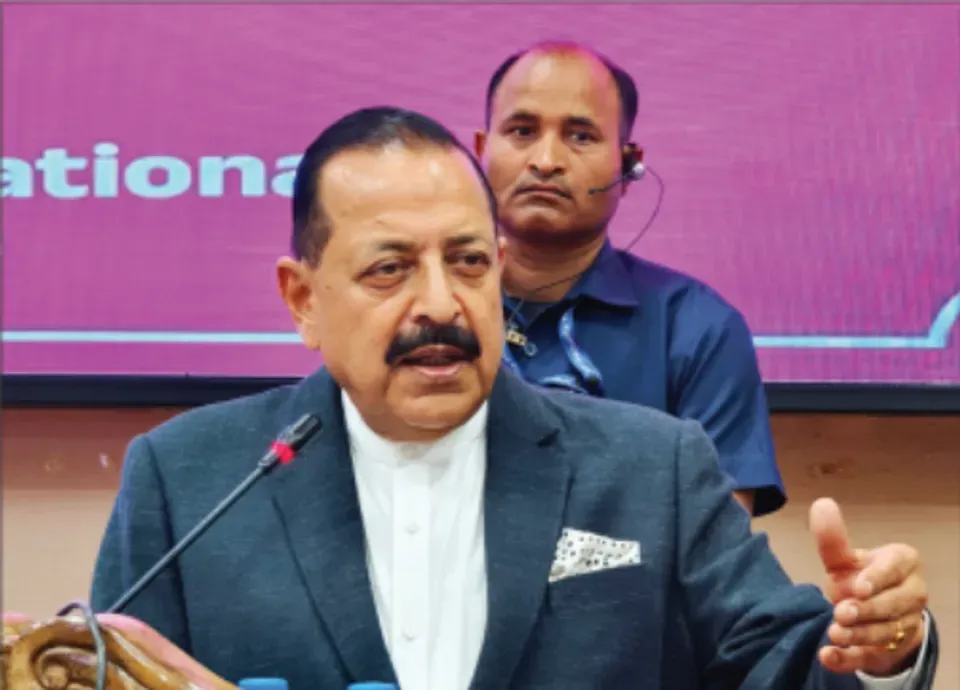
Bengaluru, Jun 13: Union Minister Jitendra Singh on Saturday said India's startup ecosystem had generated nearly 25 lakh jobs over the past decade and emerged as a key driver of economic growth.
He was speaking after inaugurating the two-day RISE Conclave 2026, hosted by the Council of Scientific and Industrial Research and its laboratories, including CSIR-NAL, CSIR-CFTRI and CSIR-4PI.
Stating that the startup ecosystem is a relatively recent phenomenon in India, the minister recalled that in 2014 there were only about 350-400 startups and that the movement gathered momentum after Prime Minister Narendra Modi highlighted it in his Independence Day address from the Red Fort in 2015.
"It was quite a novel concept here. But after the PM spoke about it, it virtually became a mass movement through Startup India. Startup policies were introduced, a new ecosystem developed, and today we have close to 2.3 lakh startups, making India the third-largest startup ecosystem in the world," he said, adding that these 2.3 lakh startups have generated nearly 25 lakh jobs across the country.
Singh said the RISE Conclave was conceived to bring together research, innovation, startups and enterprise on a single platform to ensure startups remain sustainable through continuous innovation and strong industry linkages.
The Union Minister of State for Science and Technology and Earth Sciences said sustaining a startup was often more challenging than launching one, and stressed that continuous innovation, value addition and strong industry participation were essential for entrepreneurs to scale up their ventures.
Organised by the Ministry of Science and Technology, the conclave is being held under the theme, 'Innovation & Entrepreneurship Driven Growth for Viksit Bharat 2047'.
The minister said more than half of India's startups now originate from Tier-2 and Tier-3 cities, dispelling the notion that entrepreneurship is confined to technology hubs such as Bengaluru, Hyderabad and Delhi.
"We must convey this message clearly and convincingly — that startup opportunities are available to everyone. What is required is passion, commitment, technological awareness and consistent hard work. The government is there to provide technology and handholding support," Singh said.
Stating that the startup ecosystem is not restricted to information technology, Singh said it encompasses sectors such as agriculture, food processing and several others.
The minister said the government had worked over the past decade to create a supportive ecosystem for entrepreneurship through initiatives such as Startup India, the National Education Policy (NEP) 2020, the National Research Foundation (NRF), and programmes aimed at promoting innovation among underserved communities.
Highlighting emerging opportunities in sectors such as space, biotechnology, deep-ocean exploration and the Himalayan economy, Singh said these areas would contribute significantly to India's goal of becoming a developed nation by 2047.
Referring to the space sector, he said India's space economy is currently valued at about USD 9 billion and is expected to grow to USD 40-45 billion over the next eight to 10 years.
He said much of this progress had occurred over the past five years after the sector was opened to private participation.
The minister said major national missions, including the National Quantum Mission and the IndiaAI Mission, were helping build future-ready technological capabilities, while defence exports had risen to nearly Rs 23,000 crore in 2025-26.
Singh further said the government had created a Rs 1 lakh crore Research, Development and Innovation (RDI) Fund to encourage greater private-sector participation in research and innovation.
Earlier, addressing the conclave, ISRO Chairman V Narayanan highlighted the space agency's collaboration with the Department of Atomic Energy to develop Radioisotope Heater Units that could enable future lunar landers to operate on the Moon for 100-200 days, compared with the current operational lifespan of about 14 days.
He noted that, as part of the Gaganyaan programme, the ISRO had signed an agreement with the Sree Chitra Tirunal Institute for Medical Sciences and Technology to advance research in space medicine.
Narayanan acknowledged the contributions of CSIR laboratories, particularly CSIR-NAL, to India's space programme, noting that their support had been crucial in areas such as acoustic testing, wind-tunnel testing, coatings and advanced materials.