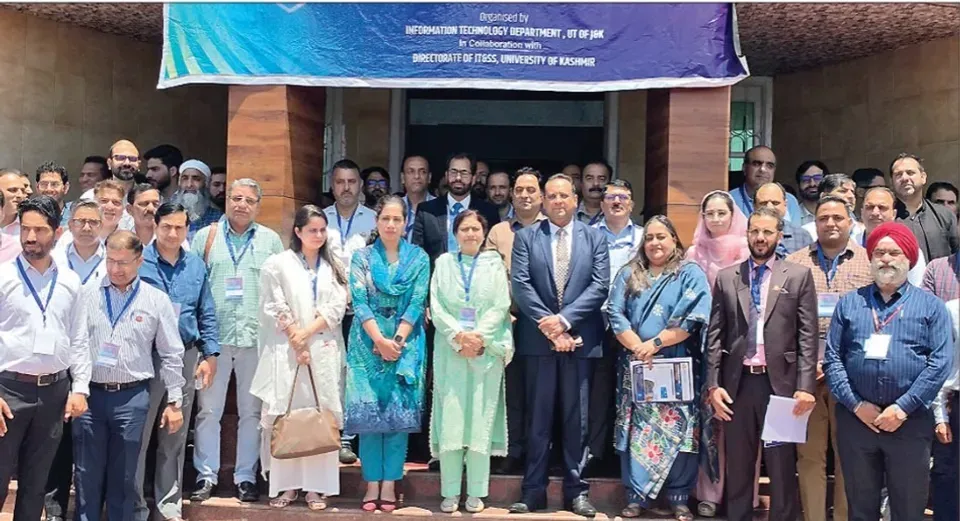
Srinagar, Jun 24: The J&K Information Technology (IT) Department on Tuesday organised a state-level consultative workshop at the University of Kashmir (KU) to formulate recommendations for India’s upcoming National Cyber Security Plan.
The ‘State Level consultative workshop on strengthening cyber security frameworks for State data’ was organised in collaboration with the Directorate of Information Technology and Support Systems (IT&SS), KU, to strengthen cyber resilience and protect critical digital infrastructure.
Addressing the gathering, Commissioner Secretary, IT Department, Saurabh Bhagat said the National e-Governance Division (NeGD) had tasked all states and Union Territories with conducting consultations on cybersecurity challenges and preparedness.
He said the recommendations would be incorporated into the national policy framework.
The workshop deliberated on cybersecurity challenges, data protection mechanisms, and the resilience of digital systems safeguarding critical state infrastructure.
Six thematic groups were constituted to discuss issues ranging from risk-based assessment and security monitoring to Security Operations Centres (SOC), legacy system modernisation, data protection, capacity building and state data centre security.
“Government is the custodian of vast volumes of public data related to citizen identity, healthcare, education, financial transactions, land records and welfare schemes,” Baghat said.
He said J&K has transitioned almost entirely to e-governance, with around 45,000 government users operating on the e-Office platform and millions of digital transactions being processed daily.
Referring to recent cyber threats, Saurabh Bhagat said cyber attacks on government infrastructure had intensified.
During Operation Sindoor, nearly one lakh cyber attack attempts were reported across various infrastructures in India, with J&K emerging as a prime target,” he added.
Bhagat said that critical websites and data centres, including those of the Housing and Urban Development Department and Power Development Department, faced sustained attacks.
“Despite the scale of threats, no major infrastructural damage occurred due to the coordinated efforts of cybersecurity teams and agencies,” he said.
He however stressed the need for continuous strengthening of cyber defence mechanisms.
Bhagat said the government has undertaken several measures, including deployment of endpoint detection and response systems, strengthening of firewalls, sanitisation of USB access across government offices, development of a State Security Operations Centre, and preparation of departmental cybersecurity management plans.
He said that security audits of 230 government websites had already been completed, resulting in multiple improvements and recommendations.
Commissioner Secretary IT department also highlighted J&K’s rapid digital transformation saying that J&K UT currently offers 1,548 online services through e-governance platforms, ranking among the top states and UTs in the country.
“The initiatives such as DigiLocker integration, MyGov participation, J&K Samadhan, J&K Sehat, Khidmat Centres and direct benefit transfer schemes have significantly expanded the digital footprint of governance,” he added.
He further added that the government had secured approval for an Artificial Intelligence Centre of Excellence in collaboration with the Indian Institute of Technology Jammu and identified around 30 governance-related AI challenges across departments such as health, education, finance, police, social welfare and horticulture.
He invited academic institutions, including KU to collaborate in developing AI-based solutions.
He also highlighted the Chief Minister’s Internship Programme, under which 100 students annually are provided internships with a monthly stipend of ₹15,000 for working on government IT and e-governance projects.
Later, talking to Greater Kashmir, Bhagat said the recommendations formulated during the workshop would be compiled by the IT department and submitted to the Government of India (GoI) for consideration in the preparation of the National Cyber Security Plan, ahead of a national-level conference scheduled to be held in Jaipur.
Later Vice Chancellor KU, Prof Nilofer Khan in her address talked about the growing significance of cybersecurity in an increasingly digital world.
She stressed the need to safeguard the integrity, confidentiality and security of public data.
“Cybersecurity is no longer merely a technical necessity but a critical component of maintaining public trust and ensuring continuity of governance,” she said.
Prof. Khan said the varsity’s extensive digital ecosystem, including examination and student databases besides securing sensitive information remained a top priority.
She also highlighted the university’s achievements in digital governance saying that the institution operates through a fully e-governance-enabled system and possesses a state-of-the-art data centre.
“KU’s IT&SS directorate has been providing consultancy and technological support to government departments and educational institutions,” she said.
She called for stronger collaboration among government agencies, academia and industry experts and said universities have a vital role in promoting cybersecurity awareness, innovation and development of skilled human resources capable of addressing emerging digital threats.
She said the recommendations emerging from the workshop would contribute significantly towards enhancing cybersecurity preparedness and building a secure digital ecosystem in J&K.
Speaking on the occasion, Director Information Technology & Support Systems (IT&SS), KU Dr. Maroof Naieem Qadri highlighted the growing importance of secure data management in governance and institutional functioning.
“Data today constitutes a strategic asset and its protection is fundamental to ensuring trust, transparency and efficient service delivery,” he said.
During his technical presentation, Qadri outlined KU’s achievements in digital transformation and technology-enabled governance.
He highlighted the University’s indigenous KU Administrative Management System (KU-AMS), a comprehensive in-house ERP platform integrating academic administration, examinations, finance, human resource management and student-centric services.
Registrar KU Prof. Naseer Iqbal, Chief Executive Officer J&K e-Governance Agency (JaKeGA) Asha Choudhary, Controller examination Dr Majid Zamaan and others were present at the occasion.