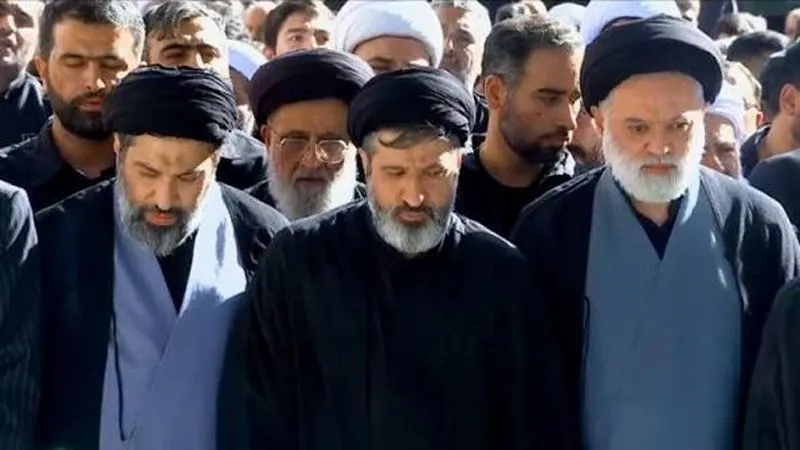
TEHRAN, July 5: Funeral prayers were held on Sunday for Iran's late Supreme Leader Ali Khamenei, as thousands of mourners, senior officials and military commanders gathered in Tehran on the second day of ceremonies following his death in a U.S.-Israeli airstrike earlier this year.
Khamenei, who led Iran from 1989 until his death at the age of 86, was killed in an airstrike on the first day of the US-Israel war against Iran on February 28.
The prayers at Tehran's Imam Khomeini Grand Mosalla were led by senior Shia cleric Ja'far Sobhani, a 97-year-old scholar based in the holy city of Qom, as senior officials, military commanders and members of the late leader's family gathered for the ceremony.
Notably absent from the ceremony was Mojtaba Khamenei, the late leader's son and successor, who has not appeared in public since being named Supreme Leader. Iranian media reports have suggested he was wounded in the February 28 attack.
Among those present were three of Khamenei's sons - Mostafa, Masoud and Meysam - who were seen praying over the coffins and mourning their father and other family members killed in the strike. However, Mojtaba Khamenei, who succeeded his father as Supreme Leader, did not appear at the ceremony, fuelling speculation about his whereabouts.
Mostafa Khamenei, 64, the eldest son of the late leader, is a Shiite cleric with limited formal political involvement but is regarded as influential in religious circles. Masoud Khamenei, 52, heads the Office for Preserving and Publishing Khamenei's Works, which oversees the publication of the former Supreme Leader's speeches and writings. Meysam Khamenei, 48, has maintained a lower public profile and has also worked with the same institution, Al Jazeera reported
Also attending the ceremony were Khamenei's son-in-law Mohammad Mohammadi Golpayegani and his father-in-law Gholam-Ali Haddad-Adel. Among the family members killed in the strike was four-year-old Zahra Golpayegani, whose small coffin drew visible emotion from mourners.
The funeral ceremonies entered their second day with thousands continuing to gather in Tehran, while a major funeral procession scheduled for Monday is expected to draw millions more participants.
Mourners carried Iranian national flags alongside red banners and flags bearing slogans including "Ya Latharat al-Hussein" (O Avengers of Hussein) and "Ya Latharat al-Khamenei" (O Avengers of Khamenei), invoking a long-standing Shia tradition that associates red banners with blood unjustly shed and calls for retribution, Al Jazeera reported.
The slogan referencing Khamenei adapts a historic Shia rallying cry linked to Imam Hussein, whose death in the Battle of Karbala in 680 AD remains a defining event in Shia Islam. The banners were widely displayed across the Grand Mosalla complex, alongside yellow Hezbollah flags.
Chants of "Death to America" and "Death to Israel" echoed through the crowd as mourners demanded retaliation for Khamenei's killing. The calls for revenge come as Iran remains engaged in negotiations with the United States, a process viewed sceptically by some attendees who pointed to previous periods of diplomacy that coincided with military confrontations.
Prominent figures attending the ceremony includes Islamic Revolutionary Guard Corps (IRGC) commander Brigadier General Ahmad Vahidi, whose appearance drew significant attention. Footage published by Iranian media Fars News showed Vahidi seated in the front rows among mourners, with some attendees seeking photographs with him.
Vahidi's appearance was notable because several senior IRGC commanders were killed during the conflict. Among them was IRGC chief Mohammad Pakpour, who was killed during the starting phase of the U.S.-Israeli war. Pakpour had succeeded Hossein Salami, who was killed in an earlier phase of hostilities.
The ceremony also featured speeches and poetry honouring the late leader. Poet Mohammad Rasouli drew loud chants from the crowd after asking, in an apparent reference to U.S. President Donald Trump, why "the most evil man in the world" was still alive, prompting cries of "Death to America" and "Death to Israel", as reported by Al Jazeera
The funeral proceedings are taking place against the backdrop of a fragile ceasefire reached in June after months of conflict between Iran, the United States and Israel. Earlier, Trump said talks with Iran would continue after the funeral ceremonies and stated that "neither side will shoot the other during the funeral proceedings."
The funeral of Khamenei, who led Iran for nearly four decades before being killed in the February US-Israel war, is being closely watched across the region as the country navigates both a leadership transition and ongoing tensions with Washington and its allies. (UNI)