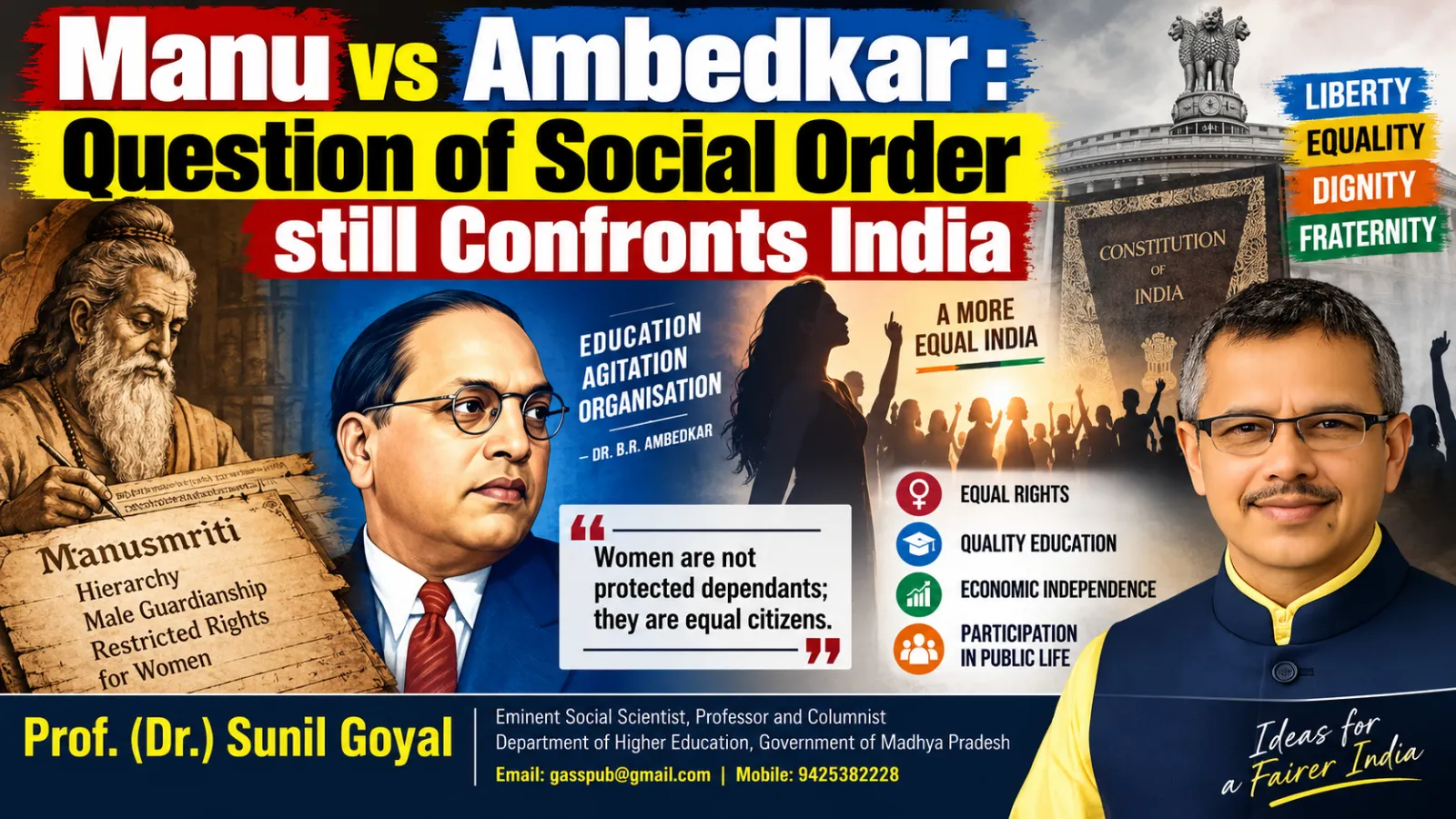
Manu vs Ambedkar : Question of Social Order still Confronts India
Prof. (Dr.) Sunil Goyal
Eminent Social Scientist, Professor and Columnist
Department of Higher Education, Government of Madhya Pradesh
Email gasspub@gmail.com Mobile 9425382228
The most unsettling lesson in the debate over Manusmriti is not that a text once described women as dependent. It is that social prejudice can be converted into state authority. Dr Bhimrao Ramji Ambedkar understood this danger with exceptional clarity. His critique was not a quarrel with history for its own sake; it was an argument about who gets freedom, who gets property, and who is permitted to shape a life.
Ambedkar’s burning of Manusmriti on December 25, 1927, symbolised opposition to untouchability and caste hierarchy. It also protested the text’s treatment of women. His account highlighted rules that denied women independence in childhood, marriage and widowhood; deprived them of control over property; restricted education and religious participation; and protected the man’s freedom while binding the woman to marriage.
This is why the debate cannot be reduced to whether one approves of an ancient scripture. Ideas acquire consequences when institutions reproduce them. A rule that places women under male guardianship may begin as a social prescription, but it becomes a political fact when families, community leaders and public authorities treat it as legitimate. Ambedkar’s warning was that Manu transformed a social theory into the law of the State.
The Constitution was designed to prevent precisely that transformation. Its promise of equality rejects the notion that women are naturally incomplete citizens. Reform of inheritance, marriage and family law was therefore not a concession to women; it was a correction to an unjust public order. The original struggle around the Hindu Code Bill showed how threatening genuine independence could be to those who preferred reform that made women more comfortable inside hierarchy, but not free from it.
That distinction remains important. Education is essential, but education without agency is a partial victory. Employment matters, but employment without safe mobility, equal care responsibilities and control over earnings leaves dependence intact. A woman may possess qualifications and still be told that family honour outranks her consent. She may earn a salary and still be expected to endure abuse rather than seek divorce. Formal progress cannot conceal substantive unfreedom.
Ambedkar’s method offers a standard for public life: judge institutions by the freedom they actually enable. Do women control their property? Can they choose whether and whom to marry? Can they leave a violent relationship? Can they speak, organise and dissent without being branded immoral? Are boys taught that equality requires a transformation of their conduct, not merely a change in women’s behaviour? These questions take us beyond symbolic condemnation.
They also expose the limits of selective reform. Patriarchy is not only a family custom or an individual man’s attitude. It is sustained by law, social expectation, economic dependence and the policing of sexuality. When caste endogamy is treated as honour, women’s choices become the frontier on which hierarchy is defended. The defence may use religious language, family sentiment or cultural anxiety, but its effect is the same: women are denied sovereign personhood.
To remember Ambedkar, India must do more than quote him. It must defend constitutional morality against every attempt to restore graded citizenship. The measure of tradition cannot be its age; it must be its compatibility with liberty and equality. The measure of reform cannot be the number of schemes announced; it must be the freedom a woman can exercise when her family, marriage or community turns against her.
That is the difference between reform and liberation.
Ambedkar asked India to confront the social order beneath its laws. That question remains before us. The answer will be credible only when women are treated not as protected dependants, but as equal makers of the republic.
Prof. (Dr.) Sunil Goyal
The author is an Eminent Social Scientist, Professor and Columnist, presently working at Department of Higher Education, Government of Madhya Pradesh. He can be reached at email gasspub@gmail.com Mobile 9425382228