Dr. D.K. Giri
India is learning to speak the language of both dharma and deterrence. This was in evidence in Prime Minister Modi’s visit to Indonesia.He is on a three-nation tour – Indonesia, 6-8 July, Australia, 8-10 and New Zealand, 10-11 July. At the time of writing (8 July), Modi had left for Australia and later New Zealand. The highlights from Jakarta are as follows.
This was Modi’s third visit to Indonesia as Prime Minister and the first bilateral engagement since both countries elevated ties to comprehensive strategic partnership in 2018. Modi became the first Indian Prime Minister to address the Indonesian Parliament. He invoked historical ties between two countries. India supported Indonesia’s independence at the UN.
Modi recalled Biju Patnaik’s 1947 daring rescue of Indonesian PM Sutan Sjahrir and VicePresident Mohammad Hatta on Nehru’s directions. He also praised Nehru for backing Indonesia’s freedom struggle and remembered that President Sukarno was the Chief Guest at India’s Republic Day in 1950.
Modi focussed on diversity as a foundation of unity, linking India’s Vasudhaiva Kutumbakam with Indonesia’s Bhinneka Tunggal Ika (different, yet one). Reference to Nehru in a foreign land by an RSS-BJP leader, at present the Prime Minister sparked social media debate, interpreting it as reaching across ideological lines to claim by partition foreign policy legacy.
Modi proposed a new ‘Ganga-Mahakam Vision’ to deepen cooperation in trade, tech, maritime security and Global South voice. This constitutes a base for consolidating India-Indonesia ties that may cause strategic worry to China.
India and Indonesia signed a MoU for supply of BrahMos supersonic cruise missile.The defence deal amounting to 630m USD made Indonesia the third country in the region after Philippines and Vietnam to get BrahMos. This deal has two major significances. One, it gives a major push for ‘Make in India’ defence exports and Indo-Pacific security with ASEAN’s largest economy. Second, it is not just about missiles, it is about maps. Indonesia sits astride the Malacca, Sunda, and Lombok straits – the choke points through which 40 per cent of world trade and 80 per cent of China’s oil passes.
By putting BrahMos missiles in coastal Indonesia, India is helping Jakarta secure sea lanes that Beijing wants unchallenged. At any rate, India is no longer just guarding its own coasts, it is partnering to guard Asia’s gateway. As one South Block officer put it: “We are not containing China. We are enabling our neighbours”. BrahMos to Indonesia is not about starting a war. It is about raising the cost of bullying. China understands costs. When Jakarta can say, “we have options”, Beijing has to recalculate.
Moreover, three ASEAN countries – Philippines, Vietnam and Indonesia, all with South China Sea concerns are now looking at Indian missiles. For China, this means India is moving from Act East rhetoric to Arm East action. On technical point, BrahMos range 290-400 km, supersonic, hard to intercept. So, deployment of BrahMos changes coastal deterrence math.
China has invested in ports: Gwadar (Pakistan), Hambantota (Sri Lanka), Kyaukpyu (Myanmar) and now penetrating in Indonesia’s Natuna area. India’s response is Sabang Port development plus BrahMos plus Maritime MoU. India’s perspective is, “we are not building bases, we are building capability with partners”. That is less provocative and harder to counter.
Indonesia can become a bridge between Quad and ASEAN. Indonesia is not in Quad, but it is ASEAN’s leader. By arming Indonesia, New Delhi is signalling to Quad partners – the US, Japan, Australia, “we can deliver security partners in ASEAN without making them choose sides”. For China, this is the real worry – India creating a network of capable, non-aligned states that can say NO to coercion.
On economic and strategic deals, 20 agreements were signed. They included critical minerals – cooperation on nickel, steel, rare-earth magnets. Indonesia has world’s largest nickel reserves which is key to India’s EV battery chain. A joint venture was made on steel between SAIL, India and Krakatau Steel to set up stainless steel plant in Indonesia. On education, IIM, Bengaluru will open campus in Indonesia. On healthcare, India will undertake to supply affordable Indian medicines and train Indonesian doctors. Digital collaboration aims at supporting Indonesia-Specific EVMs.
A UPI/ONDC (Unified Payment Interface/Open Network for Digital Commerce)-style digital commerce platform was also on the agenda. On maritime, an agreement was made to develop a framework for maritime safety and joint development of Sabang Port near Malacca Strait. A MoU was signed on agricultural collaboration. All in all, the total bilateral trade between two countries was 25b USD last year. Both leaders agreed to accelerate the preferential trade agreement talks to boost the trade.
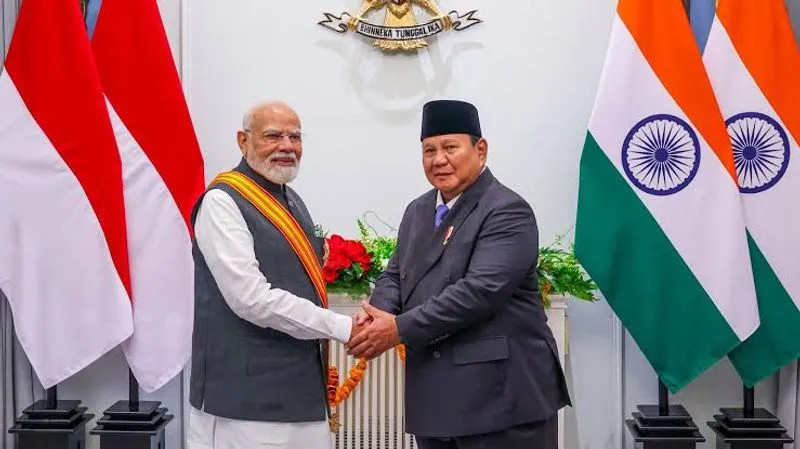
Modi received Indonesia’s highest civilian honour. In a handsome tribute to him, President Prabowo said, “he has been following Modi’s leadership and has learnt quite a few things from him”. He also acknowledged that Sanskrit had heavily influenced Indonesian languages.
Both leaders visited Prambanan Temple in Yogyakarta, a UNESCO site. Indonesia has a rich heritage of Ramayana – Hindu Buddhist culture. In tourist places, Indonesian puppetry narrates actions and stories from Ramayana. I have heard first-hand experience of Indonesian Muslim puppeteers reciting tales from Indian epics.
A civilisational-strategic approach to Indonesia was discernible in the visit to Indonesia. It combined temples and missiles – Prambanan in morning, BrahMos in evening. That seems like Modi’s foreign policy signature now. The second approach was defence diplomacy – BrahMos export should not be seen only in money terms. It signals India as a security provider in ASEAN, at a time China is competing.
The third aspect was history as a bridge – praising Nehru as well as Biju Patnaik, both leaders in opposite political camp, was a smart move. It conveyed to the Global South that India’s foreign policy has continuity not just party lines. That is an assurance when Donald Trump springs up with his disruptive foreign policy that undoes years of bilateral consolidation with US partners. That has certainly been the case with India in Trump’s second term.
The next leg of Modi’s tour is Australia. The agenda in consists of Quad, critical minerals, defence, education and diaspora. The specific items include Lithium, Cobalt, rare earths partnership, update on Quad maritime security, talks on mobility agreement for Indian students and skilled workers. Modi is scheduled to address the Indian community; Australia has 1 million plus Indians.
The last stop of Modi in the current tour is New Zealand. This will be first Prime Minister visiting New Zealand in many years. The purpose of the visit is trade – resuming FTA talks, diary and agriculture. Modi will talk Indo-Pacific security, climate change and people-to-people ties. As usual, diaspora engagement is also on the agenda.
The overall message of the three-nation tour is, “from Act East to Act Indo-Pacific” – defence with Indonesia, minerals plus Quad with Australia, trade and pacific outreach with New Zealand. (INFA)