Professor (Dr.) Sunil Goyal
Eminent Social Scientist, Professor and Columnist
Department of Higher Education, Government of Madhya Pradesh
Email gasspub@gmail.com Mobile 9425382228
India's demographic dividend can become a demographic advantage only when every child is healthy, educated, and adequately nourished. While economic growth creates opportunities, human development determines whether those opportunities translate into national progress. Recognising this reality, the Government of India transformed the Mid-Day Meal Scheme into PM POSHAN (Pradhan Mantri Poshan Shakti Nirman) in 2021, expanding its vision from merely providing meals to strengthening nutrition, health, education, and community participation. Today, PM POSHAN stands as one of the world's largest school feeding programmes and an important pillar of India's journey towards Viksit Bharat @2047.
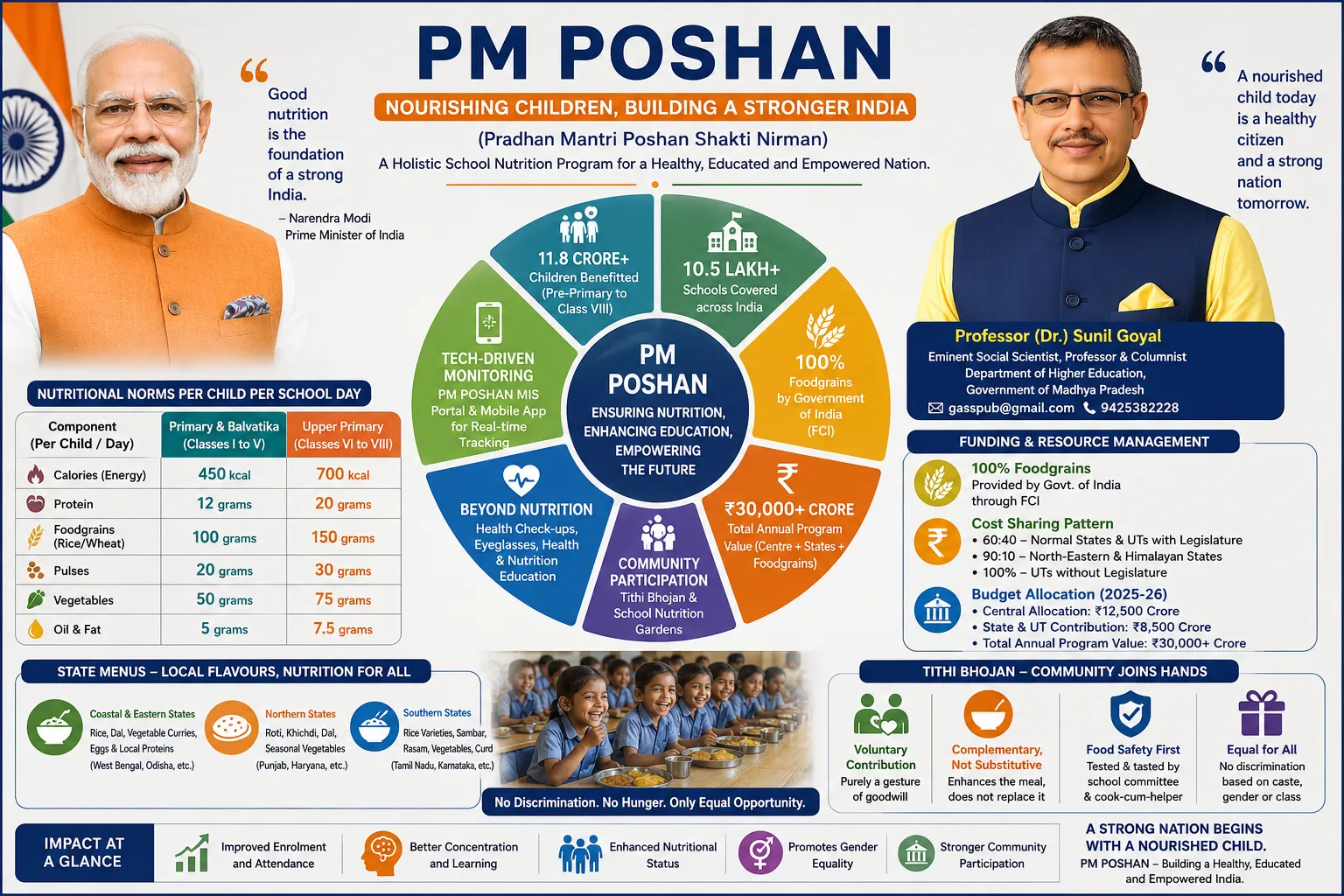
The scale of the programme is remarkable. PM POSHAN currently benefits more than 11.8 crore (118 million) children studying from Balvatika (pre-primary) to Class VIII across approximately 10.5 lakh government and government-aided schools. Few nations operate a nutrition programme of comparable magnitude. According to the 2025–26 Union Budget, the Central Government has allocated approximately ₹12,500 crore for PM POSHAN, while States and Union Territories contribute nearly ₹8,500 crore under the prescribed cost-sharing formula. Including the value of foodgrains supplied by the Food Corporation of India (FCI), the programme's annual financial commitment exceeds ₹30,000 crore, making it one of India's largest investments in child welfare.
The significance of PM POSHAN extends well beyond food security. Numerous studies by UNESCO, the World Food Programme (WFP), and UNICEF have demonstrated that school meal programmes improve enrolment, attendance, classroom concentration, learning outcomes, and gender parity. For economically vulnerable families, a nutritious meal at school often becomes a strong incentive to send children—particularly girls—to school regularly. Thus, PM POSHAN simultaneously addresses hunger, educational inequality, and social inclusion.
The nutritional framework under PM POSHAN reflects scientific planning. Every child in primary classes receives a meal providing approximately 450 kilocalories and 12 grams of protein, while students in upper primary classes receive around 700 kilocalories and 20 grams of protein. Standard food norms prescribe adequate quantities of cereals, pulses, vegetables, and edible oils to ensure balanced nutrition. Several States have gone further by providing eggs, milk, fruits, fortified foods, or region-specific protein supplements using their own financial resources.
One of the most progressive aspects of PM POSHAN is its emphasis on equity. The programme mandates that meals be served without discrimination based on caste, religion, gender, or social background. Every child sits together, eats together, and shares the same meal, reinforcing constitutional values of equality and social harmony. In many ways, the school dining space becomes one of India's earliest classrooms for social inclusion.
The transformation from the Mid-Day Meal Scheme to PM POSHAN also introduced important innovations. Digital governance has become central to programme monitoring. The PM POSHAN Management Information System (MIS) and mobile applications enable real-time reporting of meal distribution, attendance, foodgrain utilisation, and fund flow. Technology enhances transparency, reduces leakages, and strengthens accountability at every administrative level.
Equally noteworthy is the inclusion of School Nutrition Gardens, encouraging schools to cultivate vegetables, herbs, and fruits within their campuses. These gardens not only improve dietary diversity but also expose students to environmental sustainability, agriculture, biodiversity, and healthy food habits. Similarly, annual health check-ups, screening for nutritional deficiencies, and distribution of spectacles under school health initiatives strengthen the programme's holistic approach to child development.
The Tithi Bhojan initiative represents another innovative feature rooted in India's cultural traditions. It encourages voluntary community participation, allowing individuals, families, social organisations, and corporate institutions to contribute nutritious meals or supplements on special occasions such as birthdays, anniversaries, festivals, or national celebrations. Importantly, these contributions are voluntary, supplementary, and subject to strict food safety protocols. The initiative strengthens community ownership while reinforcing the traditional Indian ethos of "Annadaan"—sharing food as a social responsibility.
Yet challenges remain. According to the National Family Health Survey (NFHS-5), approximately 35.5% of Indian children under five remain stunted, around 19% suffer from wasting, and nearly 32% are underweight. Although PM POSHAN primarily targets school-going children above six years of age, these figures highlight the broader nutritional context in which the programme operates. Malnutrition, micronutrient deficiencies, and anaemia continue to affect learning ability, cognitive development, and long-term productivity.
Quality assurance must therefore remain a continuous priority. Adequate kitchen infrastructure, clean drinking water, hygienic cooking practices, regular inspection, food safety training, and timely release of funds are essential for maintaining public confidence. Periodic menu diversification, inclusion of local millets under the International Year of Millets initiative, and greater use of fortified foods can further improve nutritional outcomes while supporting local agriculture.
The programme also offers opportunities for convergence with other national initiatives such as Poshan Abhiyaan, Ayushman Bharat School Health Programme, Swachh Bharat Mission, Jal Jeevan Mission, and the National Education Policy 2020. Together, these initiatives can create an integrated ecosystem where nutrition, sanitation, health, and education reinforce one another.
Globally, India has demonstrated that large-scale social programmes can successfully combine welfare with technology, decentralised implementation, and community participation. PM POSHAN is increasingly viewed as a model for developing countries seeking to improve educational outcomes through school nutrition. Its scale, inclusiveness, and institutional framework illustrate how targeted public investment in children generates long-term social and economic returns.
Ultimately, PM POSHAN is not merely a meal programme—it is an investment in India's human capital. Every nutritious lunch served strengthens a child's health, enhances classroom learning, supports family welfare, and contributes to a more productive workforce in the future. As India aspires to become a developed nation by 2047, ensuring that no child studies on an empty stomach is not simply a welfare objective; it is a national development imperative. A nourished child today is the educated, skilled, and confident citizen who will build tomorrow's India.