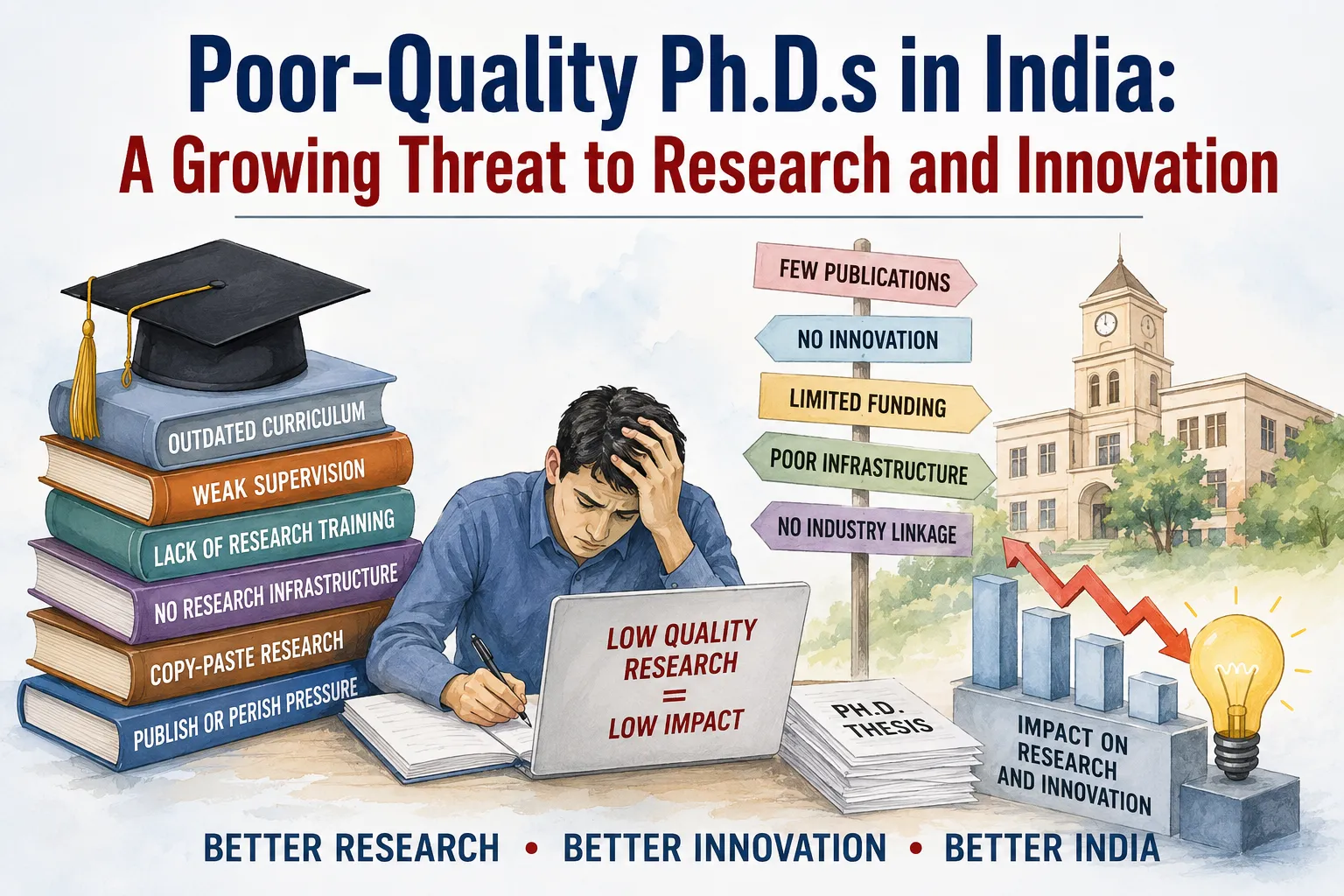
Poor-Quality Ph.D.s in India:
A Growing Threat to Research, and Innovation
Professor R.K. Uppal, [PhD, D.Litt.]
Principal S.PS Badal College of Mgmt. and Tech. Gidderbaha (Pb.)
……………………………………………………………………………………………
A Doctor of Philosophy (Ph.D.) degree represents the highest level of academic achievement. It is expected to produce original knowledge, encourage critical thinking, and generate solutions to complex social, scientific, technological, and economic problems. A strong doctoral education system is the backbone of a nation's research ecosystem and a key driver of innovation-led growth. Unfortunately, India is witnessing a growing crisis in the quality of doctoral education. While the number of Ph.D. degrees awarded has increased dramatically over the past decade, concerns over their quality, originality, and practical relevance have become equally significant. Unless this issue is addressed with urgency, India's dream of becoming a global knowledge economy may remain elusive.
India has made remarkable progress in expanding higher education. Hundreds of universities and research institutions now offer doctoral programmes, and the number of Ph.D. scholars has reached unprecedented levels. Expansion, however, should never be mistaken for excellence. The pursuit of quantity has often overshadowed the pursuit of quality. In many institutions, particularly where academic standards are weak, doctoral education has become a routine academic exercise rather than a rigorous research endeavour.
One of the most serious concerns is the declining originality of doctoral research. A Ph.D. is expected to contribute new knowledge to a discipline. Instead, many dissertations merely replicate previous studies with slight modifications in variables, geographical areas, or sample sizes. Such research rarely addresses emerging national challenges or contributes meaningful insights to global scholarship. Thousands of theses remain on university shelves or digital repositories without ever being cited, commercialized, or translated into public policy or industrial innovation.
Poor supervision is another major factor behind weak doctoral research. High-quality research depends on experienced, dedicated, and research-active supervisors who can mentor scholars throughout the research process. Unfortunately, many institutions face a shortage of qualified supervisors. Some faculty members are assigned an excessive number of research scholars, leaving little time for meaningful academic guidance. In certain cases, supervisors themselves have limited research publications or exposure to international research standards. Without effective mentoring, scholars struggle to develop sound research methodologies, analytical skills, and academic writing abilities.
Another challenge is the inadequate research infrastructure available in many universities. Quality research requires well-equipped laboratories, modern libraries, reliable internet access, advanced software, funding support, and subscriptions to leading international journals. Many institutions, especially smaller private universities, lack these essential facilities. Consequently, scholars are compelled to rely heavily on secondary data and outdated literature, reducing the originality and impact of their work. Genuine innovation cannot flourish without sustained investment in research infrastructure.
The increasing commercialization of higher education has further complicated the situation. In some institutions, doctoral programmes have become a source of revenue rather than centres of research excellence. The emphasis often shifts towards enrolling larger numbers of Ph.D. candidates instead of maintaining rigorous admission standards and academic quality. When financial considerations dominate academic priorities, research inevitably suffers. A doctoral degree should never become a commodity; it must remain a symbol of intellectual excellence and scholarly integrity.
Academic misconduct also poses a serious threat. Despite the availability of plagiarism-detection software, instances of copied content, fabricated data, duplicate publications, and unethical research practices continue to surface. Such practices damage the credibility of Indian universities and reduce international confidence in Indian research. Maintaining academic integrity requires not only technological tools but also a strong ethical culture, transparent evaluation systems, and strict institutional accountability.
Equally concerning is the weak connection between doctoral research and the needs of industry and society. Much of the research undertaken in Indian universities has limited practical application. Businesses, government agencies, and local communities often remain disconnected from university research. As a result, many Ph.D. graduates possess theoretical knowledge but lack experience in solving real-world problems. Countries that lead in innovation, such as the United States, Germany, South Korea, and China, have successfully integrated universities with industry, encouraging collaborative research that results in patents, start-ups, technological breakthroughs, and policy innovations. India must strengthen similar partnerships if doctoral education is to contribute meaningfully to national development.
The consequences of poor-quality Ph.D.s extend far beyond universities. Weak doctoral research reduces India's global research rankings, limits technological advancement, discourages foreign collaboration, and weakens the country's competitiveness in the knowledge economy. Moreover, when poorly trained Ph.D. graduates become future teachers and research supervisors, the cycle of mediocrity continues, affecting generations of students.
Government agencies, regulatory bodies, and universities must also invest substantially in research funding, laboratories, digital resources, international collaborations, and faculty development. Creating a vibrant research ecosystem requires long-term commitment, not short-term administrative reforms. Equally important is fostering a culture that rewards originality, critical inquiry, ethical conduct, and innovation rather than merely counting the number of degrees awarded.
India stands at a crucial moment in its educational journey. The country aspires to become a global leader in science, technology, innovation, and economic development. These ambitions cannot be achieved through a doctoral system that prioritizes quantity over quality. A Ph.D. should represent intellectual excellence, independent thinking, and meaningful societal contribution—not simply another academic qualification.
The future of India's higher education system depends not on producing more doctoral degrees but on producing better researchers. By restoring academic rigour, strengthening research supervision, investing in infrastructure, enforcing ethical standards, and linking research with national priorities, India can transform its doctoral education system into a powerful engine of innovation and sustainable development. The message is clear: the nation does not merely need more Ph.D.s—it needs Ph.D.s that create knowledge, solve problems, and shape a better future.