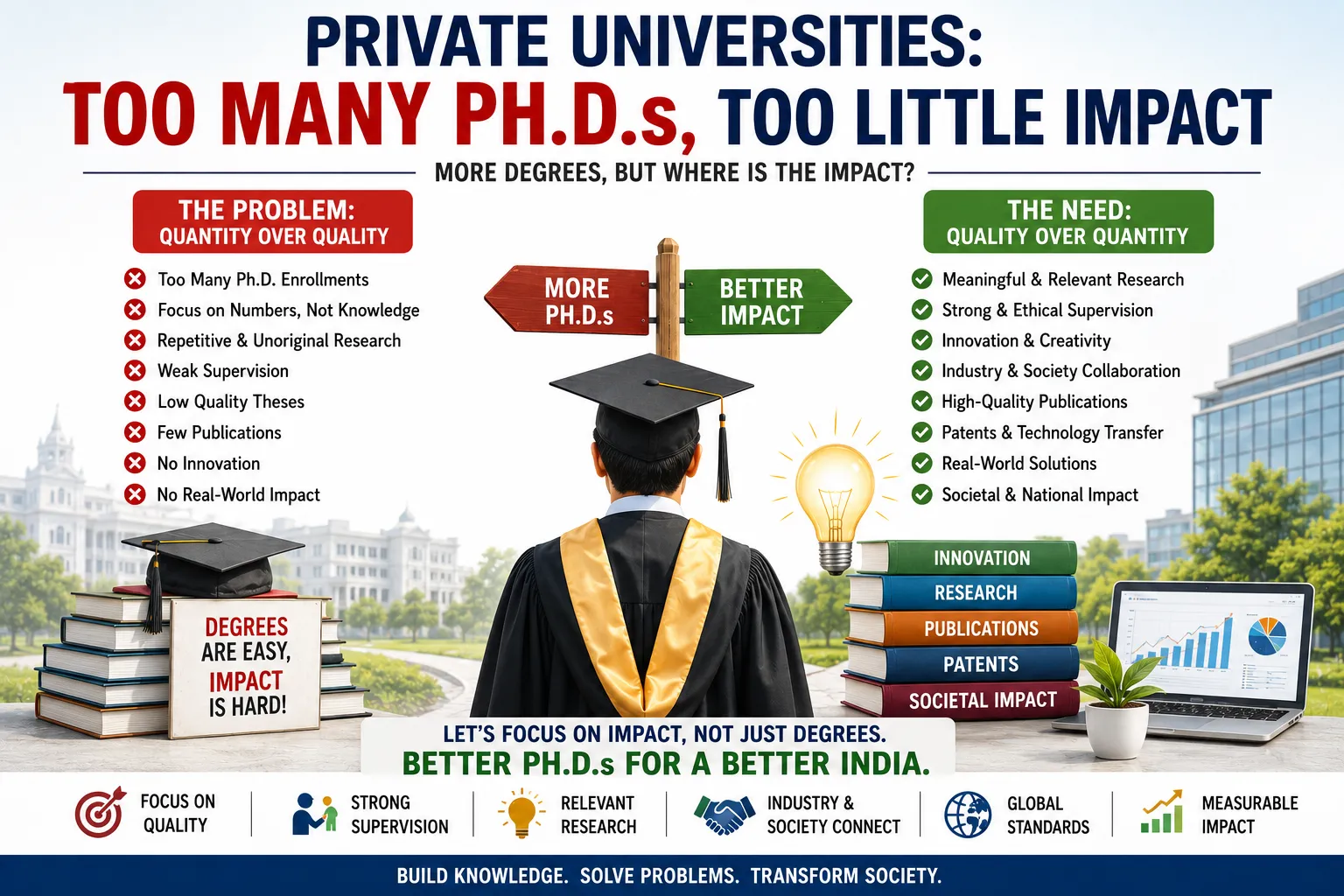
Private Universities:
Too Many Ph.D.s, Too Little Impact
Professor R.K. Uppal, [PhD, D.Litt.]
Principal S.PS Badal College of Mgmt. and Tech. Gidderbaha (Pb.)
……………………………………………………………………………………………
India has witnessed a remarkable expansion in doctoral education over the past two decades. The number of universities has grown rapidly, particularly in the private sector, and thousands of students are awarded Ph.D. degrees every year. While this growth appears impressive on paper, it raises an important question: Are this Ph.D.s translating into meaningful innovation, scientific discoveries, industrial development, or public policy improvements? The uncomfortable reality is that India is producing more Ph.D. holders than ever before, yet the overall impact of much of this research remains limited.
A Ph.D. is the highest academic qualification and should symbolize originality, intellectual excellence, and a significant contribution to knowledge. It is intended to produce researchers capable of solving complex problems, developing new technologies, influencing policymaking, and advancing society. Unfortunately, in many institutions, the focus has shifted from creating knowledge to awarding degrees.
Many universities proudly advertise the number of Ph.D. degrees they confer each year. However, they rarely highlight how many doctoral theses resulted in patents, innovative products, influential policy recommendations, startup companies, or internationally recognized research publications. A thesis that remains unread in a university library or digital repository cannot be regarded as fulfilling the true purpose of doctoral education.
One major reason behind this impact gap is the increasing emphasis on quantity rather than quality. Universities often measure their academic success by the number of doctoral scholars enrolled or degrees awarded instead of evaluating the originality and usefulness of the research. This approach encourages routine and repetitive studies rather than bold, innovative investigation .
“India does not face a shortage of Ph.D. degree holders. It faces a shortage of high-impact doctoral research. The challenge before universities is clear: stop measuring success by the number of degrees awarded and start measuring it by the knowledge created, the problems solved, and the positive change generated. Only then will India's doctoral education system become a true driver of innovation, competitiveness, and national development.”
The quality of research supervision is another critical issue. Effective doctoral education requires experienced supervisors who actively guide scholars in identifying important research questions, designing rigorous methodologies, maintaining ethical standards, and publishing high-quality work. When supervision becomes merely a formal requirement, research quality inevitably declines. Universities must ensure that only qualified and research-active faculty members supervise doctoral candidates.
Another concern is the selection of research topics. Many scholars continue to work on issues that have already been extensively studied, resulting in limited originality and minimal practical relevance. Doctoral research should increasingly focus on emerging national and global challenges such as artificial intelligence, renewable energy, climate change, public health, cyber security, sustainable agriculture, financial inclusion, digital governance, and social development. Research connected to real-world challenges has a far greater chance of generating measurable impact.
The disconnect between universities and industry further reduces the usefulness of doctoral research. In leading research nations, universities work closely with industries, government departments, and research laboratories. Doctoral students often solve practical problems, develop commercial technologies, or contribute directly to policy formulation. In India, however, many Ph.D. projects remain isolated within academic institutions, with little interaction with industries or public agencies. Stronger collaboration between academia and industry can transform doctoral research into a powerful engine of innovation.
Evaluation standards also require strengthening. A Ph.D. thesis should be examined by experienced and independent experts with proven research credentials. Transparent, objective, and rigorous evaluation safeguards academic standards and ensures that doctoral degrees maintain their credibility. Institutions should avoid treating the examination process as a mere formality.
Research ethics has become equally important in today's academic environment. The misuse of artificial intelligence, plagiarism, fabricated data, predatory journals, and unethical publication practices threatens the integrity of research worldwide. Universities must enforce strict ethical standards, provide training in responsible research practices, and promote originality at every stage of doctoral work.
Government policies should also encourage quality over quantity. Research funding should increasingly reward institutions that produce impactful research rather than simply larger numbers of doctoral graduates. Performance indicators such as patents, technology transfers, high-quality publications, citations, industrial collaborations, startup creation, and policy influence should become central measures of research excellence.
At the same time, it is important to recognize that not every Ph.D. thesis is expected to produce a revolutionary invention. Fundamental and theoretical research often advances knowledge gradually and forms the foundation for future discoveries. Nevertheless, every doctoral scholar should aim to make an original contribution that advances the discipline and, wherever possible, addresses important societal or economic challenges.
India has the intellectual talent and demographic advantage to become a global leader in research and innovation. However, this ambition cannot be realized merely by increasing the number of doctoral degrees. Universities must cultivate a research culture that values curiosity, creativity, interdisciplinary collaboration, and measurable impact. Doctoral education should encourage scholars to think beyond academic publications and explore how their research can improve industries, strengthen public institutions, enhance economic development, and improve the quality of life.
The future of Indian higher education depends not on the number of Ph.D. degrees awarded every year but on the value those degrees create. Universities should celebrate discoveries, innovations, patents, policy reforms, and societal contributions rather than simply counting graduates. Excellence in research should become the defining characteristic of doctoral education.