Every year during the hot summer months, India's hill states experience a major crisis as above-normal heat and prolonged dry spells begin to transform areas from the Himalayan foothills all the way into Northeast India's forests into active fire zones. Though wildfires are typically categorised as an environmental issue focused primarily on the number of trees lost due to wildfires, they also have significant effects on the social and economic aspects of the people living in proximity to forested areas, as not only will they have lost their homes, but their safety and means of existence are also greatly threatened as a result of wildfires. The Rajouri district in Jammu and Kashmir shows this painful reality perfectly. located within the rugged terrain of the Pir Panjal Range and is primarily covered by Chir Pine trees. Every spring and summer, the Chir Pine trees drop a thick blanket of dry resinous Pine needles on the forest floor, creating a highly flammable forest floor that requires only a long dry spell and a small ignition source for very large and very fast-moving wildfires to start. Residents play an important role on the frontline in response to wildfires. Recent video footage from Rajouri's Doongi block shows young volunteers and local villagers working tirelessly day and night to contain the wildfire. Therefore, residents are providing the initial response to the fire. By using only their own physical means to fight the fire with freshly cut green branches and basic hand tools, these community members are saving their communities.
Rajouri’s Burning Hills: When Forest Fires Become a Social Crisis
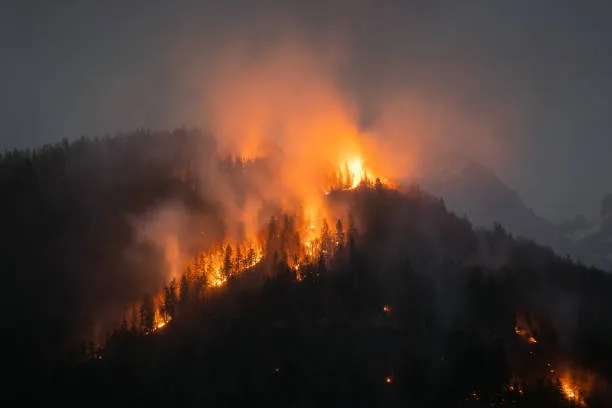
While the firefighting is done by locals all over the nation, government records show that humans are also usually the cause of the ignition. According to data from the Forest Survey of India (FSI), 95% of forest fires in India are caused by humans, as recorded by the government in three classifications:
Clearing farmland: Fires that were started to clear the leftover crop accidentally entered the woods.
Growing fresh grass: Fire set on purpose by local herders to burn dry leaves so new green grass could grow faster for livestock.
Accidental carelessness: People throw burning cigarettes or bidi butts out car windows on the mountain highway, or leave campfires to continue burning.
However, simply blaming local people ignores how much they depend on the forest to survive. These people depend on the forest floor for firewood, grazing and collecting forest products; without these resources, they have no way to live. When the forests are burned down, the results can be catastrophic. An example of this can be found in a recent and significant increase in fires, when 1,135 fire incidents occurred that resulted in 3,154 hectares of forest land being destroyed in the Jammu region alone. For a family of local individuals, this would have directly impacted their grazing land, thus leading to the animals not receiving the necessary food items to remain in good health, and a depression of milk production, eventually resulting in their overall household economy being destroyed.
Along with the above negative impact of fires within Rajouri is the additional factor of its location on the sensitive border and the serious impact they create on the security of this border. When wildfires travel through the heavy undergrowth, they will often create a situation where accidental landmine explosions occur; this will eliminate some of the defensive military posts, and put civilian lives, along with the lives of workers and livestock, at immediate danger. Thus, a simple forest fire can become a national security crisis.
The government will have to stop simply responding to fires and begin developing proactive relationships with the community to address the Wildfire issue in Rajouri.
Turn Pine Needle Waste Into Economic Incentives: Local factories should be established to stockpile dry pine needles before the summer heat. These needles can be converted into fuel briquettes and/or used as handicrafts. This program will clear the potential fire fuel from the forest floor and create jobs for area residents.
Support Local Firefighters: Villagers should not have to rely on green branches to suppress grass fires. If we want to be effective at limiting the spread of grassfires, we must support youth and formally train and compensate them using the Joint Forest Management Committees (JFMCs) structures already in place. At a minimum, these teams should be provided with appropriate fire safety and firefighting equipment.
Create Mountain Water Storage Systems: The government of Jammu and Kashmir must create high-elevation water storage systems in forest areas that are most susceptible to fire. This will provide workers and firefighters with immediate access to water when they combat wildfires.
In conclusion, the summer haze rising from Rajouri mountain is not an environmental issue alone. It is also a socially driven crisis resulting from climate change affecting human existence. The services of these forests must recognise the local bordering communities as partners, not pollution creators. By assisting the people who live in these mountains, Jammu and Kashmir will be able to protect their green forests and sustain their rural economy.
Sohrab Sharma is a Doctoral Candidate in the Department of Sociology at Hemvati Nandan Bahuguna Garhwal University (Central University), Uttarakhand. His research focuses on borderland conflict and community resilience in conflict-affected zones, with a specific focus on the Rajouri district of Jammu & Kashmir. For correspondence, he can be contacted at sohrab.9645@gmail.com. The views expressed are personal.