Role of Higher Educational Institutions
in Developing Critical Thinking Among Students
Prof. R.K. Uppal. [PhD, D.Litt.]
…………………………………………………………………
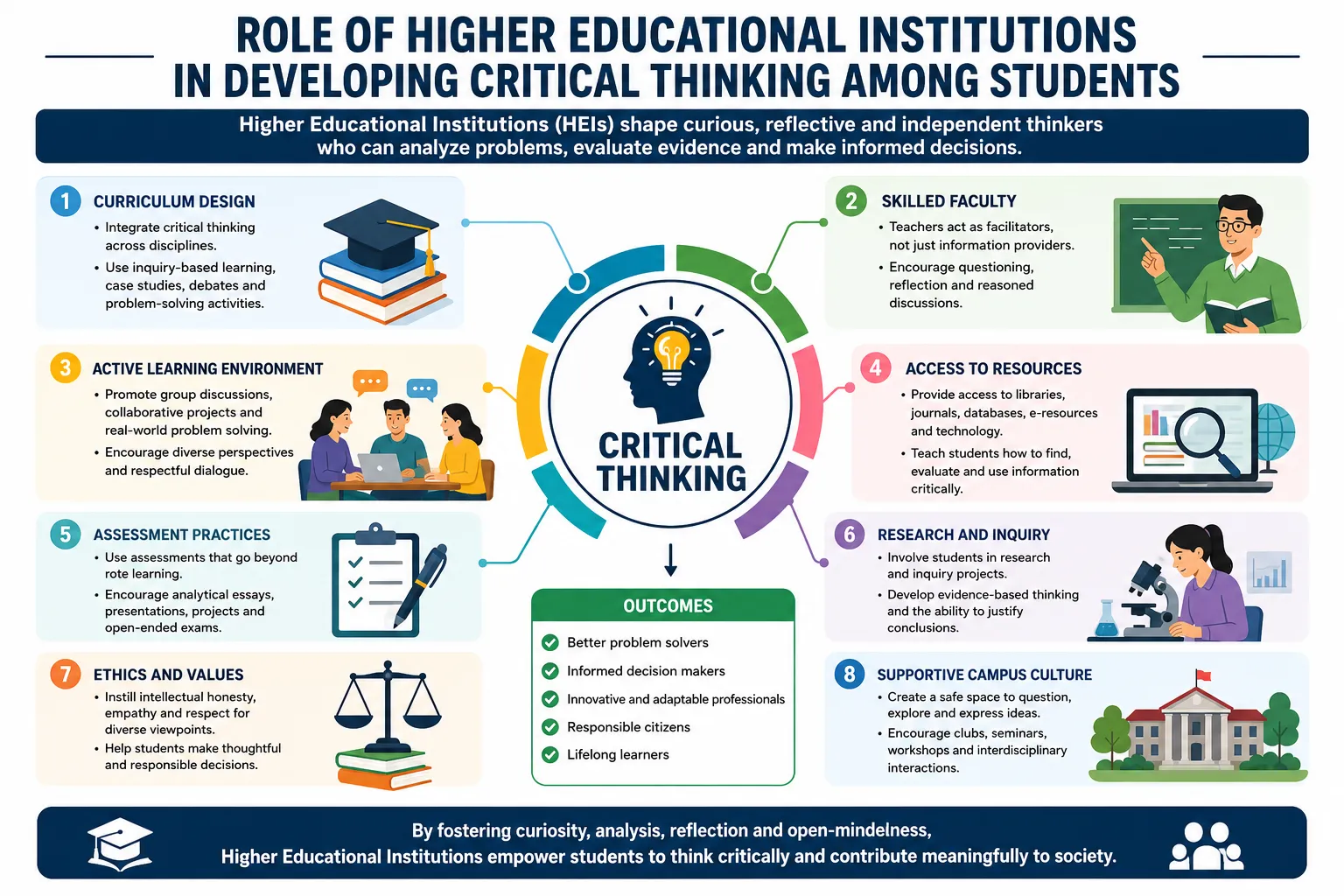
Higher educational institutions play a crucial role in shaping the intellectual, professional, and personal development of students. In today's rapidly changing world, where knowledge is expanding at an unprecedented pace and technology is transforming every aspect of life, the ability to think critically has become more important than ever. Employers, policymakers, and society increasingly expect graduates to possess not only subject knowledge but also the ability to analyze information, solve complex problems, make informed decisions, and adapt to new situations. Therefore, one of the primary responsibilities of higher educational institutions is to cultivate critical thinking among students, preparing them to become competent professionals, lifelong learners, and responsible citizens.
Critical thinking is the ability to think clearly, rationally, and independently. It involves analyzing information objectively, evaluating evidence, identifying assumptions, recognizing biases, solving problems creatively, and making sound judgments based on logical reasoning. Rather than accepting information at face value, critical thinkers question ideas, explore multiple perspectives, and draw conclusions supported by facts and evidence. These skills enable students to navigate complex situations, distinguish credible information from misinformation, and make informed decisions in both academic and real-life contexts.
Higher educational institutions provide an ideal environment for developing critical thinking because they expose students to diverse ideas, cultures, disciplines, and experiences. Universities and colleges encourage intellectual inquiry by promoting academic freedom, open discussions, and evidence-based learning. Students interact with peers and faculty members from different backgrounds, which broadens their perspectives and challenges preconceived notions. Such an environment fosters curiosity, reflection, and independent thinking—essential characteristics of critical thinkers.
Teaching methods adopted by higher educational institutions play a significant role in promoting critical thinking. Traditional lecture-based instruction, which primarily focuses on memorization, is gradually being replaced by student-centered approaches that actively engage learners. Methods such as problem-based learning, case studies, project-based learning, debates, seminars, simulations, role-playing, and collaborative group discussions encourage students to analyze real-world situations, evaluate alternative solutions, and justify their opinions with logical arguments. These interactive teaching strategies help students move beyond passive learning and develop analytical, evaluative, and creative thinking skills.
Faculty members are at the heart of developing critical thinking among students. Effective teachers do more than deliver content; they inspire inquiry, encourage questioning, and facilitate meaningful discussions. By asking thought-provoking questions, providing constructive feedback, and creating an inclusive learning environment, educators motivate students to explore ideas independently and support their arguments with evidence. Faculty members who model intellectual curiosity, ethical reasoning, and open-mindedness encourage students to adopt similar habits. Continuous professional development enables teachers to integrate innovative pedagogical techniques that further enhance critical thinking.
Research and innovation provide valuable opportunities for students to develop higher-order thinking skills. Participation in research projects enables students to formulate research questions, review scholarly literature, collect and analyze data, interpret findings, and draw evidence-based conclusions. These activities require logical reasoning, creativity, perseverance, and objective evaluation. Undergraduate research programs, innovation laboratories, entrepreneurship cells, and interdisciplinary research initiatives encourage students to investigate complex problems and develop innovative solutions. Such experiences not only strengthen critical thinking but also enhance confidence and independent learning.
Technology has transformed higher education and created new opportunities for developing critical thinking. Online learning platforms, digital libraries, artificial intelligence tools, virtual laboratories, and educational applications provide students with access to extensive information and learning resources. However, the abundance of digital content also increases the risk of misinformation and unreliable sources. Higher educational institutions must therefore promote digital literacy and information literacy by teaching students how to evaluate the credibility, accuracy, relevance, and authenticity of information. The responsible use of technology empowers students to become informed and discerning learners in the digital age.
Beyond classroom teaching, co-curricular and extracurricular activities significantly contribute to critical thinking development. Participation in debates, quizzes, model parliaments, student research conferences, innovation competitions, hackathons, community service programs, cultural activities, and leadership initiatives exposes students to real-world challenges and diverse viewpoints. These experiences improve communication, teamwork, leadership, ethical reasoning, and decision-making skills while encouraging students to think independently and responsibly. Community engagement and service-learning projects, in particular, help students connect academic knowledge with societal issues and develop practical problem-solving abilities.
Despite the recognized importance of critical thinking, several challenges hinder its effective development in higher education. Examination-oriented education systems, overcrowded classrooms, rigid curricula, inadequate faculty training, and limited institutional resources often encourage rote learning rather than analytical thinking. In some cases, students hesitate to question teachers or express differing opinions due to cultural or institutional barriers. Addressing these challenges requires comprehensive educational reforms, including curriculum redesign, faculty development, innovative assessment practices, investment in digital infrastructure, and the promotion of an open and inclusive academic culture that values inquiry and intellectual independence.
Higher educational institutions should adopt a holistic strategy to promote critical thinking across all disciplines. Critical thinking should not be confined to specific subjects but integrated into every aspect of teaching, learning, research, and assessment. Institutions should encourage interdisciplinary education, collaborative learning, experiential learning, industry partnerships, research participation, and international academic exposure. Faculty members should receive continuous training in learner-centered pedagogies, while institutional policies should recognize and reward innovation in teaching and learning. Such initiatives create an academic ecosystem that nurtures curiosity, creativity, and evidence-based reasoning.
In conclusion, higher educational institutions have a fundamental responsibility to develop critical thinking among students. As society faces increasingly complex economic, technological, environmental, and social challenges, graduates must possess the ability to think analytically, evaluate evidence objectively, solve problems creatively, and make ethical decisions. Through innovative teaching methods, well-designed curricula, research opportunities, technology integration, authentic assessment, and enriching co-curricular activities, higher educational institutions can cultivate these essential competencies. By fostering critical thinking, universities and colleges not only enhance academic excellence and employability but also prepare students to become informed citizens, responsible leaders, and lifelong learners capable of contributing meaningfully to national development and global progress.