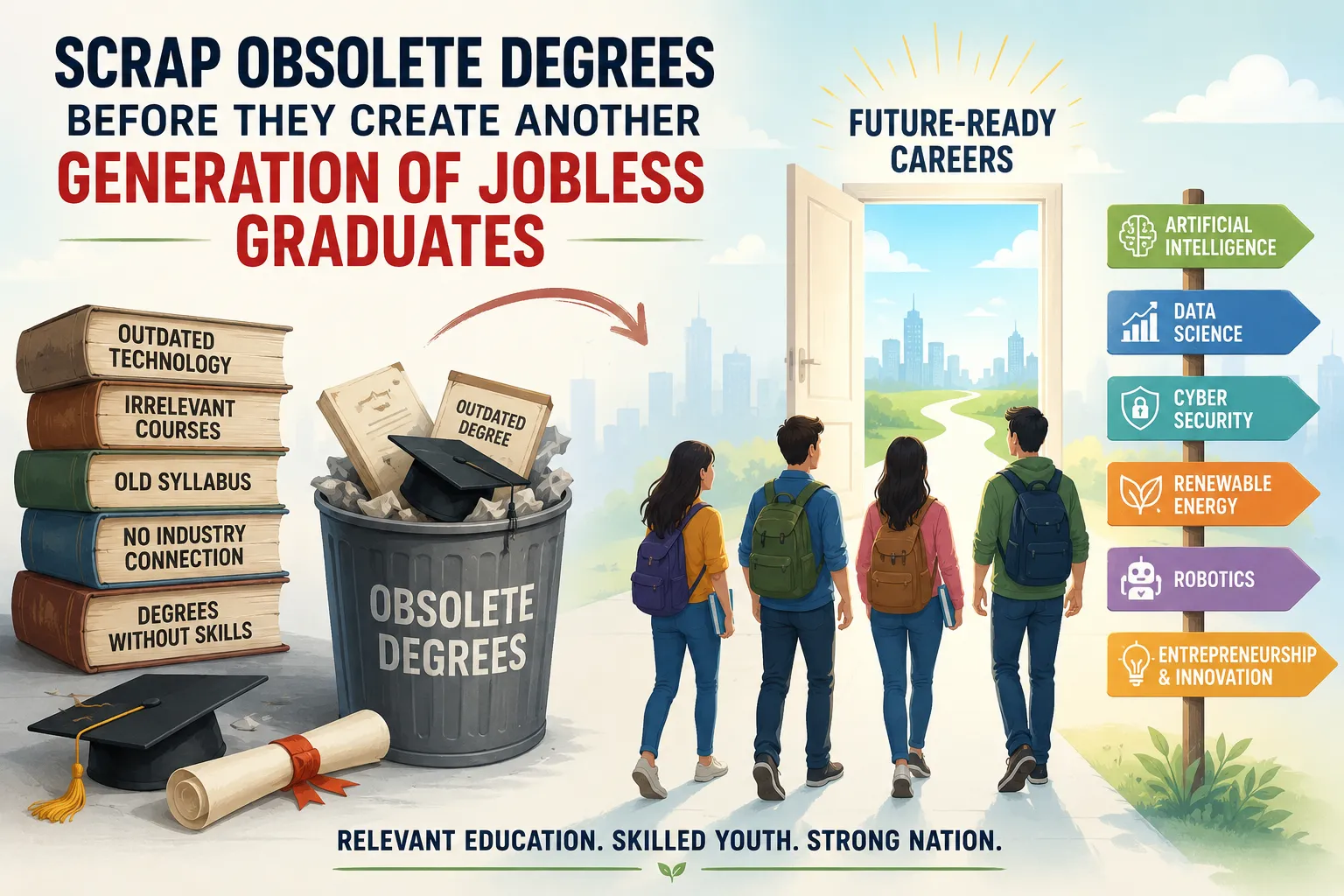
Scrap Obsolete Degrees Before They Create Another Generation of Jobless Graduates
Prof. R.K. Uppal. [PhD, D.Litt.]
……………………………………………………………………………………………………
India is home to one of the world's largest higher education systems, with thousands of universities and colleges producing millions of graduates every year. Yet, despite this impressive scale, graduate unemployment continues to rise. Employers frequently complain about a shortage of skilled professionals, while graduates struggle to secure meaningful jobs. This paradox highlights a fundamental problem: many academic degrees and programs no longer match the needs of modern industry.
The world of work is changing at an unprecedented pace. Artificial intelligence, automation, robotics, data science, cybersecurity, renewable energy, biotechnology, fintech, and digital manufacturing are reshaping every sector of the economy. New occupations are emerging, while many traditional jobs are disappearing. However, numerous Indian universities continue to offer degree programs designed decades ago, with outdated syllabi, obsolete teaching methods, and little relevance to contemporary industrial requirements.
China recently attracted global attention by discontinuing thousands of university degree programs that no longer aligned with its economic priorities and technological ambitions. The objective was straightforward: ensure that higher education supports national development and prepares students for future industries. India should seriously examine this approach. While every country has different educational priorities, regularly reviewing academic programs and discontinuing those that have lost relevance is a sound policy for any nation seeking sustained economic growth.
Unfortunately, many universities continue offering courses simply because they have existed for years or generate steady admissions. Students enroll with the hope that a university degree will improve their future, only to discover after graduation that employers no longer value the knowledge and skills they have acquired. This mismatch wastes students' time, drains family resources, and weakens the nation's human capital.
The solution is not to eliminate traditional disciplines altogether. Subjects such as history, literature, economics, philosophy, sociology, and political science continue to play a vital role in building an informed and democratic society. However, these disciplines must also evolve by integrating digital skills, analytical tools, interdisciplinary learning, entrepreneurship, and practical applications. Every academic program should periodically demonstrate its relevance, quality, and employability outcomes.
Industry participation must become central to curriculum development. Universities should not revise syllabi once every five or ten years. Instead, curriculum reviews should be conducted regularly with active involvement from employers, industry experts, professional bodies, startups, and researchers. Courses that consistently fail to provide employable skills or meaningful career opportunities should either be redesigned or gradually phased out.
Equally important is the introduction of future-oriented programs. India requires greater investment in degrees related to artificial intelligence, machine learning, semiconductor technology, quantum computing, green technologies, climate science, healthcare innovation, logistics, advanced manufacturing, financial technology, and digital entrepreneurship. These are the sectors that will create employment, attract investment, and strengthen India's global competitiveness over the coming decades.
The implementation of the National Education Policy (NEP) 2020 has introduced welcome flexibility through multidisciplinary education, multiple entry and exit options, and the Academic Bank of Credits. These reforms represent important progress. However, flexibility alone cannot solve the employability crisis if universities continue teaching outdated content. Curriculum innovation, institutional autonomy, stronger industry partnerships, and continuous quality improvement must become the next phase of higher education reform.
Universities must also be evaluated not merely by the number of degrees they award but by the quality of graduates they produce. Graduate employment rates, employer satisfaction, research impact, startup creation, innovation, internships, and industry collaborations should become key performance indicators. Higher education institutions should compete to produce competent professionals, innovators, and entrepreneurs—not simply degree holders.
Faculty development is equally critical. Teachers require continuous exposure to emerging technologies, industrial practices, digital teaching methods, and applied research. Without well-trained faculty, even the best-designed curriculum cannot produce high-quality graduates. Investment in faculty training is therefore an investment in national productivity.
India cannot aspire to become a developed nation while producing graduates equipped for industries that no longer exist. Every obsolete program that remains unchanged increases the gap between education and employment. Every student graduating with outdated knowledge represents a lost opportunity for both the individual and the economy.
Educational reform should not be driven by tradition or institutional convenience. It must be guided by evidence, labour market needs, technological progress, and national priorities. Governments, universities, regulators, accreditation agencies, industry associations, and employers must work together to establish a robust mechanism for periodically reviewing all academic programs. Degrees that consistently fail to demonstrate relevance should be restructured, merged, or discontinued, while emerging fields should receive greater institutional support.
India's demographic advantage will become meaningful only if its young people possess skills that match the demands of the twenty-first-century economy. Producing millions of graduates without ensuring their employability serves neither students nor the nation. The objective of higher education should not simply be to distribute degrees but to prepare graduates who can innovate, adapt, and contribute to economic and social development.
The message is clear: India must stop preserving obsolete degrees simply because they have existed for decades. The future belongs to nations whose universities anticipate change rather than react to it. Scrapping outdated programs and replacing them with industry-relevant, future-ready education is no longer an option—it is an urgent national necessity. Unless bold reforms are undertaken today, India risks creating yet another generation of jobless graduates in an increasingly competitive global economy.