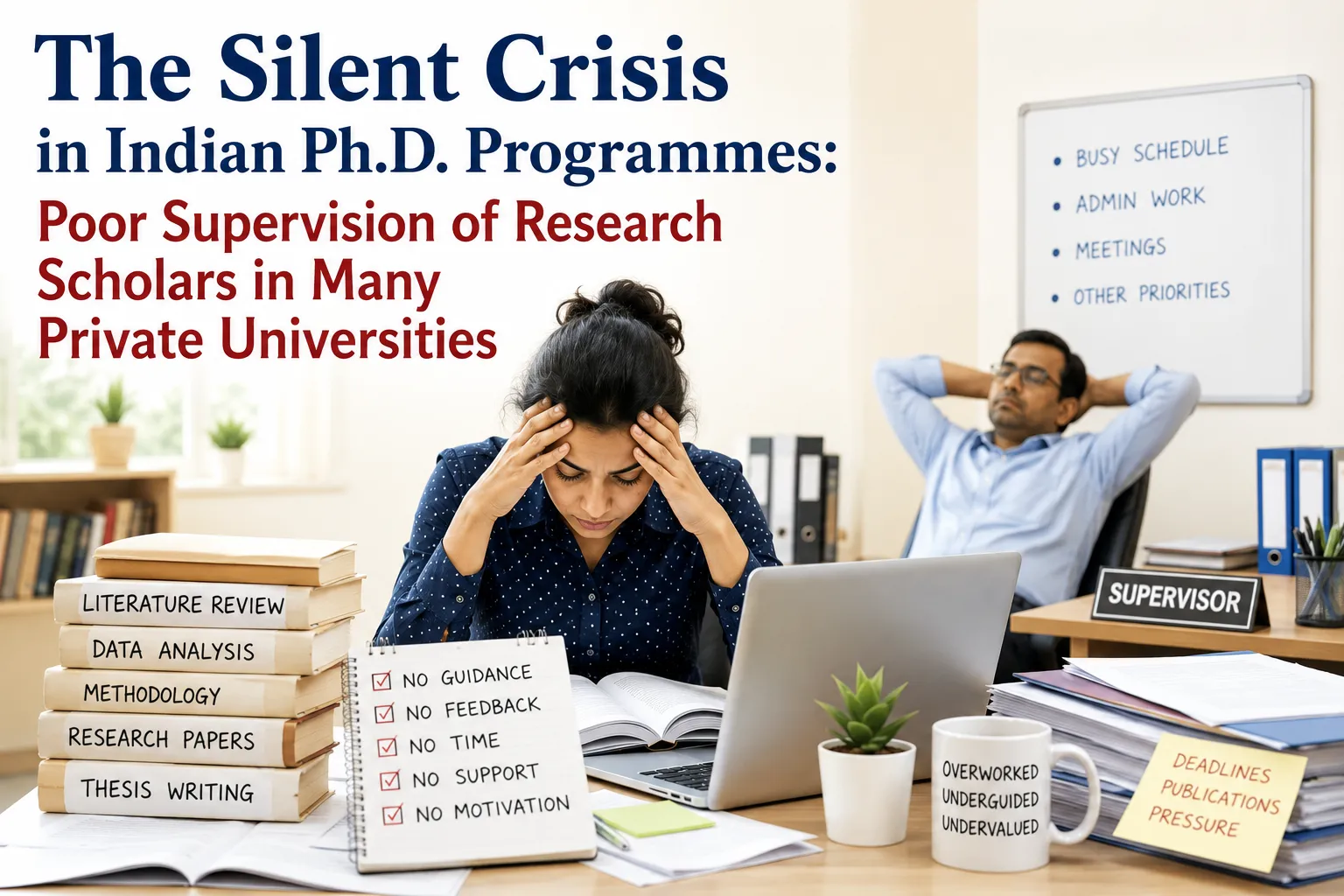
Silent Crisis in Indian Ph.D. Programs:
Poor Supervision of Research Scholars in Many Pri. Uni.
Professor R.K. Uppal, [PhD, D.Litt.]
Principal S.PS Badal College of Mgmt. and Tech. Gidderbaha (Pb.)
…………………………………………………………………………………………………..
India is striving to establish itself as a global leader in higher education, research, and innovation. With the implementation of the National Education Policy (NEP) 2020, universities have been encouraged to strengthen research ecosystems, promote multidisciplinary education, and increase doctoral enrolment. Consequently, the number of Ph.D. scholars has grown significantly across public and private universities. However, beneath this encouraging expansion lies a silent crisis that threatens the future of Indian research. Thousands of doctoral scholars are grappling with burnout, academic isolation, inadequate mentorship, financial uncertainty, and growing mental stress. Unless these issues are addressed urgently, India's dream of becoming a global research powerhouse may remain unfulfilled.
A Ph.D. is widely regarded as the highest academic qualification, requiring years of dedication, intellectual curiosity, and perseverance. It is expected to produce original knowledge, innovative solutions, and future academic leaders. Unfortunately, for many scholars in India, the doctoral journey is becoming increasingly stressful rather than intellectually rewarding.
Another equally serious concern is academic isolation. Unlike undergraduate or postgraduate education, doctoral research is largely an independent pursuit. While independent thinking is an essential characteristic of research, complete isolation can be harmful. In many Indian universities, research scholars have limited opportunities to collaborate with peers, participate in research groups, or engage in interdisciplinary discussions. Some scholars spend months working alone with minimal interaction beyond occasional meetings with their supervisors. Such isolation weakens creativity, reduces confidence, and often results in feelings of loneliness. Research flourishes in an environment of dialogue and collaboration, not in academic solitude.
Many supervisors are burdened with heavy teaching responsibilities, administrative duties, accreditation work, and the supervision of numerous research scholars simultaneously. As a result, doctoral students often receive delayed feedback, irregular meetings, and insufficient academic guidance. In some institutions, scholars report months passing without meaningful discussions about their research progress. Lack of constructive criticism and timely support delays research completion and reduces the overall quality of dissertations.
Financial insecurity further intensifies these challenges. Although fellowships are available through agencies such as the University Grants Commission (UGC), Council of Scientific and Industrial Research (CSIR), and Indian Council of Social Science Research (ICSSR), many deserving scholars either fail to receive funding or experience long delays in fellowship disbursement. Self-financed scholars often depend on part-time jobs or family support to continue their research. Financial stress not only affects their academic performance but also discourages talented students from pursuing doctoral studies.
Career uncertainty is another source of growing frustration. Every year, Indian universities award thousands of Ph.D. degrees, but employment opportunities in universities, research institutes, and industry have not expanded proportionately. Academic recruitment is often slow, highly competitive, and unpredictable. Many highly qualified researchers spend years working on temporary contracts, fellowships, or guest faculty appointments without long-term career security. This uncertainty diminishes the attractiveness of doctoral education for future generations.
Mental health has become one of the least acknowledged aspects of doctoral education. Feelings of anxiety, depression, self-doubt, loneliness, and imposter syndrome are increasingly common among research scholars. Yet, many universities lack professional counseling services, peer-support networks, or structured mentoring programmes. The stigma surrounding mental health further discourages scholars from seeking help. Institutions that aspire to become centers of excellence must recognize that the well-being of researchers is as important as their academic achievements.
The rapid integration of artificial intelligence (AI) into higher education has introduced both opportunities and challenges. AI-powered tools can assist researchers with literature reviews, language improvement, data analysis, and reference management. However, they cannot replace critical thinking, originality, ethical reasoning, or meaningful mentorship. Instead of depending excessively on technology, universities should focus on strengthening human guidance, research ethics, and scholarly integrity.
Addressing this silent crisis requires comprehensive institutional reforms. Universities should establish structured mentor training programmes to improve supervisory skills in communication, ethics, research planning, and student engagement. The number of scholars assigned to each supervisor should remain within manageable limits to ensure quality guidance. Regular research seminars, interdisciplinary workshops, collaborative projects, and peer-learning groups should become integral components of every doctoral program. Such initiatives would reduce isolation while fostering a vibrant research culture.
Equally important is the need to strengthen financial support systems. Fellowships should be adequate, timely, and transparent so that scholars can concentrate on research without financial anxiety. Universities must also expand mental health services by providing professional counseling, wellness programmes, and confidential support mechanisms. Career development cells should help doctoral scholars prepare for opportunities in academia, industry, public policy, entrepreneurship, and international research institutions.
India possesses extraordinary intellectual talent and an expanding higher education system. What it now requires is an equally strong commitment to nurturing its researchers. Investing in supportive mentorship, healthy research environments, adequate funding, and scholar well-being is not merely an educational priority—it is a national imperative. If India truly aims to become a global innovation leader, it must ensure that its Ph.D. scholars are empowered, supported, and inspired throughout their academic journey. Only then will doctoral education produce not only degrees but also discoveries that contribute to national development and global progress.