Quantity over Quality:
Why India's Ph.D. System Needs Urgent Reform
A Doctor of Philosophy (Ph.D.) is the highest academic qualification, symbolizing intellectual excellence, original research, and the ability to contribute new knowledge to society. Every Ph.D. scholar is expected to investigate complex problems, generate innovative ideas, and provide evidence-based solutions that benefit academia, industry, government, and society. For a nation that aspires to become a global knowledge superpower, the quality of doctoral education is not merely an academic issue—it is a matter of national importance.
Over the last two decades, India has witnessed an extraordinary expansion in higher education. Hundreds of new universities have been established, and thousands of students now enroll in Ph.D. programmes every year. Private universities have played an important role in increasing access to doctoral education, especially in regions where research opportunities were previously limited. Many private institutions have invested significantly in laboratories, libraries, international collaborations, and research infrastructure, producing outstanding scholars and meaningful research.
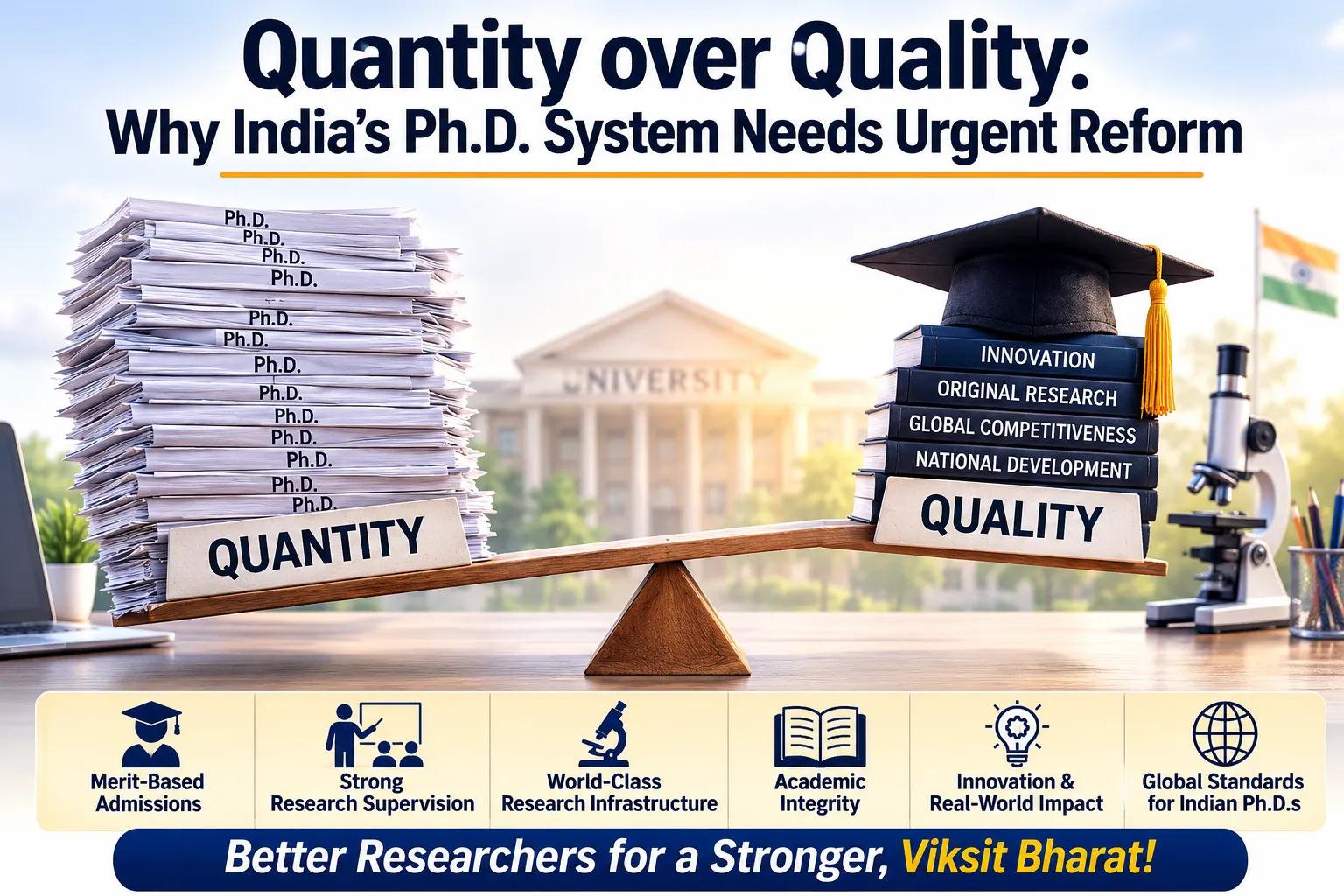
However, alongside these encouraging developments, there are growing concerns that in some institutions, the emphasis has shifted from research excellence to increasing Ph.D. enrolments. The objective of doctoral education should be to create innovators and problem-solvers, not simply to award more degrees. When quantity becomes the primary indicator of success, quality often becomes the first casualty. The first concern relates to admissions. Admission to a Ph.D. programme should be based on academic merit, research aptitude, and a genuine passion for scholarly inquiry. A rigorous selection process ensures that only capable and committed candidates undertake doctoral research. If admission standards are diluted, institutions may struggle to maintain high-quality research outcomes.
Another important issue is research supervision. A competent research supervisor is the backbone of every successful Ph.D. programme. Supervisors guide scholars in selecting research problems, designing methodologies, analyzing data, publishing findings, and maintaining academic ethics. However, when faculty members supervise too many scholars simultaneously or lack sufficient research experience, meaningful mentorship becomes difficult. Doctoral research cannot flourish without continuous intellectual engagement between supervisors and scholars.
Research infrastructure is equally critical. High-quality research demands access to modern laboratories, digital libraries, advanced software, research databases, funding support, and opportunities for interdisciplinary collaboration. Institutions that lack these essential resources face significant challenges in producing research that meets global standards. A Ph.D. cannot achieve excellence if scholars do not have the necessary academic environment to conduct meaningful investigations.
Academic integrity is another pillar of quality doctoral education. Originality, honesty, and ethical conduct are fundamental principles of research. Universities must implement strict plagiarism detection systems, transparent evaluation procedures, and independent external assessments to ensure that every doctoral thesis reflects genuine scholarly work. The credibility of Indian research depends upon maintaining uncompromising academic standards.
Publication practices also deserve attention. In recent years, publication requirements have become an integral part of doctoral programmes. However, emphasis should be placed on publishing in reputed, peer-reviewed journals rather than merely fulfilling numerical publication requirements. The objective should be the dissemination of quality research that advances knowledge rather than increasing publication counts without significant academic contribution.
The consequences of poor-quality doctoral education extend far beyond universities. Today's Ph.D. scholars become tomorrow's professors, scientists, policymakers, consultants, entrepreneurs, and innovators. If their research training is weak, the impact will be felt across the entire higher education ecosystem. Weak doctoral education ultimately affects teaching quality, research productivity, technological innovation, industrial competitiveness, and evidence-based policymaking.
India has ambitious aspirations under initiatives such as Viksit Bharat 2047 to emerge as a global leader in innovation, technology, and knowledge creation. These ambitions cannot be achieved simply by increasing the number of doctoral graduates. Countries that lead global innovation—such as the United States, Germany, South Korea, Japan, and several European nations—focus on producing high-quality research with real-world applications. Their success demonstrates that excellence, not volume, drives research leadership.
Doctoral research should increasingly address national priorities. India faces significant challenges in agriculture, healthcare, renewable energy, artificial intelligence, cybersecurity, financial inclusion, environmental sustainability, education, and rural development. Ph.D. scholars should be encouraged to undertake interdisciplinary and problem-oriented research that contributes directly to solving these challenges. Research must move beyond library shelves and become an instrument of national transformation.
The solution is not to reduce access to Ph.D. education but to strengthen quality assurance. Universities should adopt transparent admission processes, appoint qualified supervisors, maintain reasonable supervisor-to-scholar ratios, invest in research infrastructure, encourage international collaborations, and establish robust mechanisms for monitoring research progress. Continuous faculty development programmes can also enhance supervisory skills and research culture.
Regulatory bodies have an equally important role. Periodic academic audits, outcome-based accreditation, independent evaluation of doctoral programmes, and strict enforcement of research ethics can help ensure consistent standards across institutions. Universities demonstrating excellence should be encouraged and rewarded, while institutions that fail to meet minimum quality benchmarks should be required to improve through structured reforms.
Industry–academia collaboration should become a defining feature of doctoral education. Many research problems originate in industry, government, and society. When doctoral scholars work with industries, research laboratories, hospitals, financial institutions, and public agencies, their work becomes more relevant, innovative, and impactful. Such collaborations also improve employability and facilitate the commercialization of research outcomes.
India also needs to promote a culture that values innovation over mere credentialism. A Ph.D. should never be viewed as simply another qualification for career advancement. It should represent curiosity, intellectual discipline, creativity, and the pursuit of solutions to real-world problems. Universities must create research ecosystems where originality is celebrated, ethical conduct is uncompromising, and academic excellence becomes the defining institutional culture.
The future of India's higher education system depends not on how many Ph.D. degrees are awarded each year but on how much new knowledge those degrees create. A single groundbreaking doctoral thesis can transform an industry, influence public policy, improve healthcare, or create technologies that benefit millions. Such contributions are possible only when universities place quality above quantity.
India possesses immense intellectual talent, capable faculty, and enormous research potential. By strengthening doctoral standards, investing in research infrastructure, fostering innovation, and maintaining rigorous academic integrity, the country can build a doctoral education system that commands global respect. The goal should not be to produce the largest number of Ph.D. graduates, but to produce researchers whose work advances science, strengthens society, supports economic growth, and enhances India's position as a leading knowledge economy. The future belongs to nations that create knowledge, not merely those that distribute degrees. India's Ph.D. system must therefore prioritize quality over quantity if it is to become a true engine of innovation and national development.