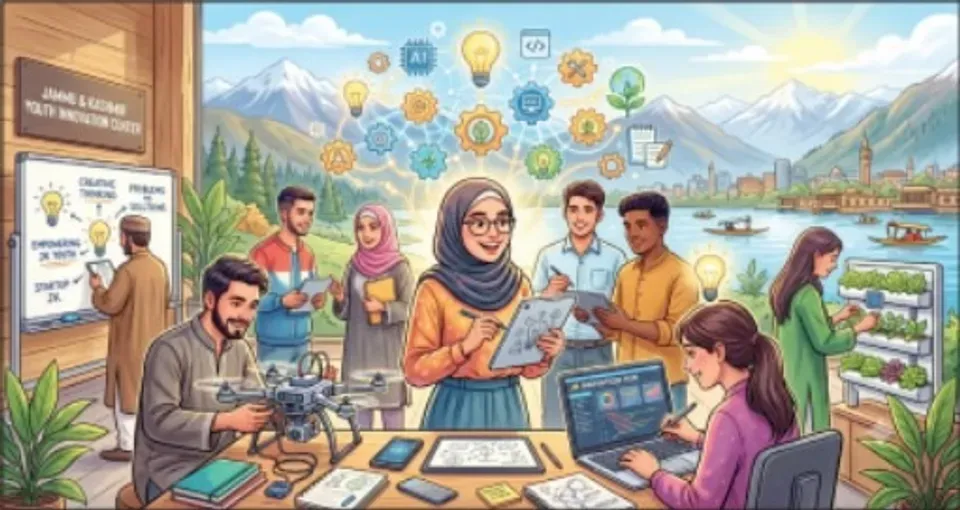
Scientific innovation is one of the most powerful tools for transforming society and empowering youth. Today, many young people are educated and talented, yet they remain dependent on government jobs or traditional employment systems. The need of the time is to create an environment where youth become innovators, entrepreneurs, and job providers rather than only job seekers.
Innovation does not mean only big inventions or advanced machines. It means developing the ability to observe problems, think scientifically, and create practical solutions that benefit society. A young person who develops a useful idea for agriculture, education, healthcare, environment, technology, or public services is also an innovator. If such ideas are properly supported, they can develop into startups, industries, and employment-generating enterprises.
Jammu & Kashmir has immense talent and some of the finest young minds. A large number of youth possess innovative ideas and creative thinking. Many students and researchers are working on solutions related to technology, renewable energy, agriculture, artificial intelligence, healthcare, tourism, and environmental protection. However, many of these talented youth continue to struggle because they lack guidance, funding, mentorship, incubation facilities, and proper government support. Many innovators move from office to office in search of help and encouragement. This situation needs immediate attention.
The government must come forward with a serious and long-term approach to promote innovation and scientific entrepreneurship among youth. A high-level technical committee of experts should be constituted to frame a comprehensive innovation policy for Jammu & Kashmir within a stipulated timeframe. The policy should clearly define goals, responsibilities, funding mechanisms, incubation support, and collaboration between institutions. Most importantly, the policy should not remain confined to discussions and paperwork. It should be approved quickly and implemented practically so that work begins at the ground level without delay.
Educational institutions have a major role in creating an innovation culture. Schools, colleges, universities, and technical institutions should establish innovation and research labs where students can experiment, design projects, and develop ideas. Students should be encouraged to identify local problems and create scientific solutions for them. Innovation competitions, science fairs, startup challenges, and technology exhibitions should be organized regularly to motivate young minds.
Scientific thinking should begin from early childhood. Children must be encouraged to ask questions, perform simple experiments, and explore the world with curiosity. Education should move beyond rote learning and focus more on creativity, problem-solving, critical thinking, and practical knowledge. When students learn to think independently, they become confident innovators.
Institutions such as Sher-e-Kashmir University of Agricultural Sciences and Technology, National Institute of Technology Srinagar, and Indian Institute of Technology Jammu are already doing valuable work in the fields of research, innovation, and technology. Their efforts are encouraging and deserve appreciation. However, the absence of a comprehensive policy and coordinated roadmap continues to hamper the overall process. There is a need to connect universities, industries, startups, financial institutions, and government departments through one integrated innovation framework.
Youth should also be trained in entrepreneurship along with science and technology. They need knowledge about business planning, digital marketing, financial management, patents, product development, and startup culture. This training will help them convert ideas into sustainable enterprises. Small innovations can often become major employment generators if they are guided properly.
At the same time, innovation must not remain limited to urban areas only. Rural youth also possess immense talent and practical understanding of local problems. Special innovation centres and startup support systems should be developed in rural and remote areas so that talented youth from every section of society get equal opportunities.
Jammu & Kashmir should also seek expert guidance and cooperation from successful institutions and innovation models outside the Union Territory and even outside the country. Many nations and regions have developed excellent systems for promoting startups, scientific research, and entrepreneurship among youth. We should study such models carefully and adopt those ideas and practices that are beneficial for our society and suitable for our local conditions.
Innovation should always be connected with ethics and service to humanity. Science and technology should not only focus on profit but also on solving human problems, protecting the environment, improving education, reducing suffering, and strengthening unity in society. Youth should be taught that the true purpose of knowledge is service to humanity.
The future of Jammu & Kashmir depends greatly on how successfully we empower our youth scientifically and intellectually. If proper policies, guidance, infrastructure, and encouragement are provided, the youth of this region can become creators of opportunity rather than seekers of opportunity. They can build startups, industries, technologies, and solutions that will strengthen the economy and bring progress to society.
The greatest investment of a nation is not only in roads, buildings, or machines, but in awakening the creative and innovative power of its young people.
Dr Nasir Shah, Former Additional Director JKSTIC, DST, has remained actively associated with the promotion of science, scientific temper, innovation, and educational awareness across J&K.