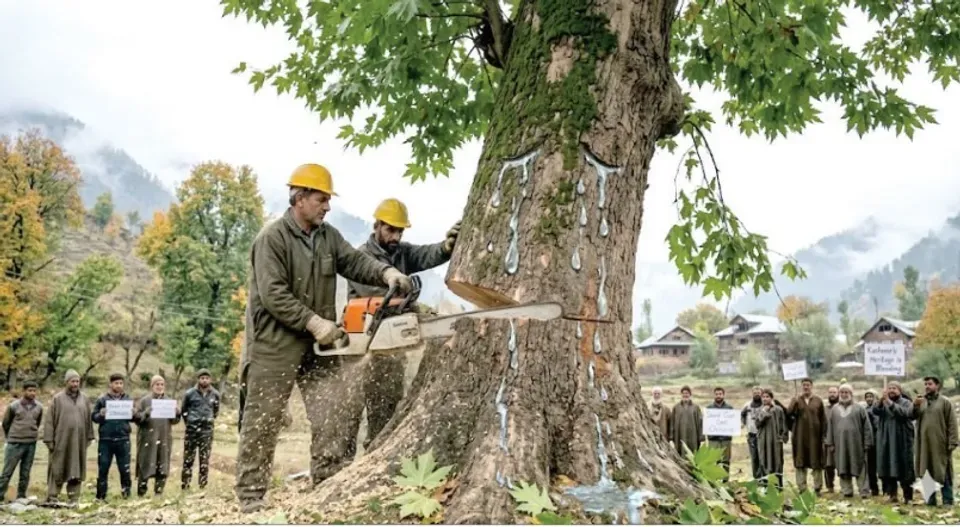
Permission is given for pruning Chinar trees and then they are axed to death
Chinar, locally known as Booen, is Kashmir’s identity. This majestic tree also called Oriental plane (Platanus orientalis) is found throughout the landscape of the Kashmir valley and some parts of Jammu region as well. It has been recognised as a Royal Tree under the section 36 of J&K Land Revenue Act 1939 (Samvat 1996). Chinar was brought to Kashmir from central Iran. It is believed that the oldest known Chinar tree which is around 650 years old was planted in Chattergam area of Chadoora in District Budgam by a central Asian preacher Syed Qasim Shah Hamadani (RA). It is said that this tree is one of the oldest chinar trees in Asia? During the Mughal Rule in Kashmir their local Governors planted hundreds of Chinars across Kashmir especially in the Mughal Gardens of Shalimar, Nishat, Achabal and many areas around Srinagar. During Pathan and Sikh rule the local authorities used to plant Chinar trees and in the Dogra rule 1846-1947 thousands of Chinars were planted in the length and breadth of Kashmir. The last Dogra ruler Maharaja Hari Singh is said to have ordered massive plantation of Chinars and the most important Chinar that was planted by him is present at Lalit Grand Palace hotel of Srinagar. This palace used to be the residence of Maharaja Hari Singh.
Birds losing their habitat
Due to urbanisation in Kashmir a large number of Chinars were cut down, especially during the last 30 to 40 years. With the decreasing numbers of Chinars and many other special trees like walnut and mulberry, even the avian life of Kashmir is also getting adversely affected. This has impacted not only the environment but the entire biodiversity of Kashmir which includes the habitat of birds, especially those who visit Kashmir during summer months and make their nests on local trees. The biddulphi subspecies of the Tawny Owl - Strix aluco, endemic to the western Himalaya, is also found in Chinar trees. Furthermore, the Kashmir Flycatcher Ficedula subrubra, is known to breed only in the Kashmir Valley. The natural home of many of these avian species may get lost forever, if the illegal tree felling is not stopped.
Axing of Chinars
In the last few months alone dozens of trees have been axed under the garb of pruning. During road widening of Baramulla to Kupwara dozens of Chinar trees were cut down. On Srinagar Bandipora road I found dozens of Chinars felled or pruned in such a way that it will never grow again? All this is done for road widening and what authorities call “development”. In this age of technological advancement when we have made so much development in the field of science, technology and AI, how can we even think of cutting green trees under the name of infrastructural development? The trees axed on highways in Kupwara, Bandipora, Srinagar, Ganderbal, Budgam or other districts could have been transplanted easily had the Govt authorities consulted the experts in J&K Forest Department, SKUAST-K, and Floriculture Department. Even if there would have been only a 50 % survival rate we could have saved dozens of Chinars?
I remember a few years back a 40 year old Chinar tree was removed on Foreshore Road Srinagar and transplanted in Char Chinar island of Dal Lake. This transplanted Chinar tree has successfully grown and I saw it myself a few years back. In fact I had an interaction with the then Principal Chief Conservator of Forests-PCCF Mr Mohit Gera and congratulated him for the great work forest and floriculture departments jointly did in collaboration with Sher e Kashmir University of Agriculture Sciences-SKUAST-Srinagar and Lakes Conservation Management Authority-LCMA.
Supreme Court Judgements on Tree Felling
The Supreme Court of India in its judgment M.K.Ranjitsinh vs Union of India, reported as 2024 INSC 280 on the importance of Articles 48 A and 51 A(g) of the Constitution of India as being important sources of the right to a clean environment and the right against the adverse effects of climate change has said that state shall endeavour to protect and improve the environment and to safeguard the forests and wildlife of the country. The said ruling reads as:
“Article 48 A of the Constitution provides that the State shall endeavour to protect and improve the environment and to safeguard the forests and wildlife of the country. Clause (g) of Article 51A stipulates that it shall be the duty of every citizen of India to protect and improve the natural environment including forests, lakes, rivers and wildlife, and to have compassion for living creatures. Although these are not justiciable provisions of the Constitution, they are indications that the Constitution recognises the importance of the natural world. The importance of the environment, as indicated by these provisions, becomes a right in other parts of the Constitution. Article 21 recognises the right to life and personal liberty while Article 14 indicates that all persons shall have equality before law and the equal protection of laws. These articles are important sources of the right to a clean environment and the right against the adverse effects of climate change.”
The Supreme Court, in its judgment M.K.Ranjitsinh vs Union of India has held that the right to life under Article 21 must be interpreted progressively to include the right to a clean and healthy environment, which is essential for the enjoyment of other fundamental rights.
Conclusion
It is important that an investigation be done into all the tree felling cases and a third party be involved to conduct this in-depth probe. This author has already taken the case to National Green Tribunal-NGT and the matter is listed around July. In the last few months alone dozens of Chinar trees were cut down / looped in Ganapora Kralgund Handwara, Pulwama near district court, Thokerpora Pulwama on way to Pakherpora, Lalbazar Srinagar near G D Goenka School and other areas. Authorities are mulling to cut down 58 Chinar trees in Ganderbal for construction of the Semi Ring Road from Manigam to Nagbal. At a time when temperature in Kashmir is increasing year by year, the trees are our only hope, especially big trees, but I am unable to understand who is allowing this onslaught? Seminars and conferences will be held today on the eve of World Environment Day, but I see all this as a mockery. We say something and do its opposite?
Dr Raja Muzaffar Bhat is Founder of J&K RTI Movement & Chairman J&K Climate Action Group