Professor (Dr.) Sunil Goyal
Eminent Social Scientist, Professor and Columnist
Department of Higher Education, Government of Madhya Pradesh
Email gasspub@gmail.com Mobile 9425382228
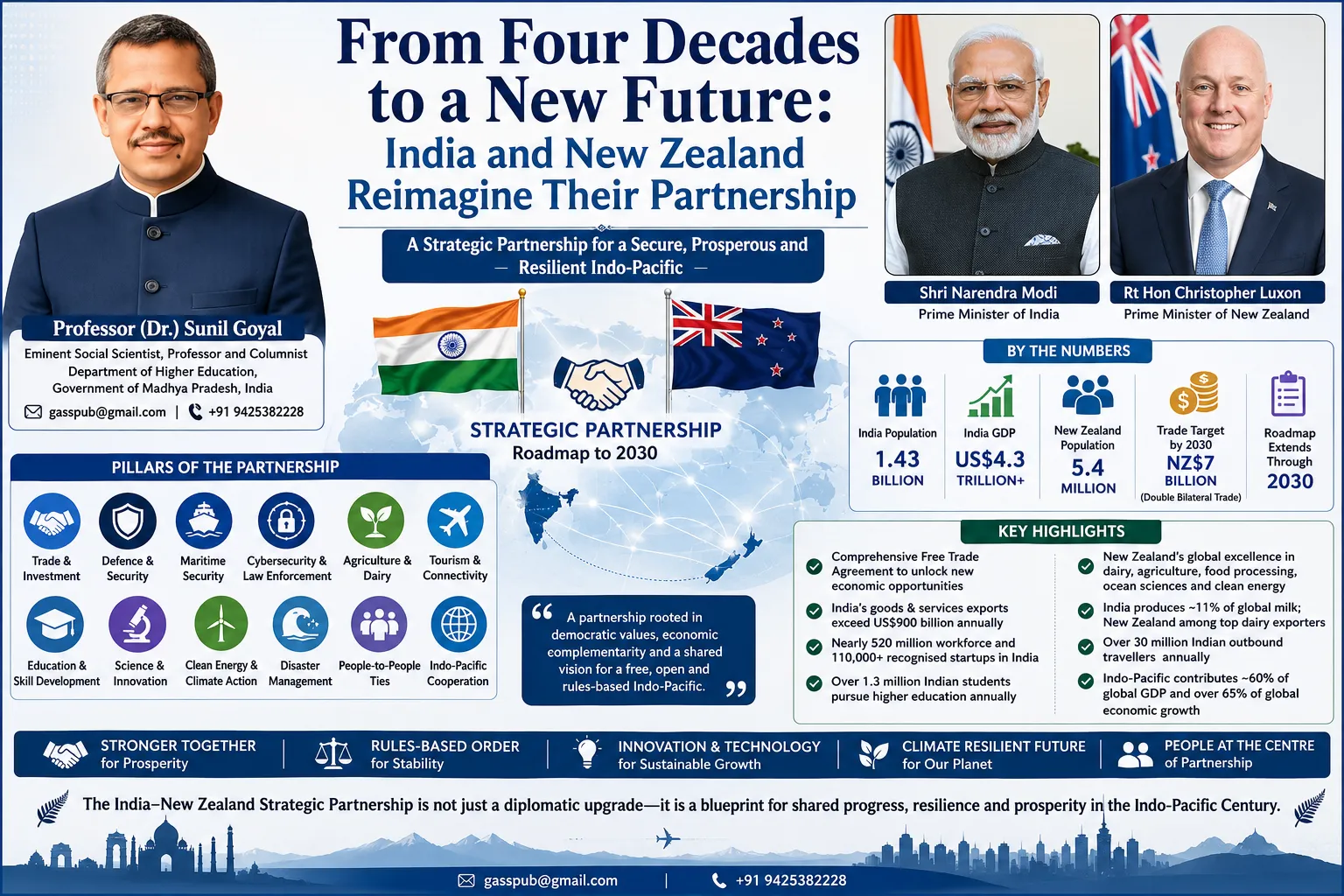
Diplomatic breakthroughs are not always measured by the number of agreements signed; rather, they are remembered for their ability to redefine the trajectory of bilateral relations. Prime Minister Narendra Modi's official visit to New Zealand in July 2026—the first by an Indian Prime Minister in forty years—marks one such watershed moment. More than a ceremonial engagement, the visit symbolises the emergence of a modern strategic partnership built upon shared democratic values, economic complementarity, maritime cooperation, technological collaboration, and a common vision for a secure and prosperous Indo-Pacific.
The decision to elevate India–New Zealand relations to a Strategic Partnership, supported by the ambitious Roadmap to 2030, reflects a clear recognition that both nations possess untapped potential capable of generating mutual economic growth and strategic stability. As the global order increasingly shifts toward the Indo-Pacific, partnerships between democratic middle powers are becoming indispensable for maintaining a rules-based international system.
Economics forms the cornerstone of this evolving relationship. India, now home to 1.43 billion people and an economy exceeding US$4.3 trillion, is projected to become the world's third-largest economy within the next few years. With sustained annual growth of 6–7 percent, expanding digital infrastructure, a thriving startup ecosystem, and an increasingly skilled workforce, India offers enormous opportunities for international investors and technology partners. New Zealand, although comparatively small with a population of 5.4 million, contributes globally recognised expertise in sustainable agriculture, dairy technology, food processing, environmental management, renewable energy, education, and innovation. Together, these complementary strengths create a natural platform for deeper economic cooperation.
The recently concluded India–New Zealand Free Trade Agreement (FTA) provides the institutional architecture necessary to transform these complementarities into measurable outcomes. The agreement is expected to reduce trade barriers, improve market access, encourage long-term investment, and strengthen supply chains across sectors such as agriculture, food processing, education, tourism, pharmaceuticals, renewable energy, digital technologies, and advanced manufacturing. The ambitious target of doubling bilateral trade by 2030 demonstrates confidence in the long-term economic prospects of both nations.
The strategic partnership, however, extends well beyond commerce. Both countries recognise that sustainable prosperity depends upon regional peace, secure sea lanes, resilient supply chains, and effective cooperation against emerging security threats. Maritime security, defence collaboration, cybersecurity, counter-terrorism, disaster management, and law enforcement cooperation have therefore become central pillars of the new bilateral framework.
This convergence is particularly significant in the Indo-Pacific, which today contributes nearly two-thirds of global economic growth and has become the world's most dynamic geopolitical theatre. As maritime democracies, India and New Zealand share a common interest in preserving freedom of navigation, respecting international law, ensuring open sea lanes, and promoting a stable regional order. Enhanced naval cooperation, maritime dialogue, hydrographic collaboration, and logistics arrangements signal increasing strategic trust between the two nations.
Innovation represents another defining feature of the partnership. India's rapidly expanding digital economy—expected to exceed US$1 trillion by 2030—combined with New Zealand's strengths in research, agritech, clean technologies, biotechnology, and scientific innovation offer tremendous scope for collaborative growth. Joint research programmes, technology transfer, startup partnerships, digital governance, healthcare innovation, artificial intelligence, and climate-smart agriculture can generate long-term economic value while addressing shared developmental challenges.
Climate cooperation has likewise emerged as an important dimension of bilateral engagement. India has committed to achieving 500 GW of non-fossil fuel electricity capacity, while New Zealand continues to lead globally in environmental sustainability and low-carbon development. Collaboration in renewable energy, green hydrogen, biofuels, sustainable agriculture, disaster resilience, and climate adaptation reflects the understanding that future economic competitiveness will increasingly depend upon environmental stewardship.
Equally significant are the people-to-people connections that underpin this relationship. The Indian community has become one of New Zealand's fastest-growing and most successful migrant communities, making valuable contributions across healthcare, education, entrepreneurship, information technology, academia, public service, and cultural life. Their success demonstrates how migration can strengthen social cohesion while simultaneously enhancing bilateral goodwill and economic integration.
Education and knowledge exchange also offer immense opportunities. India's youthful demographic profile and expanding higher education ecosystem complement New Zealand's globally respected universities and research institutions. Greater student mobility, academic partnerships, skill development, and scientific collaboration will not only strengthen human capital but also deepen long-term institutional ties.
Nevertheless, the true measure of success will depend upon implementation rather than aspiration. Strategic partnerships are sustained through consistent policy coordination, timely execution of agreements, regulatory predictability, private-sector participation, institutional collaboration, and continuous political commitment. The roadmap to 2030 provides an effective governance framework through regular ministerial dialogues, annual senior officials' meetings, maritime security consultations, defence cooperation mechanisms, and periodic implementation reviews. Its success will ultimately be judged by tangible outcomes rather than diplomatic symbolism.
The broader significance of this partnership extends beyond bilateral relations. It reflects India's growing diplomatic confidence and New Zealand's recognition of India's expanding global role as an economic, technological, and strategic power. As geopolitical uncertainties reshape international relations, partnerships founded upon democratic values, mutual respect, economic complementarity, and shared strategic interests will become increasingly valuable.
Ultimately, the India–New Zealand Strategic Partnership represents far more than an upgrade in diplomatic terminology. It is a forward-looking blueprint for cooperation in trade, innovation, sustainability, education, security, and regional governance. If pursued with determination, policy continuity, and strategic vision, this partnership can emerge as one of the Indo-Pacific's most dynamic bilateral success stories and contribute meaningfully to a more resilient, prosperous, and interconnected regional order.
Professor (Dr.) Sunil Goyal
The author is an Eminent Social Scientist, Professor and Columnist, presently working at Department of Higher Education, Government of Madhya Pradesh. He can be reached at email gasspub@gmail.com Mobile 9425382228