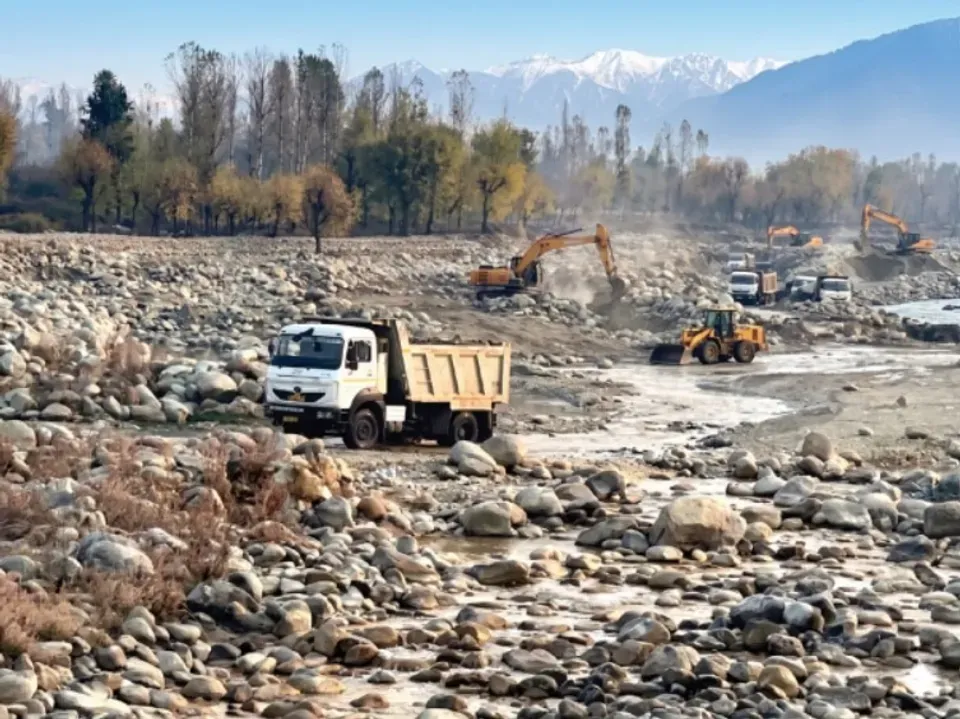
It has now come to fore how Sukhnag river in central Kashmir’s Budgam district has been vandalised and plundered on the pretext of mining!
An official report based on extensive survey has revealed how 15 lakh tonnes of riverbed material (RMB) comprising boulders, sand, nallah muck and gravel, were illegally extracted from the river. This wanton extraction of riverbed material has severely altered the natural course of the river and extensively damaged its flora and fauna.
Originating from glaciers in Pir Panjal Range, Sukhnag is one of the tributaries of Jhelum river. Passing through Tosa Maidan, the river flows through several villages in Budgam. Its water is mainly used for drinking and irrigation purposes. However, failure of authorities over the years to ensure protection of Sukhnag has given free hand to undertake illegal riverbed mining—causing extensive damage to the river’s hydrology, flora, fauna and aquatic life including trout.
Prompted by inaction of authorities to act against illegal mining, a noted environmental activist Dr Raja Muzzafar Bhat petitioned the National Green Tribunal (NGT) which constituted a high-level committee of experts. The committee has found visible signs of indiscriminate and unscientific extraction of riverbed material within the active river channel as well as along the peripheral catchment areas.
The panel after extensive scientific survey found that based on an average excavation depth of 5.22 metres derived from field measurements, the total quantity of extracted riverbed material is estimated to be around 15.3 lakh tonnes. It states that even when a conservative depth of 3,86 metres is considered, the estimated extraction remains significantly high at approximately 10.62 lakh tonnes as measured by G. B. Pant National Institute of Himalayan Environment.
The panel minced no words to reveal that large-scale, unregulated, and potentially illegal extraction of riverbed material has resulted in significant alteration of river morphology and damage to the underlying aquifer systems. And the absence of scientific assessment coupled with non-compliance with established regulatory provisions, indicates serious institutional lapses. The committee stated that the environmental degradation caused is likely to have long-term adverse impacts on the river ecosystem, as well as on dependent livelihoods of the fisheries sector and depletion in the water level.
The expert committee has recommended an immediate halt to mining operations within a 5-km stretch upstream and downstream of Sail Bridge up to Beerwah town, falling within the designated trout zone, until the river system is adequately restored. It recommends that strict implementation of the Sustainable Sand Mining Management Guidelines, 2016, and the Enforcement and Monitoring Guidelines for Sand Mining, 2020, issued by the Ministry of Environment, Forest and Climate Change (MoEF&CC), is essential to prevent further ecological degradation of the river ecosystem.
The committee has proposed a series of restoration measures, including filling up deep trenches created due to mining activities and re-levelling riverbed sediments to restore the natural river profile and ensure uniform and uninterrupted flow of water. It has also recommended the installation of real-time monitoring mechanisms, including CCTV surveillance systems at identified mining hotspots, to curb illegal and night-time mining in accordance with the 2020 enforcement guidelines.
The petitioner Dr Raja Muzaffar Bhat welcomed findings of the expert committee and sought stringent action against those responsible for permitting mining activities in the ecologically sensitive zone. He has sought compensation for damages to Sukhbag and action against the officials who granted permission for mining.
Besides Sukhnag, illegal riverbed mining coupled with haphazard and wanton extraction of mineral resources with heavy machines is taking a heavy toll on Kashmir’s fragile river ecosystem. J&K Environment Impact Assessment Authority (JKEIAA), which works under the Union Ministry of Environment Forests and Climate Change, grants Environmental Clearance after the applicant fulfills the requisite standard. The applicants have to fulfill specific conditions including prohibition of the use of heavy machinery in mining operations and install CCTVs on the site. However, due to the rise in construction activities, there is massive demand for stones, sand, boulders, bajri and clay.
Besides, organised mafias resort to illegal means to extract riverbed material. There has been massive damage to Doodh Ganga, Vaishav, Rambiara, Shali and Ganga falling in Pulwama, Anantnag, Shopian, and Kulgam districts in south Kashmir. Due to high demand owing to rise in construction activities, there is massive pressure on deposits of minor mineral resources, masonry stones, sand, boulder, bajri and clay.
Illegal riverbed mining in streams with heavy machines is severely affecting trout and other fish species. A Joint Committee submitted a report on January 13 this year to the NGT stating that due to diversion and disruption of water supply caused by the illegal mining, the trout fish farms have suffered losses.
J&K is bearing the brunt of climate change and facing extreme weather vagaries with dry winters and prolonged dry spells in summers from last several years. We did not learn any lessons from devastating floods in 2014 and no measures have been taken to conserve water bodies or enhance carrying capacity. When we ravage tributaries and even change its natural course, a few hours of rain raises flood alarms.
Government must make environmental conservation its priority. We need to understand that damage done to environment is irreparable. We can only prevent further damage. Let’s protect these natural assets, maintain ecological balance and ensure sustainable development to protect our ecosystem.
Author is Executive Editor,