Ramban, Jul 22: Moderate rainfall continued across Ramban district on Wednesday as the administration pressed ahead with restoration and relief operations following widespread damage caused by incessant rains over the past few days.
According to the district administration's cumulative damage report for the period from July 19 to July 22, up to 3 pm, six kacha houses sustained partial damage, while one pucca house was completely damaged.
A cattle shed also suffered partial damage due to the adverse weather. As a precautionary measure, 39 people have been evacuated from vulnerable areas to safer locations.
Road connectivity remains severely affected, with 24 roads still closed, including 13 PMGSY roads and 11 PWD roads.
Restoration work is underway.
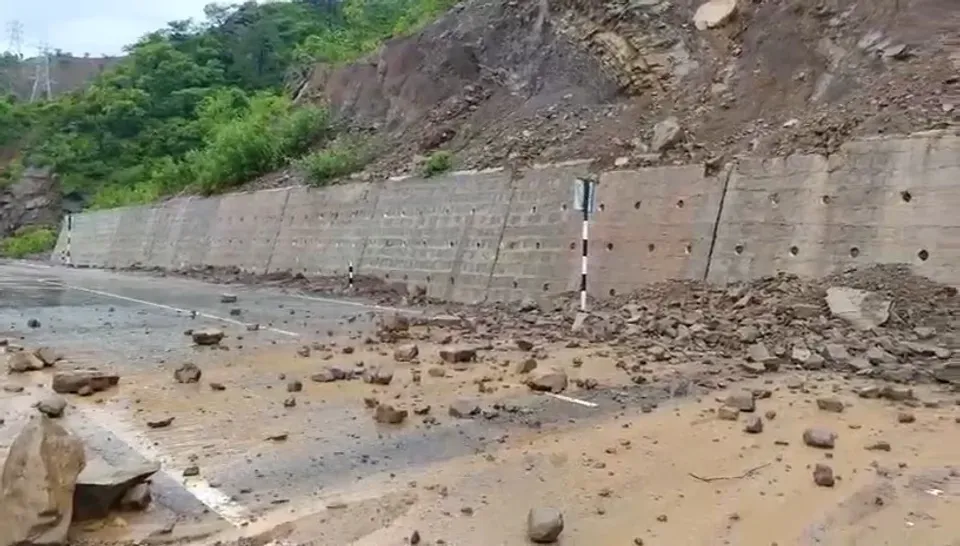
However, all roads under the Border Roads Organisation (BRO and GREF) remain open.On the Srinagar-Jammu National Highway, the Banihal-Ramban stretch has been partially restored, allowing stranded vehicles to move. However, late Wednesday evening, a fresh landslide blocked the highway in the Hingni area of Ramsu.
Continuous shooting stones at several vulnerable locations continue to hamper traffic movement, while clearance operations are being carried out simultaneously.
The Ramban-Udhampur stretch remains closed due to unsafe conditions.
Essential services have also been impacted. The Public Health Engineering (PHE) Department reported partial disruption of 20 water supply schemes. In the power sector, six electricity feeders are functioning partially, while two feeders remain under fault, affecting 241 distribution transformers across the district.
Meanwhile, the water level in the Chenab River at the Jhula Bridge gauge station was recorded at 2.20 metres below the alert level and is showing a decreasing trend, offering some relief to the administration.
District authorities are closely monitoring the situation and have urged residents to remain vigilant, avoid unnecessary travel, and strictly follow official advisories, particularly in landslide- and shooting stone-prone areas.