Dr. R. K. Uppal, Professor Emeritus [PhD, D.Litt.]
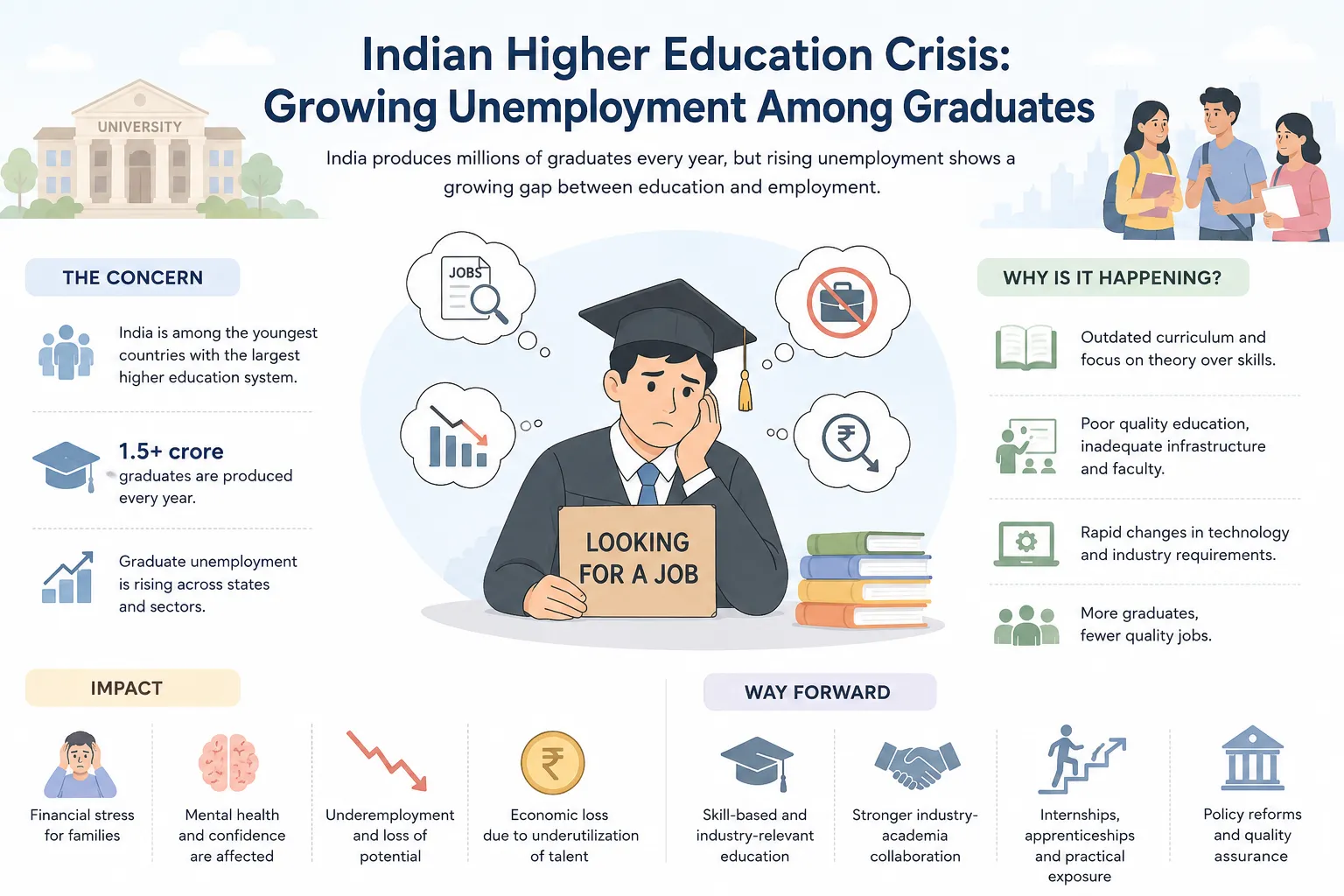
Unemployment in India is disproportionately higher among graduates compared to the rest of the population, with the graduate jobless rate hovering between (11%) and (13%). Nearly 65-67% of the country's unemployed youth are graduates. This crisis is driven by a structural mismatch: the economy produces degrees faster than high-quality salaried jobs are created
India's higher education sector has witnessed unprecedented growth over the last two decades. The country today boasts one of the world's largest higher education systems, with thousands of universities and colleges serving millions of students. Governments, policymakers, and educational institutions have consistently promoted higher education as a pathway to social mobility, economic prosperity, and national development. However, despite this remarkable expansion, a disturbing reality has emerged: a growing number of graduates are struggling to find meaningful employment. The rise in graduate unemployment has become one of the most serious challenges facing India's education system and economy.
One of the primary causes of graduate unemployment is the mismatch between academic education and industry requirements. Many universities and colleges continue to follow outdated curricula that focus heavily on theoretical knowledge while giving limited attention to practical skills and real-world applications. Employers increasingly seek candidates who possess technical expertise, problem-solving abilities, communication skills, digital literacy, and adaptability. Unfortunately, many graduates leave educational institutions without acquiring these essential competencies, making them less attractive to employers.
The issue is particularly visible in professional education. India produces a large number of engineering, management, and technology graduates every year. Yet many companies report difficulties in finding candidates who are job-ready. Numerous studies have highlighted concerns regarding employability, suggesting that a significant proportion of graduates require additional training before they can effectively contribute in the workplace. This skills gap has become one of the most significant barriers to graduate employment.
The rapid expansion of higher education has also created concerns about quality. While premier institutions maintain high academic standards and enjoy strong placement records, a substantial number of colleges suffer from inadequate infrastructure, outdated laboratories, insufficient research facilities, and shortages of qualified faculty members. In many cases, educational institutions focus more on increasing enrollment than on improving educational outcomes. Consequently, students often receive degrees without gaining the knowledge and skills necessary to succeed in competitive labor markets.
Another important factor contributing to graduate unemployment is the imbalance between the supply of graduates and the availability of suitable jobs. Every year, millions of young people enter the labor market with university degrees. However, job creation in the formal sector has not kept pace with this growing supply of educated workers. While India's economy continues to grow, employment generation has often lagged behind economic expansion. This phenomenon, commonly referred to as "jobless growth," has intensified competition for available positions and increased unemployment among educated youth.
The challenge is further complicated by changing technological and economic conditions. Automation, artificial intelligence, and digital transformation are reshaping industries across the world. Many traditional jobs are disappearing, while new occupations require specialized technical skills and continuous learning. Unfortunately, many higher education institutions have been slow to adapt to these changes. As a result, graduates frequently enter the labor market with qualifications that are not fully aligned with emerging industry needs.
Graduate unemployment also reflects weaknesses in career guidance and vocational training. Many students choose academic programs without adequate information about labor market trends, future career opportunities, or skill requirements. There remains a strong social preference for conventional university degrees, even when vocational or skill-based education may offer better employment prospects. This has resulted in an oversupply of graduates in certain disciplines and shortages of skilled workers in others.
The consequences of graduate unemployment extend beyond individual hardship. For young people, prolonged unemployment often leads to frustration, financial insecurity, declining self-confidence, and mental stress. Families invest substantial financial resources in higher education with the expectation of improved career opportunities. When graduates remain unemployed, these investments fail to generate expected returns, creating disappointment among students and parents alike.
Addressing this crisis requires comprehensive reforms in both education and employment policies. First, universities must modernize curricula to reflect contemporary industry requirements. Greater emphasis should be placed on practical learning, internships, project-based education, digital skills, entrepreneurship, and critical thinking. Industry-academia collaboration should be strengthened to ensure that educational programs remain relevant and responsive to changing labor market demands.
Second, quality assurance mechanisms must be enhanced across the higher education sector. Regulatory bodies should focus not only on enrollment growth but also on learning outcomes, employability, research quality, and institutional accountability. Investments in faculty development, research infrastructure, and technological resources are essential for improving educational quality.
Third, vocational education and skill development programs should be integrated more effectively with higher education. Students should have opportunities to acquire industry-recognized certifications and practical training alongside their academic degrees. Such integration would improve employability and provide graduates with diverse career pathways.
Fourth, India must accelerate job creation through industrial growth, innovation, entrepreneurship, and investment in emerging sectors. Government policies should encourage labor-intensive industries while simultaneously supporting high-technology sectors capable of generating quality employment opportunities for skilled graduates.
In conclusion, the growing unemployment among graduates represents a serious crisis within India's higher education system. While expanding access to higher education is an important achievement, the ultimate measure of success lies in the ability of education to prepare students for productive careers and meaningful contributions to society. Without significant reforms in curriculum design, educational quality, skill development, and employment generation, the gap between degrees and jobs will continue to widen. India cannot fully realize its aspirations of becoming a global economic leader if millions of educated young people remain unable to find suitable employment. The time has come for policymakers, educational institutions, industry leaders, and society as a whole to work together to bridge the divide between higher education and employability. Only then can higher education fulfill its promise as an engine of opportunity, growth, and national development.