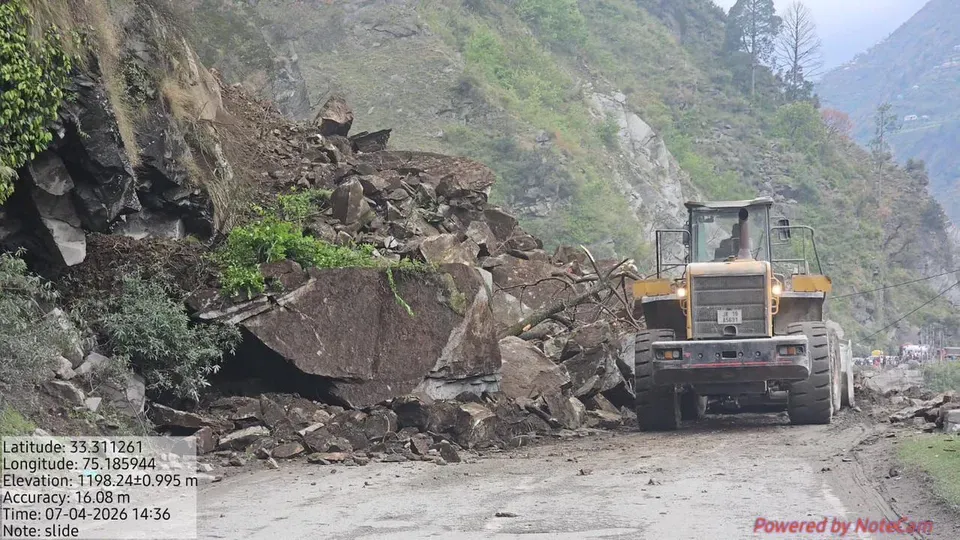
Srinagar, Aug 8: Jammu and Kashmir’s National Highway corridors faced repeated landslides, cloudbursts, and heavy rainfall-related disruptions in 2025 and 2026, blocking carriageways and damaging infrastructure, the Centre told Parliament.
In a reply to a starred question in the Lok Sabha, the Union Ministry of Road Transport and Highways (MoRTH) detailed multiple incidents on NH-44 and NH-244, particularly on the Udhampur-Ramban and Ramban-Banihal stretches of NH-44.
“On the Udhampur-Ramban stretch, cloudbursts and heavy rain triggered landslides at Bali Nallah and Tharad in 2025, while muck and slush accumulated at Karol and Kowbagh,” it said.
“In 2026, a massive landslide near Dewal, Samroli (Km 79) blocked both carriageways and damaged a retaining wall. The ministry said restoration and clearance works were subsequently completed,” the ministry said.
It said that on the Ramban-Banihal stretch, a cloudburst in 2025 triggered flash-floods, and caused heavy slush and debris at Seri, muck accumulation inside Tunnel T-2 and a landslide at Kela Mor.
“Another landslide blocked both carriageways in 2026, following which traffic was restored after clearance operations,” the ministry said.
It also reported a landslide at Marog on the Ramban-Banihal section of NH-44 during 2025, while multiple landslides were recorded on the Chenani-Sudhmahadev Road (NH-244) during the same year.
The repeated disruptions have affected the movement of people and goods along NH-44, the main surface link between Kashmir and the rest of the country.
In April last year, the highway remained closed for more than three weeks after incessant rain triggered shooting stones and rockfalls and washed away portions of the road along the Banihal-Ramban stretch.
It was again shut for much of August and September as monsoon rains triggered fresh landslides, mudslides, shooting stones, rock-falls and flash floods.
The closures stranded fruit-laden trucks carrying apples to markets outside J&K. Growers said large quantities of produce rotted in transit, causing losses running into millions of rupees for the region’s horticulture industry.
Separately, the Centre said J&K recorded one case of major structural failure on a National Highway project since 2014.
“The failure occurred in 2022, resulting in a penalty of 1% of the project cost and blacklisting of the Engineer Procurement and Construction (EPC) contractor under the contract provisions,” it said. Union Road Transport and Highways Minister Nitin Gadkari said action was taken against contractors where deficiencies were established.
“Across the country, executing agencies have imposed financial penalties, terminated contracts, suspended personnel, debarred contractors and blacklisted firms,” the ministry said. The government said highway projects incorporate drainage systems and hill-protection measures, but extreme weather remains a major challenge in mountainous terrain. “Extreme weather events such as cloudbursts, unprecedented rainfall and landslides can damage highway infrastructure, particularly in the Himalayan region," it said.
The Centre said no flooding of low-lying areas or agricultural fields due to faulty National Highway construction was reported from J&K in the data placed before Parliament. Three such incidents were reported nationwide, involving stretches in Telangana and Maharashtra.
To strengthen resilience, the government said it has introduced measures including improved slope stabilisation, mandatory quality assurance for rockfall mitigation, real-time landslide monitoring, and improved preparation of detailed project reports. It also cited collaboration with the Geological Survey of India (GSI), Defence Geo-informatics Research Establishment, National Institute of Rock Mechanics, and IIT Roorkee to improve highway safety and resilience.